
Maths for Diploma Studies
This lesson is designed to provide the background knowledge in maths required to study CIBD Diplomas successfully. It will describe the basics of maths before detailing the more complex concepts encountered in CIBD lessons. Techniques for working with numbers, equations, and units will also be described.
Combining Equations
At times in our lessons, we will encounter the need to combine two equations to solve the problem being posed. A simple example relates to calculating total resistance in an electrical circuit.
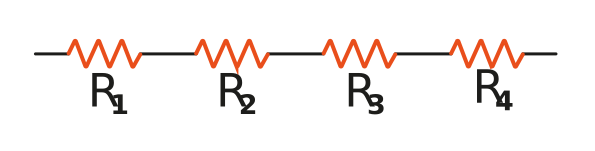
Figure: Resistors wired in series
Resistors in series are added. Here the total resistance in this system is found by:

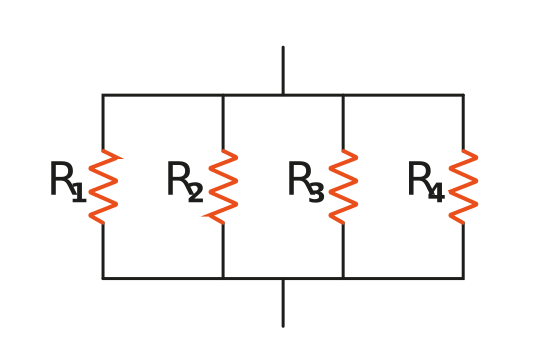
Figure: Resistors wired in parallel
Resistors in parallel are calculated by adding their reciprocals:

The maths for each of these individual circuits is straightforward. What if we were presented with a circuit that contained resistors in series and in parallel?
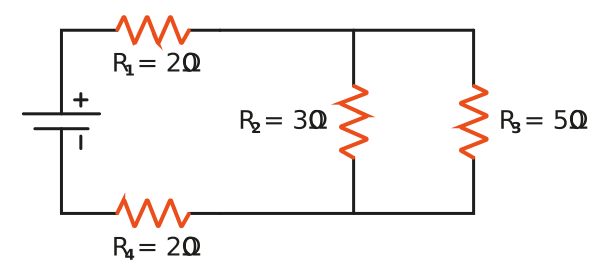
Figure: A series-parallel resistor circuit
The maths for this follows the same rules as described earlier but with an interesting technique. Let’s look at how we would combine the two equations.
If everything were wired in series, we would simply add the value of the resistors together, and that would be our answer. Since this circuit has resistors in series and in parallel to determine the total resistance, we first need to address the parallel resistors section. Once this value is determined, we can treat this equivalent resistance as a single value and add everything else together as in a series circuit.
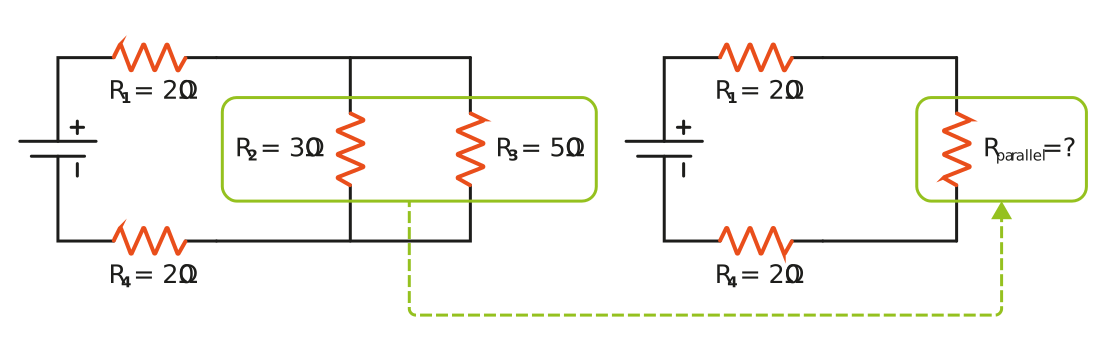
Figure: Solving for equivalent resistance of parallel resistors
As we learned earlier, to determine the equivalent resistance of resistors in parallel, we take the reciprocal and add their values together:


We are almost there. What remains is to find the value of RParallel, which is currently the denominator of the fraction. Step-by-step, this entails first multiplying both sides of the equation by RParallel:

It might look like we can’t cancel the RParallel terms because one is in a fraction in brackets. The way around this is to represent the multiplying RParallel as a fraction with 1 as the denominator. You should remember that every number can be written as a fraction with 1 as the denominator:

Now we have RParallel multiplying and dividing, so it cancels leaving us with nothing more than the left side of the equation equal to 1:

The last thing to do to isolate RParallel is divide both sides of the equation by 0.0533Ω to give us:

So:

We have now worked out the resistance for the parallel element of the circuit. If we look back to our diagram, we can see that this total parallel resistance can be treated in the same way as a series resistance and added to the total.
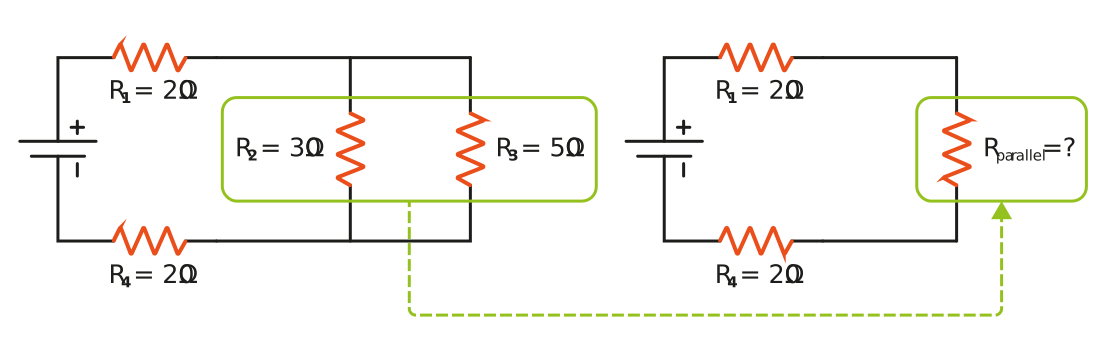
Figure: Treating parallel resistors as series resistors
So we simply add up the resistances to get the total resistance:


If we were to go back and produce an equation for the total resistance, it would look like this:

Although this example is an electrical circuit, we use the same method when calculating heat transfer resistance through pipe walls, insulation, and cladding.
Combining equations examples
Let’s look at another example from a fluid dynamics lesson. You will be introduced to the concept of equivalent diameter (de). The equation for calculating this is:

For a pipe with a circular cross-section, the equivalent diameter would simply be the pipe’s inner diameter. Let’s take a quick look at how that comes to be.
For a circle, we know that the area can be expressed as:

Where:
A = internal area of the circle
π = Archimedes constant equal to 3.14159 (or pi to you and me)
d = the inner diameter of the circle
The permitter of a circle is determined by:

Where:
C = the permitter of the circle
π = Archimedes constant equal to 3.14159 (or pi to you and me)
d = the inner diameter of the circle
Combining these two equations into the original equivalent diameter equation will yield:


Following the PEMDAS order of operations, we get:

Here we have 4 in both the numerator and denominator, so we can simplify by cancelling them:

Giving:

By writing this out differently, we can see where there are more opportunities to simplify the equation:

This lets us cancel everything on the right-hand side apart from the d:

Leaving:

So, here you can see that for a pipe of circular cross-section, the equivalent diameter (de) is exactly the same as the actual pipe diameter.
We have just covered an important concept that we will use a lot later. If a term appears in the numerator and the denominator or a fraction or equation, it can be cancelled. By cancelled, we mean removed from the equation. Remember  always equals 1.
For more complicated shapes, such as a rectangular pipe or duct, we would start by using the same base equation:
A rectangle can be described as having two sides of equal length (a) and two other sides of equal length (b).
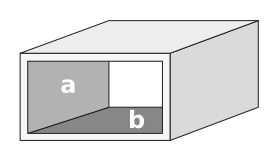
Figure: A rectangular duct
Applying this understanding to the equivalent diameter equation, we would need to determine both the duct cross-sectional area (A) and its wetted permitter (P). First, let’s calculate the area. The area of a rectangle is simply the product of the two sides:

The permitter is the sum of the length of all four sides:

Simplified, this can be written as:

Now, we are to combine these two equations into the original equivalent diameter equation:

We can now simplify things a bit further:

And further still:

Log Mean
Sometimes in engineering calculations like those for heat and mass transfer, a parameter changes across a system but the calculation requires a single value for the parameter. This poses the question: “What value do I use in this calculation?”. Using the highest value or the lowest value would not give an accurate answer nor will the arithmetic or geometric mean. The answer to our question is the log mean. which allows us to calculate the average difference between the values.
Log mean is used in the following calculations in the learning material:
- Log mean temperature difference (LMTD) – used to determine the temperature driving force for heat transfer across a heat exchanger or from vessel jackets into the product
- Log mean surface area – used to approximate the area for heat transfer in a circular pipe
The log mean of two points (X1 and X2) is calculated as follows:

As an example, to calculate the heat transfer rate across a heat exchanger we need to know the temperature difference between the two fluids in the exchanger. However, the temperature difference between the fluids varies across its length. The temperature difference between the inlet and outlet fluid at one end of the exchanger can be different to the temperature difference between the two fluids at the other. The average temperature difference can be calculated using the log mean:
This is defined as:

Where ΔTLM is the log mean temperature difference
ΔT1 is the temperature difference at one end of the exchanger
ΔT2 is the temperature difference at the other end of the exchanger
Another example from the learning material is calculating heat transfer through a circular pipe. The surface area that the heat is transferred through changes as you move away from the centre of the pipe. So the surface area on the inside of the pipe is smaller than the surface area on the outside of the pipe which in turn is smaller than the surface area of the insulation covering the pipe.
In this case the log mean area is calculated as:

Where:
A1 is the surface area of the inside of the pipe
A2 is the surface area of the outside of the pipe
ALM is the log mean average surface area of these two
Alternatively, A1 could be the outside pipe surface area and A2 could be the outside surface area of the insulation.
The area of a pipe is calculated by this equation: A=2πrL
Where:
A is the area of the pipe
π is the mathematical constant that is the ratio of a circle's circumference to its diameter
r is the radius of the pipe
L is the length of the pipe
This means that:
A1=2πr1L and A2=2πr2L
This gives us an opportunity to use our equation combining skills.
Substituting the above terms into the log mean area equation as follows gives us:

This is a big lump of an equation and we can use some of the maths skills we have learned so far to simplify it. We can start with the numerator. Both terms are multiplied by 2π and L so we can factorise it by 2πL:

This gives us:

As we learnt in the key point above, any fraction where the numerator and denominator are the same, the fraction equals one and we can cancel them from the equation. In the denominator of the equation we have a fraction with 2πL in the numerator and denominator so we can cancel these terms:

And the equation becomes:

We (should) have now mastered the equation and be comfortable with using them to find the answers we need.
To help reinforce what we have just learned, on the next page there are some practice questions. Answers and explanations can be revealed by clicking on show answer.