
Maths for Diploma Studies
This lesson is designed to provide the background knowledge in maths required to study CIBD Diplomas successfully. It will describe the basics of maths before detailing the more complex concepts encountered in CIBD lessons. Techniques for working with numbers, equations, and units will also be described.
Exponents and Exponentiation
We hear the word exponentially a lot to describe things that increase at a rapid rate, and most of us will be familiar with a particular exponent – the two in squared. Let’s find out some more about exponents and the rules for using them.
Exponents are written as superscript next to the number or term in the equation that they act on. For example:

The exponent describes how many times the number or term is multiplied by itself. The number acted on by the exponent is called the base number. For example:

This calculation is called exponentiation. You should note that is not the same as 2 × 4 = 8.
Exponents are also represented as ^number. This is the case for most calculators.
56 appears as 5^6 and 2-4 appears as 2^-4.
For the exponents 2 or 3, we often say squared or cubed, but for higher exponents, we say to the power of. In the example above, 24 is two to the power of four or sometimes two to the fourth power, or two raised by the power of four.
A base number with an exponent of 1 will be unchanged, for example:

And a base number with an exponent of 0 will always equal 1, for example:

With a negative exponent, the result is always a fraction with 1 as the numerator and the denominator being the original number raised by the power of the exponent. It is important to note that the exponent loses its negative sign when it moves to the denominator of the fraction. For example:

On your calculator, the xy key allows you to use exponents. First, you type in the base number, then press the xy key. The display will show the base number with ^ next to it. You can then type in the exponent and then press the +/- key to make it a minus.
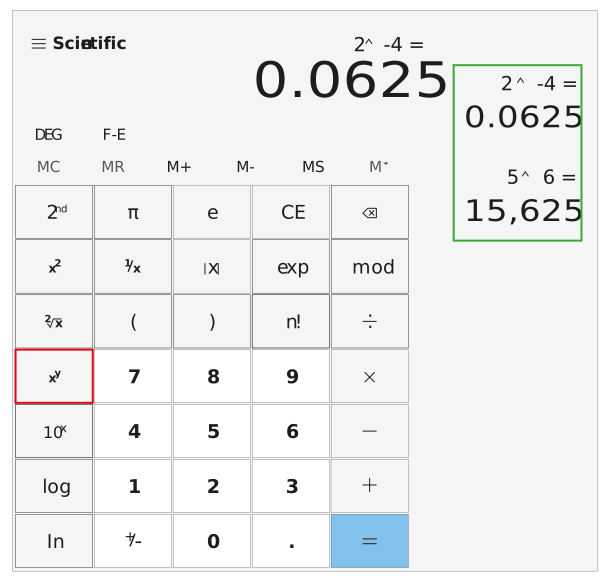
Figure: The exponent button and calculator representation
Have a go with some of the examples above to check we have got them right!
There are five rules for working with exponents:
Rule 1 – Product of powers

Here you are multiplying a by itself z times and y times and then multiplying the two together. This is the same as adding the exponents together and raising a by that power. For example:
a = 2
z = 5
y = 4


Rule 2 – Power of a product

When you multiply two numbers and then multiply the number produced by itself y times, it’s the same as multiplying the first number by itself y times and multiplying that by the second number multiplied by itself y times. Let’s do an example:
a = 5
b = 4
y =3


Rule 3 – Power of a power

Here we can see that if you multiply a number by itself y times and then multiply the number produced by itself x times, it is the same as multiplying the original number by itself x  y times. For example:
a = 2
x = 3
y = 4


Rule 4 – Quotient of powers

Because we are dividing rather than multiplying, this is the opposite of rule 1. Here we are multiplying a by itself x times and y times and then dividing the two together. This is the same as subtracting the second exponent from the first and raising a by that power. For example:
a = 2
x = 4
y = 5

Here, we end up with a negative exponent, so the result is a fraction with 1 as the numerator and the denominator, the original number raised by the power or exponent but as a positive exponent rather than a negative one:

As the exponent is 1, the resultant denominator is unchanged (x to the power of 1 is x):


Rule 5 – Power of a quotient

Rule 5 shows that when we divide a number, a by another number, b, and then multiply the result (quotient) by itself y times, it is the same as multiplying a by itself y times and then dividing that product by the number b multiplied by itself y times. For example:
a = 3
b = 4
y = 2


So, there are a lot of rules to remember when dealing with exponents, and you need to follow these rules when rearranging and solving equations if they contain exponents. We will use some of these rules later in the lesson.
To help reinforce what we have just learned, on the next page there are some practice questions. Answers and explanations can be revealed by clicking on show answer.