
Lesson 2 - Wort Separation Principles
This lesson deals with the principles of wort separation. Before wort separation, we have completed mash conversion. We will now need to separate the liquid wort from insoluble material. This is mainly the husks from the malt, known as spent grain. We will review the reasons why filtered wort must be clear, and how this affects wort quality. We will examine how the all-important grain filter bed is formed differently, by each of the three most common mash separation devices. These devices are: the lauter tun, the mash filter and the mash tun. We will investigate a typical wort collection profile, which ends with the removal of the spent grain.
Darcy’s Law describes filtration flow rate. We will assess both the variables involved, and what influences them. We will finally use Darcy’s Law to predict the relative flow rates of the three mash separation devices.
The Effect of Grain Bed Depth and Cross-Sectional Area on Filtration Flow Rate
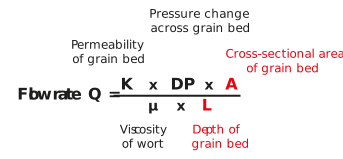
Figure: The Darcy equation and grain bed depth and cross-sectional area
Darcy’s Law proves that decreasing grain bed depth will increase filtration flow rate, and vice versa. For a given malt charge, the only way to spread out the grain bed and make it shallower, is to increase its bed cross-sectional area. If we reduce grain bed depth, this automatically increases the grain bed cross-sectional area. This gives us a double benefit of reducing a Darcy bottom line variable and increasing a Darcy top line variable.
Reduced bed depth results in faster filtration. How thin can we go?
With the mash tun and lauter tun, we rely on a bed depth sufficient enough to achieve wort clarity. The lauter tun must have a minimum bed depth of around 500 mm to achieve acceptable clarity. The mash tun, with a coarser grind, requires 1,000 mm. Thus for the same grist charge, to achieve a thinner bed depth, the lauter tun will have a larger diameter, and a greater cross-sectional area compared to the mash tun.
The mash filter uses a bed depth of 50 mm. This requires a very high surface area, which is accommodated in multiple chambers.
If we factor in the grain bed depth L and the bed cross-sectional area A, for each mash separation device, Darcy’s Law provides us with relative filtration flow rates.
Table: Lower grain bed loadings increase flow rate
|
|
Lauter Tun |
Mash Tun |
Meura 2001 Mash Filter |
|
Grain bed loading (11 t) (kg/m2) |
200 |
500 |
30 |
|
Grain bed depth L (m) |
0.5 |
1.0 |
0.05 |
|
Grain bed cross-sectional area A (m2) |
50 |
20 |
330 |
|
Tun diameter (m) |
8 |
5 |
20 (58 filter chambers) |
|
A / L |
100 |
20 |
6600 |
|
Relative flow rate |
5 |
1 |
330 |
|
|
|
|
|
Darcy’s Law predicts that the low bed loading of the mash filter should allow it to run 330 times faster than a mash tun. In reality, it is only four times faster.
Why do we not get the same mash filter flow rates as predicted by Darcy’s Law?
To understand, we must consider grain bed permeability.