
Lesson 2 - Wort Separation Principles
This lesson deals with the principles of wort separation. Before wort separation, we have completed mash conversion. We will now need to separate the liquid wort from insoluble material. This is mainly the husks from the malt, known as spent grain. We will review the reasons why filtered wort must be clear, and how this affects wort quality. We will examine how the all-important grain filter bed is formed differently, by each of the three most common mash separation devices. These devices are: the lauter tun, the mash filter and the mash tun. We will investigate a typical wort collection profile, which ends with the removal of the spent grain.
Darcy’s Law describes filtration flow rate. We will assess both the variables involved, and what influences them. We will finally use Darcy’s Law to predict the relative flow rates of the three mash separation devices.
The Effect of Grain Bed Permeability (K) on Filtration Flow Rate
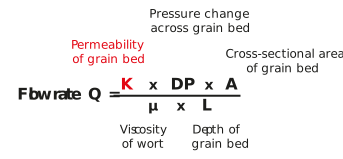
Figure: The Darcy equation and grain bed permeability
Figure: The Darcy equation and grain bed permeability
Now let us look at the impact of grain bed permeability (k) in the Darcy equation on filtration flow rate.
We are now going to calculate the permeability based on some experimental data. Don’t get overly concerned about the calculations and numbers. They are here to illustrate the difference between the technologies and you don’t need to remember the equations or how to calculate permeability. It is not something you will ever need to do as a brewer.
The permeability of a grain bed is a measure of how easily wort flows through it during wort separation. The higher the permeability of the grain bed, the higher the flow of wort through the grain bed. The permeability of a grain bed is a function of the porosity of the grain bed and the mean particle diameter of the grist.
Grain bed permeability (k) is defined by the following equation:

Where:
- k is the grain bed permeability in m2
- n is the grain bed porosity
- d is the mean particle diameter in m
The porosity of a grain bed is the ratio of the volume of wort in the grain bed to the total volume of the grain bed. The lower the volume of wort in the grain bed, the lower the grain bed porosity and the lower the permeability of the grain bed.
The mean particle diameter is the average diameter of particles in the grist. This will be smaller in finely milled grist and larger in coarsely milled grist. The smaller the mean particle diameter of the grist, the lower the permeability of the grain bed.
Different mashing equipment is used to process coarse and fine grist. Let’s consider the permeability of the grain bed in a mash tun, a lauter tun and a mash filter. We will assume that the grain bed porosity and mean particle diameter vary proportionately to the grist husk fraction. So, finely milled grist with a smaller husk fraction will have a smaller mean particle diameter and lower grain bed porosity.
Mash tun grain bed permeability
In a mash tun, wort is filtered through a deep suspended grain bed. Therefore, coarse grist with a large mean particle diameter is used to create a grain bed with high permeability. Let us calculate the grain bed permeability for a mash tun based on the following grain bed parameters:
- Grain bed porosity (n): 0.22
- Mean particle diameter (d): 0.001 m

Lauter tun grain bed permeability
In a lauter tun, wort is filtered through a shallow grain bed. Rotating rakes are used to create channels through the grain bed to help separate the wort from the grain solids. Therefore, a relatively fine grist with a small mean particle diameter is used. Let us calculate the grain bed permeability for a lauter tun based on the following grain bed parameters:
- Grain bed porosity (n): 0.18
- Mean particle diameter (d): 0.0008 m

Mash filter grain bed permeability
In a mash filter, fine filter clothes are used to separate the wort from the grain solids across a very large shallow grain bed. Therefore, a very fine grist with a very small mean particle diameter is used. Let us calculate the grain bed permeability for a mash filter based on the following grain bed parameters:
- Grain bed porosity (n): 0.07
- Mean particle diameter (d): 0.0004 m

Now let’s compare all of these parameters in the table below which also shows the relative permeability of the mash tun and lauter tun when compared to the mash filter. The mash filter grain bed permeability is 275 times lower than the mash tun grain bed permeability. This is due to the mash tun having a coarse grist with a large mean particle diameter which results in a higher grain bed permeability than the mash filter or the lauter tun.
Table: Grain bed permeability
|
|
Grain bed porosity |
Mean particle diameter (m) |
Grain bed permeability (m²) |
Relative grain bed permeability |
|
Mash tun |
0.22 |
0.001 |
9.72 x 10⁻¹¹ |
275 |
|
Lauter tun |
0.18 |
0.0008 |
3.084 x 10⁻¹¹ |
87 |
|
Mash filter |
0.07 |
0.0004 |
3.525 x 10⁻¹³ |
1 |
The very low bed permeability in a mash filter, explains why we do not see the vastly higher wort flow rate that would be expected on the basis of its much shallower bed and large area.
We will now look at how differential pressure affects the performance of each of our mash separation devices.