
Lesson 2 - Wort Separation Principles
This lesson deals with the principles of wort separation. Before wort separation, we have completed mash conversion. We will now need to separate the liquid wort from insoluble material. This is mainly the husks from the malt, known as spent grain. We will review the reasons why filtered wort must be clear, and how this affects wort quality. We will examine how the all-important grain filter bed is formed differently, by each of the three most common mash separation devices. These devices are: the lauter tun, the mash filter and the mash tun. We will investigate a typical wort collection profile, which ends with the removal of the spent grain.
Darcy’s Law describes filtration flow rate. We will assess both the variables involved, and what influences them. We will finally use Darcy’s Law to predict the relative flow rates of the three mash separation devices.
Point of reflection – reconvene
Welcome back. So, what were your thoughts?
The mash wort strength is determined by the mash water:grist ratio, the extract in the raw materials used, and the mashing conversion efficiency. For instance, we could use a mashing ratio of 3 L of water to 1 kg of malt, using a typical lager malt. Assuming 100% mashing conversion, we will produce a mash wort strength typically S.G. 1.092 or 22 ˚Plato. This initial wort sent to the downstream wort boiling device is known as our ‘strong worts’.
The strong worts tend to adhere to the husk residues in the grain bed. To ensure a good extract efficiency, we use hot sparge water to rinse wort from the spent grains. This sparge water mixes with the strong worts, to increasingly dilute the sparged worts.
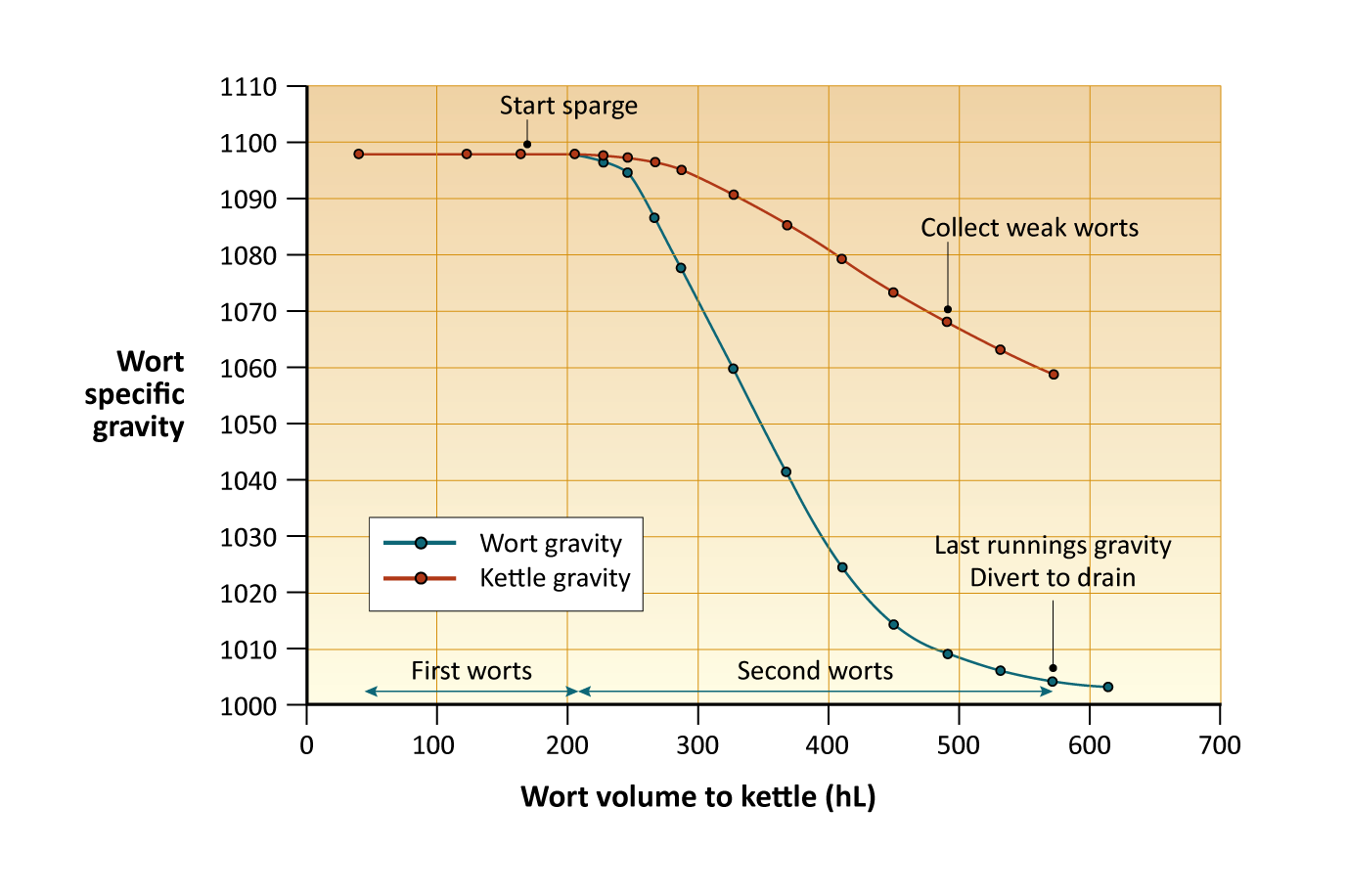
Figure: Wort collection gravity profile (curves show gravity profile for standard brew where weak worts are not recycled)
We need a certain sparge volume to ensure that minimal soluble extract remains in the spent grain. (In a later lesson, we will learn how this volume varies with the separation device used.)
We have looked at what determines the strength of the strong worts. What do you think will determine the strength of our resultant wort in the kettle?
The resultant wort strength in the kettle depends on the volume of water used to obtain our extract. The higher the water volume, the weaker the kettle strength. If we use 3 L/kg mash water and 3.5 L/kg sparge water, the kettle wort strength will typically be around specific gravity (SG) 1.061, or 15 ˚Plato. However, if we terminate wort collection to the kettle early at say SG 1.010 or 2.5 °Plato we can collect these remaining weak worts for use as mash or sparge water in a future brew. Now our kettle wort strength can be nearer to SG 1.070, or 17 ˚Plato. Collection of weak worts allows us to achieve a significantly higher kettle wort strength. Using the weak worts as mash water, or sparge water, keeps our extract efficiency high. Recycling of weak worts is commonly used to support ‘high gravity brewing’ where beer is produced at extra high alcohol. It is then diluted to sales strength just before packaging.
The mash, and therefore the strong worts, are around pH 5.2-5.4. However, the sparge water may range from pH 6.5-7.5. As higher proportions of water make sparged worts weaker, we will see the wort pH increase towards that of the sparge water. As the weaker worts start to exceed pH 6.0, the undesirable materials of tannins and silica tend to dissolve from the husks. These are detrimental to beer quality (more of this in a later lesson). Thus, traditionally, we brewers have terminated collection of weak worts at a strength of around SG 1.004-1.006, or 1.0-1.5 ˚Plato. This avoids these higher pH extractions. This process is commonly known as the ‘last runnings gravity check’ and is our trigger to divert from wort collection to the drain.
These drainings are disposed of as effluent, and are high in biological/chemical oxygen demand (BOD/COD). We should adjust the volume of sparge water used, to minimise the volume of these last runnings.