
Lesson 2 - Wort Separation Principles
This lesson deals with the principles of wort separation. Before wort separation, we have completed mash conversion. We will now need to separate the liquid wort from insoluble material. This is mainly the husks from the malt, known as spent grain. We will review the reasons why filtered wort must be clear, and how this affects wort quality. We will examine how the all-important grain filter bed is formed differently, by each of the three most common mash separation devices. These devices are: the lauter tun, the mash filter and the mash tun. We will investigate a typical wort collection profile, which ends with the removal of the spent grain.
Darcy’s Law describes filtration flow rate. We will assess both the variables involved, and what influences them. We will finally use Darcy’s Law to predict the relative flow rates of the three mash separation devices.
Spent Grain Filter Bed Formation ‒ The Mash Tun
When we mash into the mash tun, not only is the grist coarser, but there is also incomplete grist hydration in the pre-masher. We thus create a suspended grain filter bed.
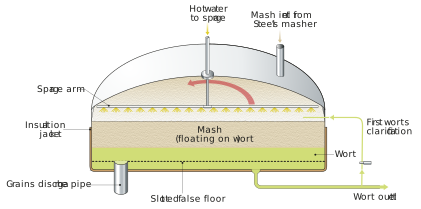
Figure: Mash tun grain bed formation
The volume of wort below the floating grain bed, and below the false floor, is greater than the under-floor volume of the lauter tun. However, the coarser grind used for the mash tun means there are less fines in the grist (which would slip through the slots in the false floor). This mash receives far less physical damage than the stirred and pumped mashes for the lauter tun or mash filter. In reality, the first worts recirculation volume is no greater than for the lauter tun. And many breweries do not recirculate the first worts to prevent destroying the suspended grain bed.
If recirculating first worts they must be dispersed gently over the suspended grain bed, so as not to damage it.