
Lesson 2 - Wort Separation Principles
This lesson deals with the principles of wort separation. Before wort separation, we have completed mash conversion. We will now need to separate the liquid wort from insoluble material. This is mainly the husks from the malt, known as spent grain. We will review the reasons why filtered wort must be clear, and how this affects wort quality. We will examine how the all-important grain filter bed is formed differently, by each of the three most common mash separation devices. These devices are: the lauter tun, the mash filter and the mash tun. We will investigate a typical wort collection profile, which ends with the removal of the spent grain.
Darcy’s Law describes filtration flow rate. We will assess both the variables involved, and what influences them. We will finally use Darcy’s Law to predict the relative flow rates of the three mash separation devices.
The Effect of Wort Viscosity on Filtration Flow Rate
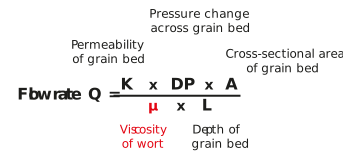
Figure: The Darcy equation and wort viscosity
Darcy’s Law states that if we reduce wort viscosity, this will increase flow rate, and vice versa. Viscosity indicates the resistance to the flow of a liquid. A concentrated sugar syrup is much more viscous than water. If we take a jug of each and pour, the water empties quickly, but the syrup is very slow. The reluctance of the syrup to flow is due to its higher viscosity. In the same way, stronger worts have higher viscosities.
The strong worts’ strength is determined by the same water:grist ratio used at mashing. A more dilute mash will have lower viscosity and filter faster. There are, however, other restraints affecting how thin our mash can be. These include the size of mash conversion vessel, the impact on enzymic conversion, and the requirement for kettle gravity.
Less well-modified malts are higher in ‘gummy’ viscous materials, like β-glucan and arabinoxylan. These will both increase our wort viscosity. If we assume that wort β-glucans are at a satisfactorily low level, then viscosity is proportional to wort strength. Stronger worts have higher viscosity and filter more slowly.
Something that can help counteract our wort strength is the fact that viscosity reduces with increasing temperature.
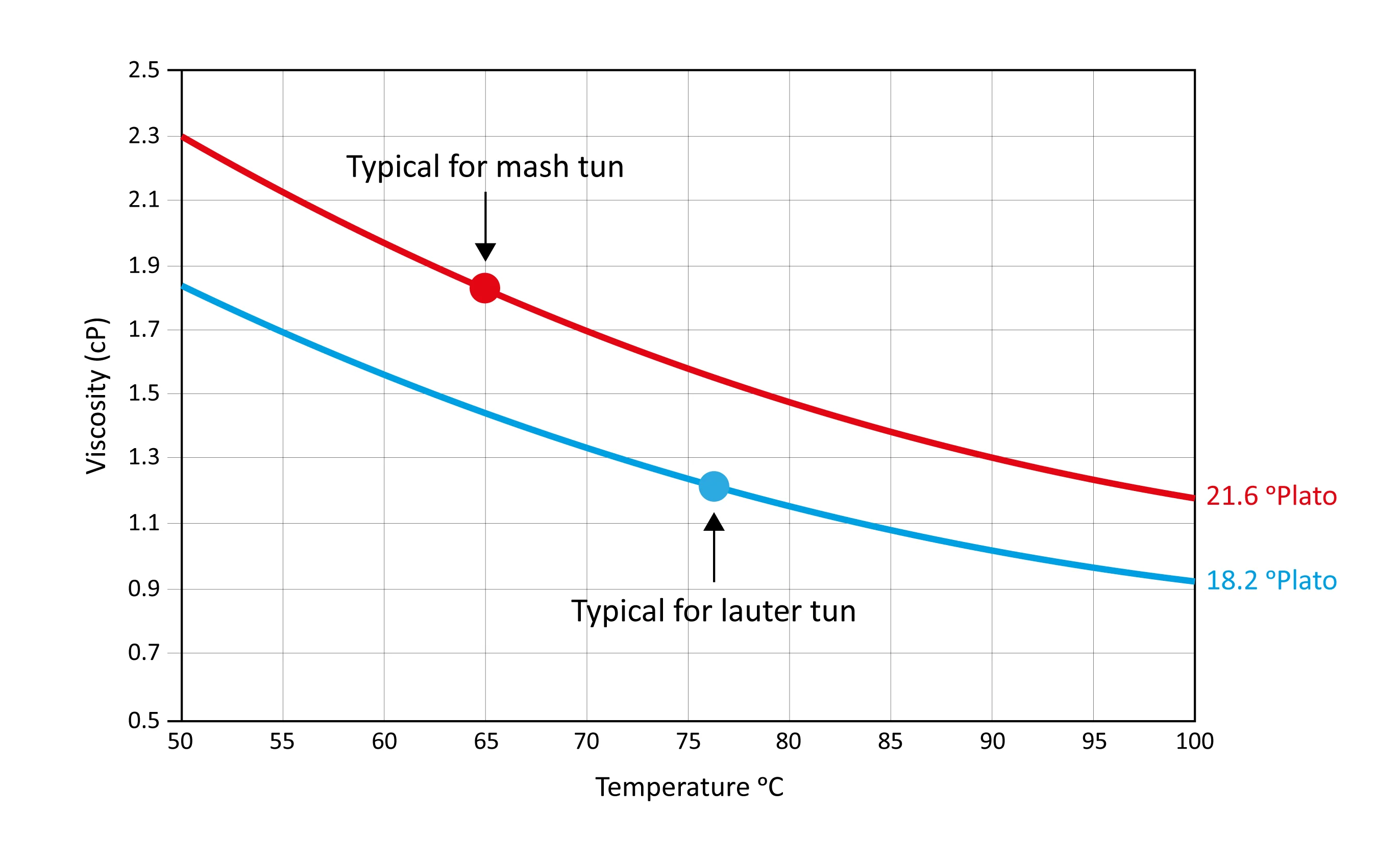
Figure: Wort viscosity varies with gravity and temperature
The mash tun uses roughly 2.5 L of mash water per kg of grist. The resultant strong worts are around SG 1.090, or 21.6 ˚Plato. The lauter tun uses about 3.2 L of mash water per kg of grist. Its resultant strong worts are roughly SG 1.075, or 18.2 ˚Plato.
If we assume that these two strong worts were at the same temperature, say 76˚C, the mash tun viscosity would be 1.6 cP compared to the lauter tun at 1.28 cP. The gravity difference of 15˚ has created a 20% difference in viscosity.
However, the temperature of wort leaving the mash tun is initially at the saccharification temperature of 65˚C. The lauter tun receives mash from the mash conversion vessel at around 76˚C. The higher gravity, and lower temperature of the mash tun strong worts, results in a viscosity of 1.83 cP, which is 30% higher than the lauter tun at 1.28 cP.
What is the unit of viscosity used in Darcy’s equation? Well, the unit of dynamic viscosity we often use is the Poise (P) but we will usually encounter this in a much smaller unit called the centipoise (cP) which is one hundredth of a Poise. And to help you get a feeling for this, it turns out that the viscosity of pure water at 20°C is exactly 1cP !. The unit was named after Jean Poiseuille who was a physicist in France in the late 1800’s and although in wide use, it is not actually a S.I. unit for which the unit of viscosity is the Pascal second (Pa.s). One Poise is equal to 10 Pa.S and so 1 cP is equal to 1 mPa.s. Maltose syrup used as a brewing adjunct has a viscosity of between 2000-3000 cP. Both the higher gravity, and lower temperature of the mash tun result in higher viscosity worts. Darcy’s Law shows us that the mash tun flow rate will be relatively slower than the lauter tun.
Point of reflection: Why do we not use higher mash off/sparge temperatures to further reduce viscosity and increase wort filter flow rate? Give yourself 5-10 min to think about this and then click ‘Next’ to continue this lesson.