
Lesson 2 - Wort Separation Principles
This lesson deals with the principles of wort separation. Before wort separation, we have completed mash conversion. We will now need to separate the liquid wort from insoluble material. This is mainly the husks from the malt, known as spent grain. We will review the reasons why filtered wort must be clear, and how this affects wort quality. We will examine how the all-important grain filter bed is formed differently, by each of the three most common mash separation devices. These devices are: the lauter tun, the mash filter and the mash tun. We will investigate a typical wort collection profile, which ends with the removal of the spent grain.
Darcy’s Law describes filtration flow rate. We will assess both the variables involved, and what influences them. We will finally use Darcy’s Law to predict the relative flow rates of the three mash separation devices.
Wort Filtration Physics – Darcy’s Law
Henry Darcy was a French hydraulic engineer who investigated the flow of water through an aquifer of porous rock. He set up experiments to examine the flow of water through a filter bed of sand. In 1856, he formulated an equation to calculate the flow rate through a sand filter bed, identifying the variables involved.
This equation is known as ‘Darcy’s Law’. It applies to a filter bed that is not compressible e.g. the physical structure of the filter bed does not change with varying flow rate. Our spent grain filter bed is in fact compressible, and its physical structure is affected by the flow through it. However, we can still use Darcy’s Law to provide great insights into the flow of wort through a spent grain bed.
In forms of the Darcy equation given in other literature the differential pressure (DP) sometimes has a negative value (calculated from outlet pressure - inlet pressure) and the equation is given a negative sign so as to provide a positive flow rate. However, it is common practice in breweries to measure and report DP as a positive value (inlet pressure - outlet pressure). This allows us to use the following expression and is the one used throughout this lesson.
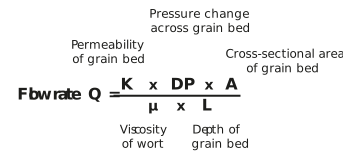
Figure: The Darcy equation for filter flow rate
This is less complicated than it first looks. You can see that there are three top line variables (the numerator), and two bottom line variables (the denominator). The filtration flow rate will increase if any of the top line variables increase, or if any of the bottom line variables decrease. Conversely, the flow rate will decrease if any of the top line variables decrease, or if any of the bottom line variables increase.
We will now explore each of these variables and determine their impact on filtration flow rate. All the variables relate to the grain filter bed, except for wort viscosity. Let us look at this first.