
Lesson 2 - Wort Separation Principles
This lesson deals with the principles of wort separation. Before wort separation, we have completed mash conversion. We will now need to separate the liquid wort from insoluble material. This is mainly the husks from the malt, known as spent grain. We will review the reasons why filtered wort must be clear, and how this affects wort quality. We will examine how the all-important grain filter bed is formed differently, by each of the three most common mash separation devices. These devices are: the lauter tun, the mash filter and the mash tun. We will investigate a typical wort collection profile, which ends with the removal of the spent grain.
Darcy’s Law describes filtration flow rate. We will assess both the variables involved, and what influences them. We will finally use Darcy’s Law to predict the relative flow rates of the three mash separation devices.
Point of reflection – reconvene
Welcome back. So, what were your thoughts?
Before the spent grain bed has properly formed, significant amounts of fine materials are able to pass through the false floor slots. The wort under the false floor has not been adequately filtered. Unsurprisingly, the first worts we collect from the lauter tun are turbid and contain high levels of undesirable solids. We need to recirculate these first worts back to above the grain bed, so that they will then get re-filtered.
The turbid wort below the false floor is of a significant volume. The higher this volume, the greater the first worts’ volume. The greater the under-floor volume the more wort needs to be recirculated before satisfactory clarity is achieved. Modern lauter tun design tries to minimise the under-floor volume, in order to reduce the time needed for the first worts’ clarification. A lower under-floor volume also results in a lower underlet volume to reduce the dilution of the mash.
Recirculating first worts continues until an acceptable clarity is achieved. We can assess this by visual inspection of either an off-line sample or visual inspection of a sight glass installed in the pipework. A fully automated system will use an in-line optical turbidity meter. When clarity is acceptable we can start to collect the clarified strong worts and transfer them to the downstream boiling system.
Best practice requires that the mash should enter the lauter tun at low level, just above the false slotted floor. This reduces the risk of large husk particles being forced through the fine slots in the false bottom and minimises air entrainment and wort oxidation.
During pumped mash transfer, we need to take care not to damage the husk particles. This would alter the structure of the spent grain filter bed and cause hindrance to wort separation. High mash pump impeller speeds, high transfer velocities, and sharp bends in pipework, will cause such husk damage. They can also cause gelling of proteins and β-glucans, which again hinders wort separation. We will examine the influence of these factors on filter bed performance later in this lesson.
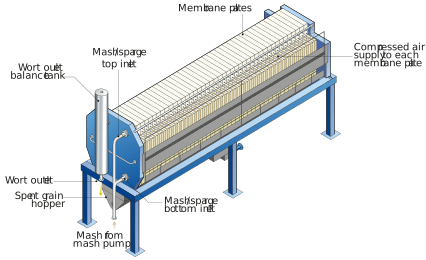
Figure: The mash filter
The mash filter is a series of alternating solid plates and empty frames (also called chambers). The solid plates support the filter cloths; the mash slurry collects in the frames.
The spent grain husk particles produced by the hammer mill are much finer, but they still need to be kept in suspension by the mash conversion vessel agitator. As we pump the mash slurry, the frames fill simultaneously. When the frames are full (leaving the mash vessel only one third empty) the continued mash pumping forces wort through the filter cloths (typically made from polypropylene). This wort can then find its way to the outlet ports in the plates. The husk material continues to build up as a filter bed in the frames, until mash transfer is complete.
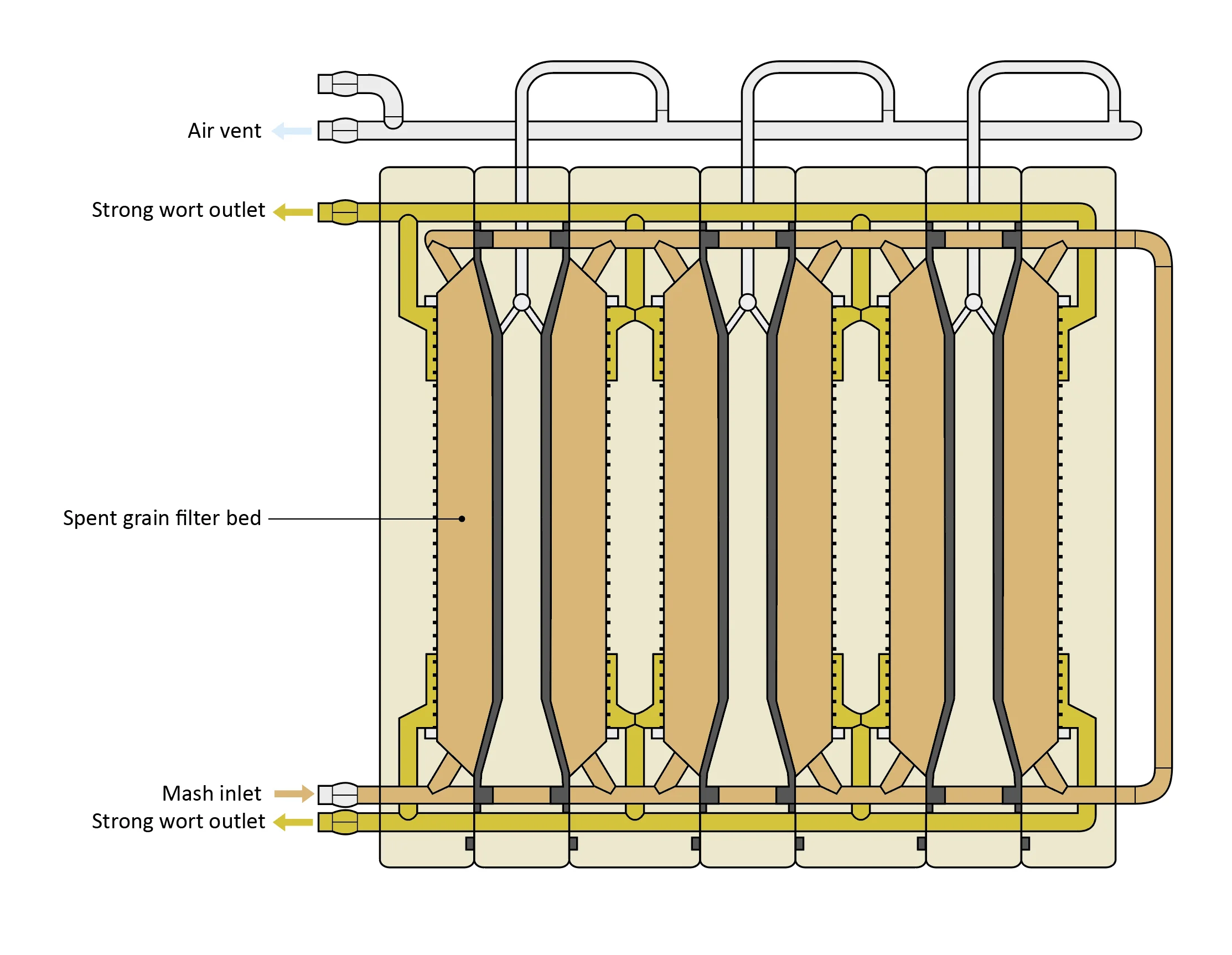
Figure: Mash filter grain bed formation
Point of reflection: Generally, mash filters do not facilitate a first worts recirculation. Why might that be? Give yourself 5-10 min to think about this and then click ‘Next ‘to continue with this lesson.