
Lesson 2 - Wort Separation Principles
This lesson deals with the principles of wort separation. Before wort separation, we have completed mash conversion. We will now need to separate the liquid wort from insoluble material. This is mainly the husks from the malt, known as spent grain. We will review the reasons why filtered wort must be clear, and how this affects wort quality. We will examine how the all-important grain filter bed is formed differently, by each of the three most common mash separation devices. These devices are: the lauter tun, the mash filter and the mash tun. We will investigate a typical wort collection profile, which ends with the removal of the spent grain.
Darcy’s Law describes filtration flow rate. We will assess both the variables involved, and what influences them. We will finally use Darcy’s Law to predict the relative flow rates of the three mash separation devices.
Forming a Spent Grain Filter Bed and Pre-clarifying First Worts
The formation of a spent grain filter bed is critical to wort separation. We need it to filter our wort, providing the required clarity. We also need it to leach away our wort from the spent grain, using the rinsing action of sparge water.
The spent grain filter bed is formed quite differently by the three most common mashing devices.
Spent Grain Filter Bed Formation ‒ The Lauter Tun
The lauter tun is a circular, enclosed vessel, fitted with a false slotted floor above the true floor. These fine slots are typically 0.7 mm wide and 55 mm long. The false floor supports the spent grain filter bed that we are about to create. Before we bring in the mash slurry, the space below the false floor is filled with hot brewing water, until it is flooded approximately 50 mm deep. This is called an ‘underlet’ and can either be done by filling from below or by using the overhead sparge water sprays. The underlet allows the entering mash to better distribute itself, in turn reducing the risk of blocking the false floor slots. This underlet water gets mixed in with the mash, slightly reducing the mash wort strength.
If we return to what is happening in the mash conversion vessel, the insoluble spent grain is being gently kept in suspension by the mash vessel agitator. As the pumped mash enters the lauter tun, the heavier husk materials start to sediment by gravity. This forms a spent grain filter bed on the false floor. The wort is meanwhile forming a supernatant liquid layer above. To achieve the desired clarity, the wort needs to be filtered through the grain bed as it drains out of the vessel, via the outlet ports in the true bottom of the vessel.
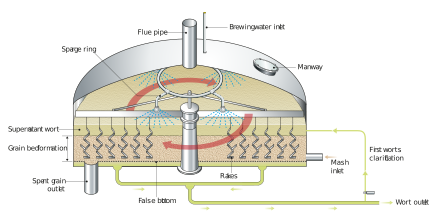
Figure: Lauter tun grain bed formation
Point of reflection: Take a few moments to think about the first worts leaving the lauter tun. What problem do you foresee, and what can be done about it? Give yourself 5-10 min to think about this and then click ‘Next’ to continue with this lesson.