
Lesson 2 - Wort Separation Principles
This lesson deals with the principles of wort separation. Before wort separation, we have completed mash conversion. We will now need to separate the liquid wort from insoluble material. This is mainly the husks from the malt, known as spent grain. We will review the reasons why filtered wort must be clear, and how this affects wort quality. We will examine how the all-important grain filter bed is formed differently, by each of the three most common mash separation devices. These devices are: the lauter tun, the mash filter and the mash tun. We will investigate a typical wort collection profile, which ends with the removal of the spent grain.
Darcy’s Law describes filtration flow rate. We will assess both the variables involved, and what influences them. We will finally use Darcy’s Law to predict the relative flow rates of the three mash separation devices.
Preface
This lesson introduces you to the principles of wort separation. We need to be mindful of how this is heavily influenced by the preceding brewing operations. We will also need to understand how the type of separation device used will in turn influence subsequent brewing operations.
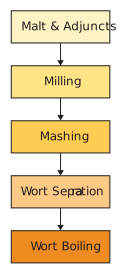
Figure: Wort separation in context
Wort separation performance is significantly affected by the physical nature of the mash. If our selection of raw materials and mashing regime has created a wort with high viscosity, this will hinder wort separation. The device we use relies on having a correctly structured grain filter bed. We have predetermined this by how finely we have ground the malt at milling. The type of wort separation device used will also affect the wort gravity at boiling, and the number of brews possible per day.