
Lesson 8 - Gases
In this lesson we take a closer look at gases, including compressed air. We will look at the quality requirements and specifications for use in the brewery. Different compressed air generation methods will be considered. For nitrogen and oxygen, we will look at the common uses, quality requirements, and options available for supply, storage, usage, and generation.
On-site Nitrogen Generation
For bigger scale users, on-site nitrogen generation is an option. Nitrogen is used in far greater quantities than oxygen, so the feasibility for this is greater.
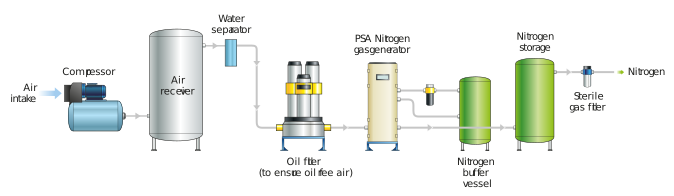
Figure: Typical nitrogen generation system
Let’s first look at the most common type of nitrogen generator – the pressure swing adsorption (PSA) generator. The figure below shows the operating principle of a PSA generator.
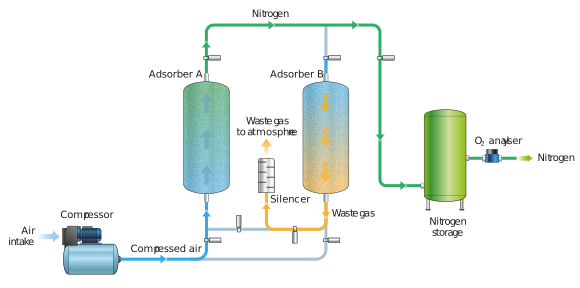
Figure: Operation of a PSA nitrogen generator
A PSA has two adsorption columns or beds filled with particles that adsorb oxygen and carbon dioxide as they are smaller molecules than nitrogen. Let’s start with column A. It is filled with compressed air and absorbs oxygen, carbon dioxide, and moisture. Once it reaches operating pressure, nitrogen flows through into the receiver. After a time, the bed reaches its adsorption capacity, which is normally detected by the purity dropping. The outflow and inflow are closed off and the pressure is then equalised between columns A and B. Thereafter, column A is depressurised so that a waste stream of oxygen-rich gas is vented to the atmosphere. Column B is simultaneously pressurised, and so the process continues.
You may wonder about the purity that can be achieved via this method. The higher the flowrates through a unit, the lower the nitrogen purity will be. Thus, the same generator can be capable of delivering purities of 95-99.9999%.
Another technology that can be used is membrane technology. The figure below shows a typical nitrogen membrane.
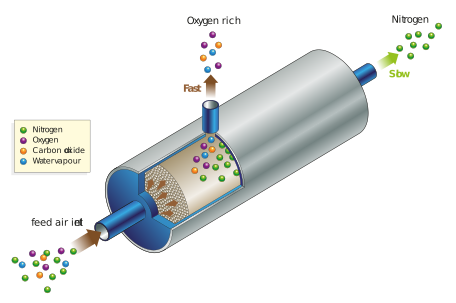
Figure: Membrane nitrogen generator
Compressed air is passed through a permeable membrane at high pressures. The technology relies on selective gas permeation. Gases have different permeation rates, and gases with faster rates like oxygen and carbon dioxide pass through the membrane driven by the pressure within it. These are released to the atmosphere, whilst the gas exiting the membrane consists mainly of nitrogen. The purity is determined by the membrane, the pressure, and the flowrate. Typically, membrane generators can only deliver nitrogen at a purity of 99.5% or lower.