
Lesson 8 - Gases
In this lesson we take a closer look at gases, including compressed air. We will look at the quality requirements and specifications for use in the brewery. Different compressed air generation methods will be considered. For nitrogen and oxygen, we will look at the common uses, quality requirements, and options available for supply, storage, usage, and generation.
Compressed Air
Compressed air has many uses in a brewery. These include:
-
Aeration of wort and yeast
-
Air to actuate valves and solenoids – commonly referred to as instrument air
-
Top pressure for vessels
-
Pneumatic transport of raw materials
-
Spent grain transport
-
Vessel blowdowns (air is used to displace CO2)
Compressed air can also be used to drive pneumatically operated tools and pumps. However, from an energy perspective this is extremely inefficient as it needs eight to ten times more electricity to generate the compressed air than using the equivalent electrical devices.
Overview of the compressed air system
Air compressors are at the heart of a compressed air system, but their operation is dependent on other components. The air has to be taken in and potentially pre-cleaned, compressed, treated, stored, and distributed. In smaller breweries, it is possible to have all the components built into an air compressor skid. In larger breweries, these components are more significant. The figure below gives an overview of a typical system.
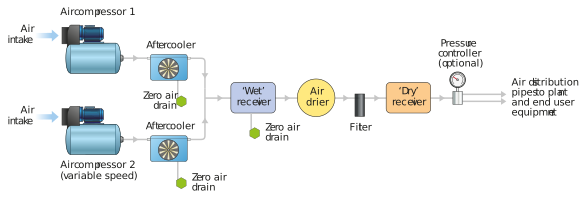
Figure: Typical compressed air system
We will go into more detail on these components in the next sections. First, let’s get an understanding of the physical (air flow rate, volume, and pressure) and quality parameters.
Compressed air flow measurement
It is important to know how much compressed air is required and at what pressure. To simplify this, we usually define the amount of air volume at either normal temperature and pressure (NTP) conditions or standard temperature and pressure (STP) conditions. Thus, if airflow in m3/s is specified at STP it uses 0°C and 100,000 Pa a (1 bar a) as the reference; if specified in m3/s at NTP, it uses 20°C and 101.325 kPa a as the reference. The universal gas law we looked at earlier shows us why specifying a volume at a given temperature and pressure is so important. Thus, we can have specifications for the air delivered by a compressor under these conditions, but the flowrate will have to be adjusted for changes in altitude, temperature, and humidity, which all affect the performance.
Compression ratio is a term given to the ratio of the discharge pressure (absolute pressure) to the intake pressure (absolute). It is another way of specifying discharge pressure which allows you to compare the output of different compressors.
Compressed air pressure
Pressure is important in all compressed air applications. Instrument air is normally required to be at a minimum of 600 kPa, as this is what most actuators are designed for. We must take into consideration that this is at the point of use, so any pressure drops need to be accounted for; otherwise, not meeting the required pressure could result in many valves not opening as required.
Other applications have different pressure requirements. Spent grain removal only requires 200-300 kPa. Vessel blowdowns could be as low as 100 kPa depending on size.
The quality of the compressed air required will depend on what it is to be used for. Let’s have a closer look at compressed air quality.