
Lesson 8 - Gases
In this lesson we take a closer look at gases, including compressed air. We will look at the quality requirements and specifications for use in the brewery. Different compressed air generation methods will be considered. For nitrogen and oxygen, we will look at the common uses, quality requirements, and options available for supply, storage, usage, and generation.
Removal of Contaminants
Contaminants can be removed by a range of equipment, depending on the end specification and condition of the air.
The table below shows some of the equipment available to remove a range of contaminants.
Table: Compressed air purification technologies
|
Purification Technologies |
Contaminants
|
||||||||
|
|
Atmospheric particles |
Rust and pipe scale |
Microorganisms |
Liquid water |
Water aerosol |
Water vapour |
Liquid oil |
Oil aerosol |
Oil vapour |
|
Water separator |
|
|
|
x |
|
|
x |
|
|
|
Coalescing filters |
x |
x |
x |
|
x |
|
|
x |
|
|
Adsorption filters |
|
|
|
|
|
|
|
|
x |
|
Dryer |
|
|
|
|
|
x |
|
|
|
|
Dry particulate filters |
x |
x |
x |
|
|
|
|
|
|
|
Sterile filters |
|
|
x |
|
|
|
|
|
|
The complexity of your compressed air purifying equipment will depend on:
-
Air intake quality
-
Type of compressors used
-
Specification of your compressed air
Thus, you may use very few or all of these technologies. Especially when it comes to filters, there are specialist companies that can provide off-the-shelf solutions, and many of these are seen as consumables. Let’s briefly go into more detail on air treatment.
Particulate removal
Particulate removal is done by means of filters. Different filters take out different size particles. For critical applications such as wort aeration, sterile filters must be used, as this will effectively remove spoilage microorganisms.
Moisture removal (air drying)
Drying of air in brewing is required mostly to prevent water from damaging equipment. Wet air can result in damage to actuators and instruments, as well as corrosion in pipework over time. Moisture also allows for microbiological growth.
You may think the air around you is quite dry, but once compressed it contains a lot more moisture (this is proportional to the increase in pressure). For some brewing applications, reducing the dew point of the air to zero would be adequate and thus refrigerant dryers can be used.
The dew point is an indication of the temperature at which moisture in the air will condense out. The more moisture in the air, the higher the dew point.
Water separators can be used to remove droplets, and coalescing filters can aid in separating out entrained water. However, these are not adequate for the standards required in brewing.
Refrigerant dryers essentially cool the air down so that the moisture in the air condenses out. There is potential to recover some of the heat, depending on the type of cooler used. The figure below shows a typical refrigerant air dryer.
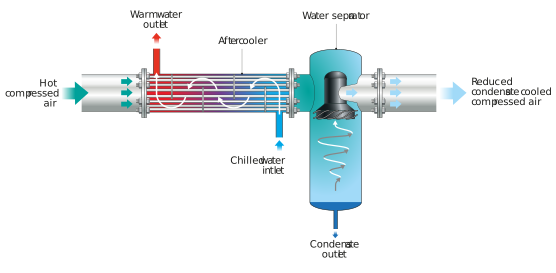
Figure: Refrigerant air dryer
For more sensitive applications, or where the air lines are exposed to extreme cold, there are other options. For example, desiccant dryers and membrane dryers cater for applications where air dew points below zero are required.
The figure below shows a typical desiccant dryer.
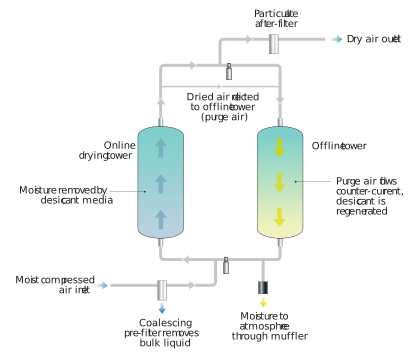
Figure: Typical desiccant dryer
Desiccant dryers contain carbon, silica gel, or activated alumina that absorbs water. Normally, these operate with two units so one is on line and the other one is regenerated using dry warm air.
Oil removal
In oil-lubricated machines, oil is initially removed through oil air separators. To meet more stringent specifications, coalescing filters and adsorption filters can also be used. Coalescing filters typically have two layers. The first layer has fine material elements which catch liquid aerosols and droplets. As they accumulate, they are forced into the coarser outer layer from where they drain. Adsorption filters do exactly what they say they do – they adsorb contaminations. These filters can allow air to reach class 1 for lubricated oil compressors.
Now that we have covered how to produce compressed air, let’s look at how it is supplied to the brewery.