
Lesson 8 - Gases
In this lesson we take a closer look at gases, including compressed air. We will look at the quality requirements and specifications for use in the brewery. Different compressed air generation methods will be considered. For nitrogen and oxygen, we will look at the common uses, quality requirements, and options available for supply, storage, usage, and generation.
Blowers
Blowers are often used for specific standalone operations where lower pressures are required. Applications such as pneumatic transport of raw materials and spent grain transport are suitable for blowers. The most common type of blower used in the brewery is a Roots blower.
Roots blowers are positive displacement compressors. However, unlike screw and piston compressors, compression doesn’t take place internally. Two identical counter-rotating rotors in a housing force air out on the discharge side. Thus, the compression takes place on the discharge and not internally. Some of the air flows back in the housing and is compressed. This results in high noise and low efficiency. Roots blowers can be oil free, and perform well at lower pressures.
A typical Roots blower is shown in the figure below.
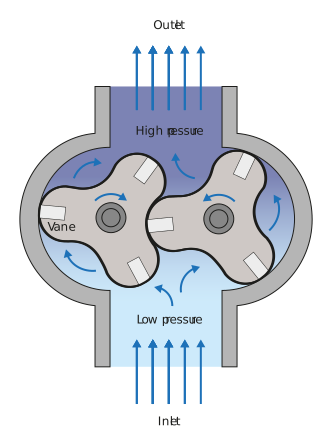
Figure: Tri-lobe Roots blower
Air enters the inlet and as the rotor moves around a volume of air is trapped. As the rotor moves further, the air is discharged. The volume of air does not get smaller in the blower. Basic Roots blowers can typically only deliver 100 kPa pressure, although there are multistage and other variations which can deliver higher pressures.
Before we finish our discussion on air compressors, we need to know how contaminants can be removed.