
Lesson 8 - Gases
In this lesson we take a closer look at gases, including compressed air. We will look at the quality requirements and specifications for use in the brewery. Different compressed air generation methods will be considered. For nitrogen and oxygen, we will look at the common uses, quality requirements, and options available for supply, storage, usage, and generation.
Screw Compressors
Screw compressors are rotary machines that work on the principle of positive displacement.
They have two screws that rotate in opposite directions, as seen in the figure below.
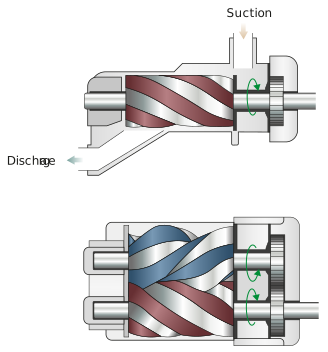
Figure: Rotary screw compressor
The screws are intermeshed. They draw air in from the intake side and squeeze the air into the smaller and smaller spaces formed by the intermeshing. This compresses the air and it is then discharged at a higher pressure. Screw compressors can be lubricated or oil free.
First, let’s look at a typical lubricated screw air compressor.
Lubricated screw air compressors
With lubricated screw compressors, one screw is driven and the other rotates as a result of the movement of the main screw. The lubricating oil creates a seal and the two screws don’t touch. This oil is fed into the compressor and then recovered by an air/oil separator on the discharge. The oil is filtered and circulated back for reuse in the compressor. The air heats up as a result of the compression, and thus needs to be cooled down. This is normally done with an aftercooler. It is a bit like jumping into the pool after spending time in the sun! Cooling will cause water in the air to condense, and thus a water separator is installed after the air cooling. We will cover water separation in more detail later in this lesson. The figure below illustrates a typical lubricated screw compressor.
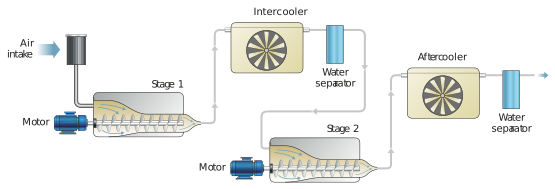
Figure: Lubricated screw compressor
The oil in a lubricated screw compressor has several functions:
-
It lubricates the bearings.
-
It provides a seal between the screws and the body of the compressor, which increases efficiency.
-
It helps to cool the air, and thus the compressor runs cooler than an unlubricated one. The oil can typically absorb as much as 80% of the heat generated during compression.
-
It absorbs gaseous contaminants.
Oil-free screw air compressors
Screw compressors can also be oil free. These operate in a different way to lubricated screw compressors. The screws are manufactured to tight tolerances and the screws are turned together using gears. The screws are also rotated much faster than those in lubricated screw compressors. This higher rotation speed, along with the absence of oil cooling, results in the compressed air exiting at a far higher temperature.
In order to prevent the temperature from being excessively high, oil-free air compressors typically operate in two stages so that intermediate cooling can be applied. The figure below shows a typical oil-free compressor.
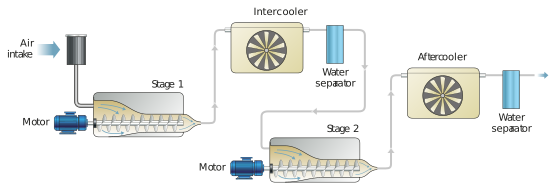
Figure: Oil-free screw compressor
Here we have an intercooler after the first stage and an aftercooler after the second stage, but essentially they do exactly the same thing. It is important to understand that oil-free compressors still have oil in them to lubricate the bearings and gears. Thus, if seals are not in good condition, oil can carry over into the air.
Another important point to remember is that the intake air can contain oil as a result of air pollution. At normal pressure we cannot see it, but once compressed it can become more significant. If you increase the pressure 10 times, you increase the amount of contaminants per volume of air 10 times. This is influenced to a large degree by the location of your air intake to your compressor and by atmospheric conditions. If you are in the middle of a city with lots of cars and air pollution, your compressed air will concentrate the pollutants from the air to the point where they could damage the product.
Thus, oil-free compressors do not necessarily result in oil-free compressed air.
Advantages and disadvantages of screw compressors
Screw compressors offer a number of advantages:
-
They are relatively quiet and have low vibrations.
-
They have higher efficiency, as most of the energy is used to rotate the shafts.
-
They are well suited to continuous operation.
-
They can easily be fitted with variable speed drives.
The disadvantages are:
-
They are relatively expensive compared to reciprocating compressors.
-
They are not suitable for start-stop operations.
-
They can still use 15-35% power when run unloaded.
-
Whilst they do not require as much maintenance as reciprocating compressors, the maintenance is very specialised. As you can imagine, lining up the shafts is critical for efficient operation.