
Lesson 6 - Refrigeration Theory and Cycle
This lesson explains the concepts of refrigeration. It describes the cycle that is utilised in all refrigeration systems and identifies where such systems are found in a brewery.
Refrigeration Principles
Before getting into the specifics of a refrigeration cycle, it is important to understand a few principles related to the phase change of a substance. Let’s start with the very important relationship between pressure and temperature.
At a given pressure, every substance has a boiling point. If we change the pressure of a process, we will expect to see a change in boiling point. The figure below shows the temperature-pressure equilibrium curve for ammonia, which is a common primary refrigerant. This curve, known as the equilibrium curve, shows the temperature at which a substance will boil, at a given pressure.
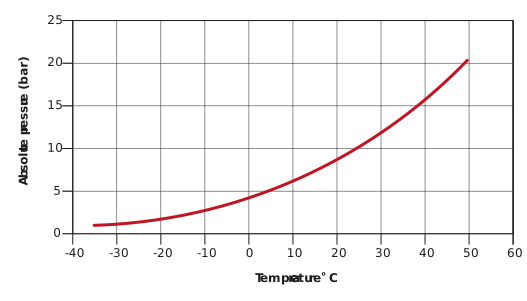
Figure: Temperature-pressure equilibrium curve for ammonia
We can use the above chart to determine what the boiling point of ammonia is at different pressures. For example, at 5 bar a pressure, the boiling point of ammonia is about 3°C. If we increase the pressure to 10 bar a pressure, the boiling point becomes 25°C.
Another important principal to recall from the Heat Transfer unit is that of latent heat.
The latent heat is the energy associated with a phase change. More importantly, the latent heat energy is released without a change in temperature. Heat is absorbed as a liquid changes to a vapour, and is released as the vapour condenses, but it does not change temperature. So, the latent heat is the difference between the specific enthalpy of the substance as a saturated liquid and the specific enthalpy of the substance as a saturated vapour.
The relationship between temperature, pressure, and enthalpy has been analysed via experimentation, and documented in tables as well as in Mollier diagrams. In the following sections, we will discuss how Mollier diagrams can be used to discuss a refrigeration process.