
Lesson 6 - Refrigeration Theory and Cycle
This lesson explains the concepts of refrigeration. It describes the cycle that is utilised in all refrigeration systems and identifies where such systems are found in a brewery.
Overview of Refrigeration
A refrigeration system, such as a chiller, includes the following four processes that occur in a continuous cycle: compression, condensation, expansion, and evaporation. Each of these processes is performed on the refrigerant by a specific piece of equipment.
You may now be wondering, what is a refrigerant? Let’s answer that for you!
A chilling process will likely involve three types of refrigerants:
-
Primary – A primary refrigerant is the fluid that physically gets compressed, condensed, expanded, and evaporated in the cycle. In other words, this is the material that produces the refrigerating effect due to a phase change. Ammonia is an example of a commonly used primary refrigerant in brewing.
-
Secondary – A secondary refrigerant is the fluid that receives the cooling from the primary refrigerant. Secondary refrigerants are usually aqueous solutions, containing a concentration of a suitable substance that depresses the freezing points of water. It does not undergo the cycle. The secondary refrigerant’s main job is to harness the cooling and pass it on to something else. Propylene glycol is a commonly used secondary refrigerant within the brewery.
-
Tertiary – A tertiary refrigerant is the fluid that is cooled by the secondary refrigerant. In a chilling system, the tertiary refrigerant may often be chilled water. More specifics on refrigeration and chilling systems will be discussed later in this lesson, as well as in the Refrigeration Technology lesson.
Sometimes when discussing refrigeration systems, the origin of heat is called the ‘source’ and the recipient of the rejected heat is called the ‘sink.’
The refrigeration cycle withdraws heat from the source through an evaporator, and discharges it to the sink through a condenser. The figure below illustrates this process.
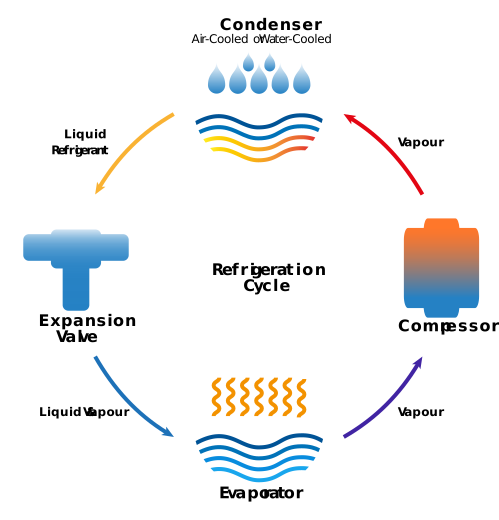
Figure: The refrigeration cycle
Let’s quickly define what each component does:
-
Compressor – compresses a vapour to a higher pressure. Compression is a reversible adiabatic (constant entropy) process. A saturated vapour enters the compressor, and a superheated vapour exits.
-
Condenser – condenses a vapour into a liquid. Condensing occurs at a constant pressure. A superheated vapour enters the condenser and a saturated liquid exits. The latent heat is removed in this process.
-
Expansion valve – reduces the pressure (and temperature) of a liquid. A saturated liquid enters the expansion valve and a vapour/liquid mixture exits. It is often assumed that the expansion step occurs at constant enthalpy.
-
Evaporator – evaporates a liquid into a gas. Evaporation occurs at constant pressure (and temperature). A vapour/liquid mixture enters the evaporator and a saturated vapour exits.
In this lesson, it is important to remember that pressure and temperature have a direct relationship. In general, if you increase the pressure of a fluid, you will also increase the temperature.
Now that we have defined all the key components needed within a refrigeration cycle, let’s discuss some of the important scientific principals used in the cycle.