
Lesson 14 - Fluid Mechanics End of Unit SAQ
This lesson allows you to test yourself on the material covered in all of the lessons in the Fluid Mechanics Unit and to determine the level to which you met the learning outcomes.
Suggested Response - Q7
***
a) Describe the concept of valve flow rate characteristics with reference to linear, fast-opening and equal-percentage characteristics.
b) Compare and contrast the various valve options for providing overpressure and vacuum-pressure protection for a fermenter.
Response:
a) The flow rate characteristic of a valve is simply the relationship between the extent that the valve is open with the percentage of the maximum flow which the valve will pass. Examples of three types of valve characteristic are shown in the figure below.
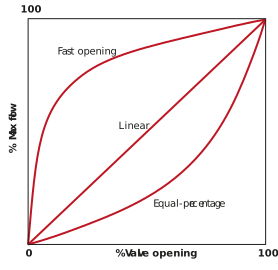
Figure: Three common valve characteristics: fast-opening, linear and equal-percentage
The three most common characteristics encountered are:
-
Linear – in which the flow rate increases linearly with the percentage of valve opening, e.g. if the valve is halfway open, then the flow rate through the valve is half of the maximum.
-
Fast-opening – in which a small change in valve opening achieves a rapid increase in flow rate and conversely, if the valve is fully open, then a large reduction in valve opening yields a very small decrease in flow rate. Therefore, this type of characteristic is not suitable for modulating flow control. However, it is ideal for on-off flow control, although care must be taken as it is very effective at rapidly opening a flow, but not so effective at rapidly shutting it off.
-
Equal-percentage – in which flow rate increases exponentially with valve opening. Equal percentage valves are so-called because whenever the valve opening is changed, the percentage change in flow is equal to percentage change in the valve opening. This means the change in flow is proportional to the flow just before the next incremental valve opening is undertaken.
b) Pressure relief from a fermenter can be achieved using either a pressure-relief valve or a bursting disc.
Pressure-relief valves (also known as a relief or vent valves) ensure that overpressure is relieved or vented from the fermenter to ensure that any overpressure situation does not cause a vessel failure, e.g. a vessel deformation, rupture, or explosion.
These valves work by opening at a set pressure, and they create an alternative path for the pressurised fluid to exit the fermenter. Venting of overpressure, in all likelihood CO₂ in the case of a fermenter, can be done into the cellar area but caution should be exercised regarding any risks to personnel.
The valve relieves excess pressure when the pressure lifts a weight or a spring allowing the pressurised fluid access to the alternative path.
An alternative pressure-relief system, which is not technically a valve, is a bursting disc which consists of a weakened disc of metal which catastrophically fails at a set pressure. This is a disc of metal that is certified to fail at a pre-set pressure.
Vacuum relief is required in a fermenter to avoid the vessel imploding if exposed to a vacuum pressure. Vacuum pressures can be formed in the following situations:
-
The reaction of sodium hydroxide (caustic soda) and CO₂, which is commonly the case when cleaning the fermenter.
-
Improperly racking the fermenter without either opening the vessel to atmosphere or providing top-pressure.
-
Even a running sample valve can draw a vacuum.
Vacuum relief valves (also known as vacuum breakers) open at a specified vacuum pressure, where the vacuum pressure typically overcomes a weight or a spring force. A common example is a simple weighted flap which is opened by the vacuum pressure within the vessel, which allows the external atmosphere to enter the vessel and relieve the vacuum.
A vacuum bursting disc can also be used.