
Lesson 14 - Fluid Mechanics End of Unit SAQ
This lesson allows you to test yourself on the material covered in all of the lessons in the Fluid Mechanics Unit and to determine the level to which you met the learning outcomes.
Suggested Response - Q6
***
a) Describe the mechanism of cavitation, its cause and the impact on pump operation and integrity.
b) Hot caustic solution at 80°C is recirculated from a tank (which is open to atmospheric pressure of 100 kPa), through a cleaning circuit and back to the tank, using a centrifugal pump. A minimum head of 0.5 m, above the base of the tank, will be preserved at all times. The suction line from the tank outlet to the pump inlet has a pressure drop of 0.6 kPa/m, and it is 10 m long. If the pump suction is at the level of the base of the tank, what is the available net positive suction head? (The vapour pressure of the caustic solution is 45 kPa a and density is 1,100 kg/m³).
c) If the pump in b) above has a required NPSH of 6 m of water (ρ = 1,000 kg/m³), would you foresee any problems in operating the pump and how would you mitigate against them?
Response:
a) Cavitation is the generation and subsequent collapse of gas or vapour bubbles due to localised reductions in pressure within a pump/pipeline system. The cause of cavitation is related to flashing (or vapour generation), which will occur if the pressure on a liquid is reduced to or below a threshold pressure. This threshold pressure is different depending on whether a dissolved gas is present, or the liquid is gas-free, and its vapour will be generated. The threshold pressure is the vapour pressure if vapour is being generated from the liquid or the equilibrium pressure if dissolved gas comes out of solution from the liquid.
Some impacts on pump operation and integrity can include:
-
Impaired pump performance – as cavitation creates vapour or gas, these can impair the performance of a pump by gas-binding.
-
Slugs of unwanted vapour can adversely affect pipeline instrumentation, such as flow meters, which would register gross departures from the actual flow rate.
-
Physical damage to pumps, valves, pipes, and the liquid being transported due to the short-lived but high pressures generated as the cavities refill.
-
Severe surface pitting and erosion, also known as spalling, which can lead to a reduced component life cycle.
-
Permanent loss of performance due to the loss of close tolerance geometry – prone in valves and pumps.
b) Let us start with a schematic of the problem (below):
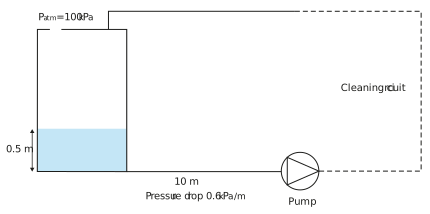
The NPSHA is the difference between the absolute head (or pressure) at the suction (inlet) of the pump and the vapour pressure of the liquid. We can determine the absolute pressure at the inlet of the pump by starting at the headspace of the vessel and working towards the inlet.
The pressure at the pump inlet (P₁) would consist of:
-
Atmospheric pressure (remember, we want the absolute pressure, so we need to account for atmospheric pressure) which is pushing down on the liquid.
-
Added to this is the hydrostatic pressure due to the 0.5 m head of liquid which is pushing down on the outlet of the tank.
The pressure drop along the suction line would not add to the suction pressure, as the two pressures above do, but rather it would reduce the pressure at the suction; it is after all, a pressure drop or loss, so we would need to deduct it.
Hence:


The absolute pressure at the pump inlet is 99.4 kPa, and we know that the vapour pressure of the caustic solution is 45 kPa. Therefore, we have a net positive pressure (or head) at the pump suction (inlet) of:

c) The NPSH required for the pump is 6 m water (ρ = 1,000 kg/m³), so let us convert the NPSHA into m water:

In this case the NPSHA < NPSHR, so we would expect the pump to run the risk of cavitating.
To mitigate against cavitation, we could consider the following options:
-
Change the pump for a low NPSHR pump.
-
Increase the NPSHA by increasing the minimum head of caustic in the tank.
-
Increase the NPSHA by reducing the suction line pressure drop (perhaps some valves are not fully open?).
-
Reduce the temperature of the caustic solution and thereby reduce the vapour pressure.