Suggested Response - Q3

*** A bulk caustic tank is connected to a supply main of 75 mm internal diameter, where the mean flow velocity is constant throughout the main at 1.9 m/s. The main consists of an exit from the bulk tank; a half-open gate valve and six threaded 90° elbows. The loss coefficients are as follows: k = 0.5, exit from the tank; k = 0.9, 90° elbow; and k = 5.6, 50% open gate valve.

The total length of the supply main is 30 m and the main runs level with the exit from the tank. If a 7 m head of caustic is present in the tank, and the tank is open to atmosphere, what is the pressure downstream of the last elbow fitting?

The caustic density and viscosity are 1,200 kg/m³ and 3 x 10-³ Ns/m², respectively, and the absolute pipe roughness is 0.0075 mm.

Response:

The first thing to do is sketch the tank/main set-up (the main is shown in the horizontal plane):
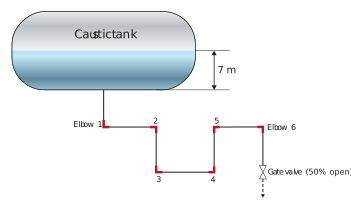
caustic tank

  • Main length = 30 m

  • ρ = 1,200 kg/m³

  • M = 3 x 10-³ Ns/m²

The total pressure drop along the main will be given by the sum of the loss due to friction and the total fitting loss:

increment p subscript t o t a l end subscript equals increment p subscript f r i c t i o n end subscript plus increment p subscript f i t t i n g end subscript

Using the Darcy-Weisbach equation, we deal with the frictional pressure loss first:

increment P subscript բ equals 4 phi L over d rho u to the power of ²

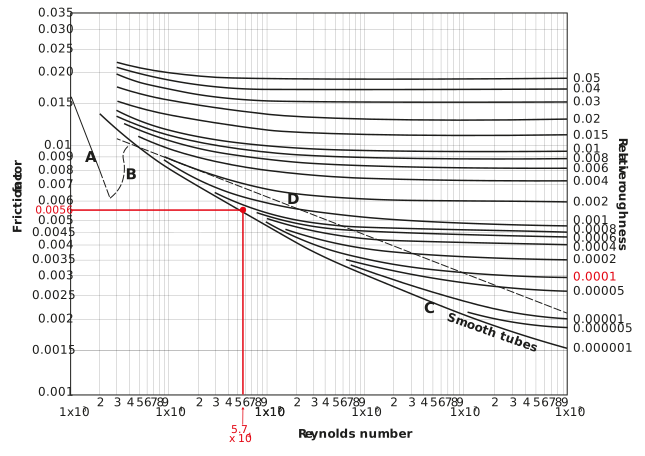
To determine the friction factor from a Moody diagram, we need the Re and the relative roughness ε, which is given by:

R e equals fraction numerator rho u d over denominator mu end fraction equals fraction numerator 1 comma 200 cross times 1.9 cross times 0.075 over denominator 3 cross times 10 to the power of negative ³ end exponent end fraction equals 5.7 cross times 10 ⁴

And:

ϵ equals e over d equals fraction numerator 0.0075 over denominator 75 end fraction equals 0.0001

Plotting these on the Moody diagram (below), the friction factor φ is 0.0056 so 5.6 x 10-³. Hence ∆pfriction is:

increment P subscript f r i c t i o n end subscript equals 4 phi L over d rho u to the power of ²

increment P subscript f r i c t i o n end subscript equals 4 cross times 5.6 cross times 10 to the power of negative ³ end exponent fraction numerator 30 over denominator 0.075 end fraction cross times 1 comma 200 cross times 1.9 to the power of ²

increment P subscript f r i c t i o n end subscript equals space 38 comma 814 space equals 38.8 space k P a

pipe friction chart

Turning our attention to the fitting pressure loss, this will be given by:

increment P subscript f i t t i n g end subscript equals increment P subscript e x i t end subscript plus 6 cross times increment P subscript e l b o w end subscript plus increment P subscript v a l v e end subscript

Where each term is given by:

increment P subscript f i t t i n g end subscript equals k subscript e x i t end subscript left parenthesis fraction numerator u to the power of ² rho over denominator 2 end fraction right parenthesis plus 6 cross times k subscript e l b o w end subscript left parenthesis fraction numerator u to the power of ² rho over denominator 2 end fraction right parenthesis plus k subscript v a l v e end subscript left parenthesis fraction numerator u to the power of ² rho over denominator 2 end fraction right parenthesis

increment P subscript f i t t i n g end subscript equals left parenthesis fraction numerator u to the power of ² rho over denominator 2 end fraction right parenthesis space left square bracket k subscript e x i t end subscript plus 6 cross times k subscript e l b o w end subscript plus k subscript v a l v e end subscript right square bracket

increment P subscript f i t t i n g end subscript equals left parenthesis fraction numerator 1.9 to the power of ² cross times 1200 over denominator 2 end fraction right parenthesis space left square bracket 0.5 plus 6 cross times 0.9 plus 5.6 right square bracket

increment P subscript f i t t i n g end subscript equals 24.9 k P a

Hence the total pressure loss along the main will be: 

increment p subscript t o t a l end subscript equals increment p subscript f r i c t i o n end subscript plus increment p subscript f i t t i n g end subscript

increment p subscript t o t a l end subscript equals 38.8 plus 24.9

increment p subscript t o t a l end subscript equals 63.7 space k P a

This is the pressure that is lost along the main. However, we were asked to determine the pressure at the downstream end of the main, so we need to take account of the hydrostatic pressure in the tank due to the 7 m head of caustic. The hydrostatic pressure is given by:

increment p subscript h y d r o s t a t i c end subscript equals rho g h equals 1 comma 200 cross times 9.81 cross times 7 equals 82.4 space k P a

Therefore, the pressure at the downstream end of the pipe will be given by:

p subscript d o w n s t r e a m end subscript equals p subscript h y d r o s t a t i c end subscript minus p subscript t o t a l end subscript

p subscript d o w n s t r e a m end subscript equals 82.4 minus 63.7 equals 18.7 space k P a g

It should be noted that this pressure is a gauge pressure because the tank is open to atmosphere.

You have completed 0% of the lesson
0%