
Lesson 14 - Fluid Mechanics End of Unit SAQ
This lesson allows you to test yourself on the material covered in all of the lessons in the Fluid Mechanics Unit and to determine the level to which you met the learning outcomes.
Self-Assessment Questions
1. ***
a) A cylindroconical fermenter has a wort depth of 20 m (measured from the base of the cone up to the wort surface) with a headspace pressure of 5 kPa (g). The density of the wort is 1,080 kg/m³, and the atmospheric pressure is 95 kN/m². Calculate the absolute pressure at the base of the fermenter cone.
b) What would be the external force that a single yeast cell located at the base of the fermenter cone is exposed to? You may assume the yeast cell is a 5 µm diameter (d) sphere and the surface area of a sphere is given by πd².
2. *** An automated sampling system fitted to a bright beer tank uses a 5 mm internal diameter tube to transport samples over a distance of 20 m. The beer has a density and a dynamic viscosity of 1,005 kg/m³ and 2 x 10-³ kg/ms, respectively.
a) If the flow rate in the sample line was 600 mL/min, what would be the average transit time for a sample to travel the length of the sample line?
b) During the cleaning of the sample line, it is required that the cleaning solution passes through the line under turbulent flow conditions. What would be the minimum flow rate supply of cleaning fluid to achieve this requirement? (You may assume the cleaning fluid has the same fluid physical properties as the bright beer).
3. *** A bulk caustic tank is connected to a supply main of 75 mm internal diameter, where the mean flow velocity is constant throughout the main at 1.9 m/s. The main consists of an exit from the bulk tank – a half-open gate valve and six threaded 90° elbows. The loss coefficients are as follows:
-
k = 0.5, exit from the tank
-
k = 0.9, 90° elbow
-
k = 5.6, 50% open gate valve
The total length of the supply main is 30 m and the main runs level with the exit from the tank. If a 7 m head of caustic is present in the tank, and the tank is open to atmosphere, what is the pressure downstream of the last elbow fitting?
The caustic density and viscosity are 1,200 kg/m³ and 3 x 10-³ Ns/m², respectively, and the absolute pipe roughness is 0.0075 mm.
4. **
a) Describe the principle of operation of a centrifugal pump with reference to Bernoulli’s equation and pump geometry.
b) Describe the principle of operation of a positive displacement pump.
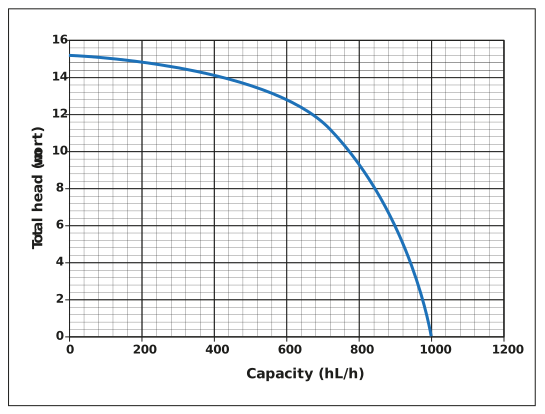
5. *** A centrifugal wort collection pump is used to pump three separate brews, of 500 hL each, into a multi-brew fermenter. The fermenter may be assumed to be a vertical cylinder of 4 m internal diameter. The characteristic curve for the pump is shown below.
a) What would be the initial flow rates that the pump would deliver for each of the three brews? (You may assume the suction head on the pump is zero, and that the only head on the discharge of the pump is due to the hydrostatic head of the brews inside the fermenter).
b) What would be the three values of pumping power at the start of each brew transfer? Wort density is 1,065 kg/m³.
c) Explain why the flow rates during the transfer of each brew are neither constant nor the same?
d) If you wished the flow rate for each brew to be the same and constant, explain how adjusting the speed of the pump may achieve this?
6. ***
a) Describe the mechanism of cavitation, its cause and the impact on pump operation and integrity.
b) Hot caustic solution at 80°C is recirculated from a tank (which is open to atmospheric pressure of 100 kPa), through a cleaning circuit and back to the tank, using a centrifugal pump. A minimum head of 0.5 m, above the base of the tank, will be preserved at all times. The suction line from the tank outlet to the pump inlet has a pressure drop of 0.6 kPa/m, and it is 10 m long. If the pump suction is at the level of the base of the tank, what is the available net positive suction head? (The vapour pressure of the caustic solution is 45 kPa a and density is 1,100 kg/m³).
c) If the pump in b) above has a required NPSH of 6 m of water (ρ = 1,000 kg/m³), would you foresee any problems in operating the pump and how would you mitigate against them?
7. ***
a) Describe the concept of valve flow rate characteristics with reference to linear, fast-opening and equal-percentage characteristics.
b) Compare and contrast the various valve options for providing overpressure and vacuum-pressure protection for a fermenter.