
Lesson 8 - Control of Fluid Flow 1
This lesson will consider two main classifications of pumps: centrifugal and positive displacement. These will be introduced together, with aspects of their design and operation. The lesson will also pull together various fluid mechanics concepts from previous lessons, such as the Darcy-Weisbach equation and the use of loss-coefficient to calculate pressure drops in pipe systems. It will use this information to then size pumps for particular pipe systems.
Pump Flow Control
Flow control techniques differ significantly depending on whether centrifugal or positive displacement pumps are used. Let us look at the methods commonly available to control these two pump types.
Centrifugal pump flow control
Probably the simplest method of controlling the flow from a centrifugal pump is to install a flow control valve on the pump outlet and partially close this valve to reduce the flow. This is exactly the approach you use to control the flow of water at home, with a tap (which is a form of flow control valve), so it is not new to you, but using the concepts of fluid mechanics which we have studied to date, let us consider how the use of a valve controls flow and what advantages and perhaps disadvantages it offers.
The first thing to consider is that for a pipeline of fixed flow rate, the presence of any fitting which has a positive value of loss-coefficient, be it a flow control valve or otherwise, increases the pressure drop across the fitting and hence along the entire pipeline. As a valve is closed, the amount of pressure dropped across it increases. So if you think of a pipeline characteristic curve, the presence of a valve and its closure on the curve is to steepen the curve, as shown in the figure below.
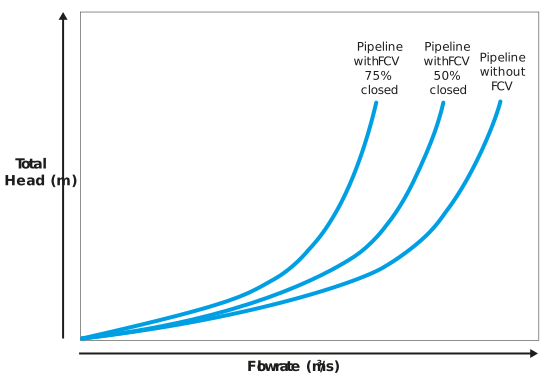
Figure: The steepening of a flow rate total head pipeline characteristic curve due to the presence and closure of a flow control valve
The pipeline characteristic curve steepens as a valve closes, but what does this do to the flow rate delivered by the pump? What’s going to tell us this? That’s right…the operating point where the pump and pipeline curves intersect (see earlier in this lesson!). The figure below shows this, and you can see that as the control valve closes, the operating point moves such that the flow rate delivered by the pump reduces.
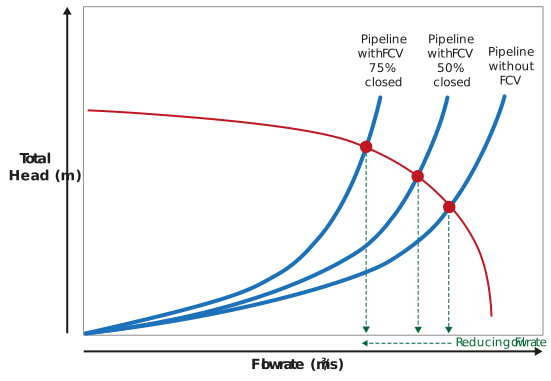
Figure: The effect on pump performance of the closure of a flow control valve
Controlling flow using a valve on discharge of the pump, also called ‘throttling’, although effective (if the correct valve is chosen – more on this in a later lesson), is not very efficient from an energy point of view. We are generating more pressure from the pump and then dropping it across the valve (look at the figure above, the pump generates a greater total head at the valve closes).
Remember, pressure is a form of energy.
A more energy-efficient means of controlling the flow of a centrifugal pump is to control the rotational speed of the pump, which directly influences the pump operating curve. The figure below shows the impact on the pump curve of reducing impeller speed, and that is to shift the curve towards the origin. The intersection with the pipeline characteristic curve shown describes the operating point with reducing flow rate with impeller speed.
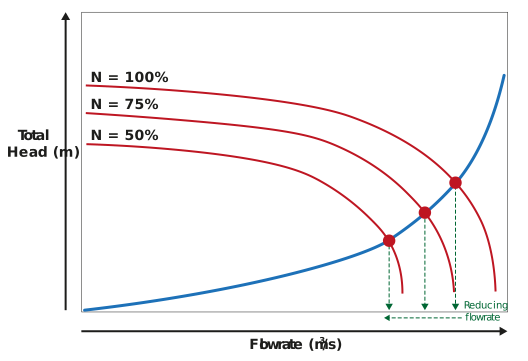
Figure: The effect on pump performance of the closure of reducing impeller speed
But what about a more energy-efficient means of controlling the flow? Well, you can see that unlike the effect of a flow control valve, as the flow rate reduces, the total head generated by the pump also reduces. As we previously discussed, the pumping power is the product of flow rate and total head, so, as the impeller speed drops, the pumping power also reduces.
Speed control of a centrifugal pump to regulate flow rate results can result in more efficient use of energy.
Positive displacement flow control
Flow control with positive displacement pumps can be done either by adjusting the stroke length (essentially changing the volume of liquid which is entrapped by the pump) or by varying the speed of the pump with a variable speed drive; the latter in a similar way as for centrifugal pumps.
However, a flow control valve on outlet of a positive displacement pump cannot be used as pump outlet pressure can rise to an excessively high level which can cause the failure of the pump. For this reason, it is common to have a discharge pressure relief system incorporated with the pump to protect the pump from overpressure.