
Lesson 8 - Control of Fluid Flow 1
This lesson will consider two main classifications of pumps: centrifugal and positive displacement. These will be introduced together, with aspects of their design and operation. The lesson will also pull together various fluid mechanics concepts from previous lessons, such as the Darcy-Weisbach equation and the use of loss-coefficient to calculate pressure drops in pipe systems. It will use this information to then size pumps for particular pipe systems.
Positive Displacement Pumps
Positive displacement pumps are named so because of the entrapment and movement of a volume of liquid occupied within the pump. An everyday positive displacement pump system, with some 7.5 billion individual pumps in use and counting, is in your chest. That is right, the human heart! It works by receiving blood in a pair of flexible chambers (called atria) which then contract to reduce their volume, thereby pumping blood into another pair of chambers (called ventricles) which similarly contract and pump blood to different parts of the body. Around 100,000 repeat pump cycles per day with an output pressure of 16 kPa and a throughput of 1 hL per day. A lifetime of trouble-free operation (with luck and some essential preventative maintenance).
Volume entrapment and displacement
Let us just consider what we mean by volume entrapment and displacement, which, as mentioned, defines a positive displacement pump. We can do this with a simple example.
So, let us take a syringe, which is commonly used to give you an injection at the hospital. If you were to use a syringe to empty a cup of water, you would pull the plunger of the syringe up, thereby drawing a fixed volume of water into the syringe or entrapping a volume of liquid. When we push the plunger to empty the syringe, the movement of the plunger is to push out, or displace, the volume of liquid in the syringe. Repeated cycles of drawing up or entrapping liquid and displacing it with the syringe, would gradually empty the cup of water with a small volume at a time. This principle of volume entrapment and displacement can be seen in the following positive displacement pump types. Let us now look as the classifications of positive-displacement pumps.
Positive displacement pumps can be classified by how the pump displaces the liquid, namely whether it does so using reciprocating displacement or via a rotary displacement.
Let us consider these different sub-classifications together with some pump examples.
Reciprocating displacement pumps
As the name suggests, this classification of pumps moves the liquid backward and forward (Latin reciprocus, where re and pro mean back and forward, respectively) using a piston, plunger, or a diaphragm (membrane). This might sound a little confusing (how do we pump the liquid in the direction required?), so let us look at an example of a reciprocating piston pump in the section below.
Reciprocating piston pump
In the figure below, you can see a cylinder with a reciprocating piston which moves back and forth (or upwards and downwards if you prefer!). The cylinder is fitted with an inlet and an outlet port, each with a valve.
As the piston moves downwards, the inlet valve is open, and the outlet valve is closed. The piston draws in liquid through the inlet port by suction. As the piston changes direction and is driven upwards, the inlet valve is closed, and the outlet valve is opened to allow the piston to pump out liquid under pressure. In this way, you can see that the cylinder and piston, together with the valves, entrap a volume of liquid, and then the piston displaces that volume through the outlet port. The suction and pressure cycles are repeated many times to pump liquid at a particular flow rate.
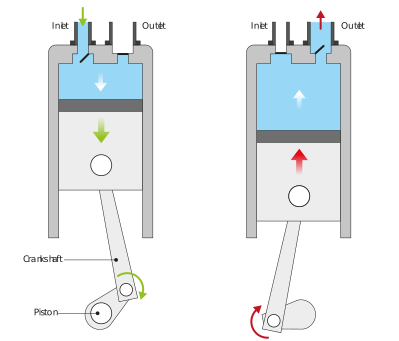
Figure: Suction and pressure cycles of a reciprocating positive displacement pump
The piston pump is not suited to stringent hygienic applications, such as those related to product handling. This is due to the difficulties in cleaning the valves and the seal between the piston and the cylinder. A more suitable reciprocating positive displacement pump for hygienic brewing applications is the reciprocating diaphragm pump.
Reciprocating diaphragm pump
A diaphragm (or membrane) pump utilises the reciprocation of a flexible membrane and non-return (or check) valves to entrap and displace liquid. The means of producing the linear motion to move the membrane can either be done using an electric motor, a solenoid (an electro-mechanical device which produces linear motion), a manually driven handle or compressed air.
In order to more efficiently operate the linear motion used to drive the membrane, it is common to use two opposing membranes with one being driven forwards, whilst the other one is driven backwards. This is called double-acting operation. The figures below show a double-acting diaphragm pump and its operation using two diaphragms and four non-return valves.
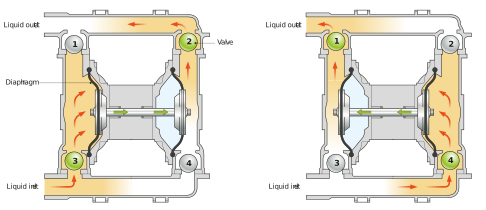
Figure: A double-acting diaphragm pump showing its operation
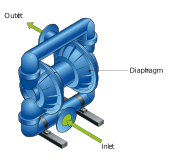
Figure: A double-acting diaphragm pump
Diaphragm pumps can be operated in hygienic application as long as attention is paid to the cleaning of the pump and also the integrity of the diaphragm. This is to prevent cracks (which could harbour microorganisms) developing.
Other attributes of a diaphragm pump include:
-
It can handle liquids with a high proportion of solids, even abrasive solids, which makes it ideal for handling filter aid slurries.
-
It can handle corrosive liquids if the appropriate membrane is chosen, which makes it ideal for pumping concentrated (bulk) caustic (sodium hydroxide) solutions for CIP plants.
-
It is not as accurate for metering as a piston pump due to deformation of the diaphragm, which can lead to variable entrapped volumes.
-
Other uses can include pumping of trub, yeast, tank bottoms, and chemical dosing.