
Lesson 8 - Control of Fluid Flow 1
This lesson will consider two main classifications of pumps: centrifugal and positive displacement. These will be introduced together, with aspects of their design and operation. The lesson will also pull together various fluid mechanics concepts from previous lessons, such as the Darcy-Weisbach equation and the use of loss-coefficient to calculate pressure drops in pipe systems. It will use this information to then size pumps for particular pipe systems.
Pumps in Series
It is usual to want to increase the capacity of a single pump by fitting another pump to boost the capacity (booster pump). This can be done with a pump of a different size in series with the original pump.
This may be because:
-
Two (or more) smaller pumps may be cheaper to purchase than one larger pump.
-
Two (or more) pumps offer greater control flexibility.
-
Line capacity has increased so that one pump is not capable of meeting demand and a second booster pump is the cheaper option than a new larger pump etc.
Common instances of booster pumps include:
-
Booster pumps to deliver bright beer (BB) at a constant flow rate from BB tanks to the packaging hall – in a large brewery the number of BB tanks could be considerable and spread out around the site.
-
Transport of beer through the connecting BB main will impose different loads on the delivery pump depending on whether the live tank is close or otherwise to the packaging hall.
-
Booster pumps around the BB main can compensate for this variable load and deliver bright beer at a fixed flow rate.
It is possible to create a compound pump curve to represent two or more serial pumps by noting the following rules:
-
The head curves are added to produce the compound curve.
-
The efficiency curves are multiplied together to give the compound curve.
-
The pumping power curves are added together to form the compound curve.
When looking at pump operating characteristics, it is the tendency of some manufacturers to summarise the pump curve by providing data from the pump curve itself – stating the capacity and head that the pump can provide. Sounds simple enough? Well, not quite because the capacity and head quoted together are often the ‘zero-head’ capacity and ‘dead-end’ head but without stating the conditions. From what we have just discussed above, these conditions are at opposite ends of the pump curve and cannot exist together. Still confused? Well, let us look at the worked example below to get some more clarity.
The pump curve and summary table shown are for a small centrifugal pump typically used by homebrewers or small craft brewers. The pump specification sheet states the pump is capable of ‘transferring 30 L per minute with a max head of 5.8 m.’
State the dead-end total head and the zero-head capacity and comment on whether it is achievable to transfer 30 L per minute with a max head of 5.8 m as claimed.
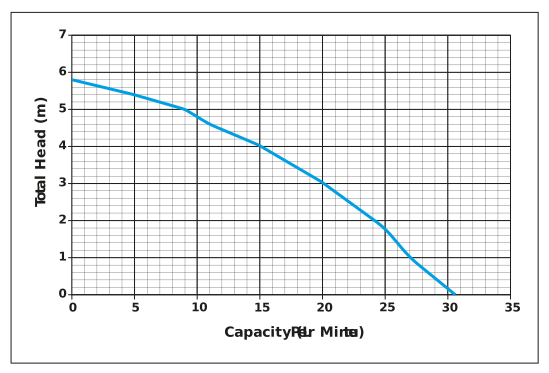
The dead-end total head would be the total head that the pump can produce if the capacity is zero. From the pump curve, this equates to a total head of 5.8 m (the extreme left end of the curve).
The zero-head condition would be when the total head is zero. From the pump curve, this equates to a flow rate of 30 L per minute (the extreme right end of the curve).
As for whether it is achievable to transfer 30 L per minute with a max head of 5.8 m, hopefully you can see that we cannot have both. We can either transfer 30 L per minute or generate a total head of 5.8 m, but not at the same time. So, the manufacturer’s claim is open to erroneous interpretation.
Care must be taken when examining pump specification and operating characteristics to ensure that the correct capacity and total head is generated from the pump for the pumping application in question.
We have spent quite some time discussing pump characteristics and how to be wary of misinterpreting specifications for a particular pumping application, but how do we actually ensure we can match a pump to a particular application and get the required capacity and/or total head? Well, that uses some quite involved concepts and maths, which in practice, a brewer would be very unlikely to need to apply. That would be the job of a friendly engineer, but it is important for you as brewers to both know how the principle of this matching process and most importantly, why it is required. Let us now have a look at this matching process.