
Lesson 8 - Control of Fluid Flow 1
This lesson will consider two main classifications of pumps: centrifugal and positive displacement. These will be introduced together, with aspects of their design and operation. The lesson will also pull together various fluid mechanics concepts from previous lessons, such as the Darcy-Weisbach equation and the use of loss-coefficient to calculate pressure drops in pipe systems. It will use this information to then size pumps for particular pipe systems.
Impeller Design Types
Two types of impeller design are available and commonly used in a brewery. These are termed open and closed impellers and are shown in the figure below.
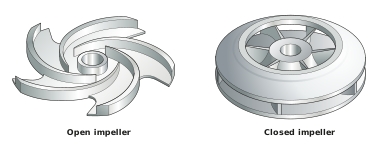
Open impeller – as its name suggests, has an impeller with an open structure and no enclosure surrounding the vanes on the impeller, which produces lower levels of shear. Open impellers are often used for liquids which contain substantial solids, e.g. mash transfer (to avoid damage to husks) and yeast handling. However, they operate with lower efficiencies than closed impellers.
Closed impeller – closes the space between the vanes with an upper and lower surface, termed webbing, which increases efficiency. The inter-vane spaces can be susceptible to blockage. They are commonly used for liquids with low solids content such as water, wort, beer, secondary refrigerants, CIP (clean-in-place) feed, and return.
So, here is something for you to consider; we have a rotating shaft driving the impeller, and the impeller is within a stationary volute casing which carries the liquid being pumped. Do you see any practical issues with this situation?
Give yourself 5-10 mins to think about this and then click ‘Next’ to continue with this lesson.