
Lesson 4 - Beer Haze
In this lesson we will discuss beer haze. This will include defining the biological and non-biological (protein-polyphenol) haze types and their formation. We will also identify other hazes that can occur in beer. We will consider the influence of raw materials and discuss processing. To end the lesson, we look at how haze is measured and how we can use accelerated shelf-life testing to predict colloidal stability.
Protein Precipitation Tests
Alcohol chill test
Here, ethanol is added to a beer sample which is chilled to -8 ºC. The alcohol serves to prevent freezing and induce protein precipitation. After eight hours, the chill haze is recorded. Lower haze equates to greater colloidal stability.
Sensitive protein
This test measures the amount of protein involved in haze formation. A defined amount of tannic acid (a polymerised polyphenol), is added to a defined amount of beer. The resultant haze is measured, which gives an indication of the haze forming potential.
Saturated ammonium sulphate precipitation limit (SASPL)
Saturated ammonium sulphate solution (SASS) is added to beer until the haze value begins to increase. SAS precipitates higher molecular weight (MW) proteins causing a haze increase at the point of saturation. This point of haze increase is the SASPL, and the result is expressed in SASS mL / 10 mL of sample.
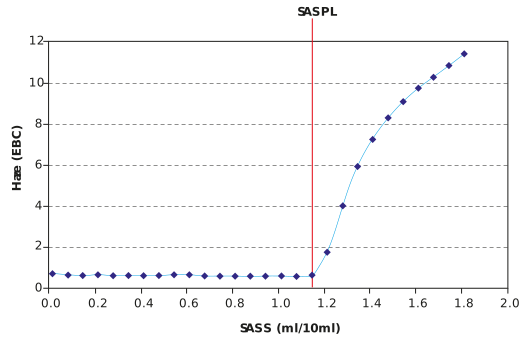
Figure: SASPL titration graph