
Lesson 4 - Beer Haze
In this lesson we will discuss beer haze. This will include defining the biological and non-biological (protein-polyphenol) haze types and their formation. We will also identify other hazes that can occur in beer. We will consider the influence of raw materials and discuss processing. To end the lesson, we look at how haze is measured and how we can use accelerated shelf-life testing to predict colloidal stability.
Non-Biological Haze
Non-biological haze in the finished product is far more common than biological haze.
There are two types of non-biological haze: chill haze and permanent haze.
-
Chill haze (also known as temporary haze) – when beer is chilled to sub-zero temperatures during maturation, a haze develops. If the beer warms up on its route to the filter, the haze dissolves only to reform in the bottle in the consumer’s beer fridge. This haze is called chill haze and is defined as a haze that appears in a beer on chilling to 0 ºC but re-dissolves on warming to 20 ºC.
-
Permanent haze – this forms over time or in an accelerated ageing regime from repeated cooling and warming cycles and once formed will not re-dissolve. Permanent haze is defined as a haze that is present irrespective of the temperature of the beer.
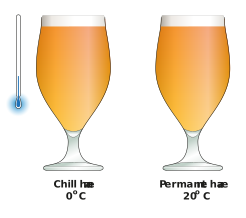
|
Forms on chilling Reversible complex Dissolves on warming |
Forms over time from chill haze Irreversible complex Stable haze at all temperatures |
Figure: Chill haze and permanent haze
Mechanism of haze formation
The most common non-biological chill hazes in beer are formed from the loose bonding of proteins and polyphenols. The protein fraction originates from malted barley and is very reactive. Even a small amount (e.g. 2 mg/L protein) will be enough to cause a haze of 1 EBC in beer.
Malt storage proteins, called hordeins, are the source of these haze proteins. These so-called sensitive proteins are rich in proline, which is able to associate with polyphenols through hydrogen bonding and hydrophobic force. This weak interaction results in the type of haze known as chill haze and can be reversed through warming to 20 ºC.
Although grouped with amino acids proline is actually an imino acid. Imino acids contain the imine functional group (C=NH), whereas amino acids contain the amine functional group (C-NH2). Proline exists in a ring structure and is not assimilated by yeast in fermentation.
Chill haze can be reversed by warming the beer up to 20 °C.
Further aggregation of protein and polyphenol (and the growth of the resultant haze complexes featuring covalent bonding) leads to the formation of insoluble permanent haze which cannot be removed by heating. These mechanisms are shown in the figure below.
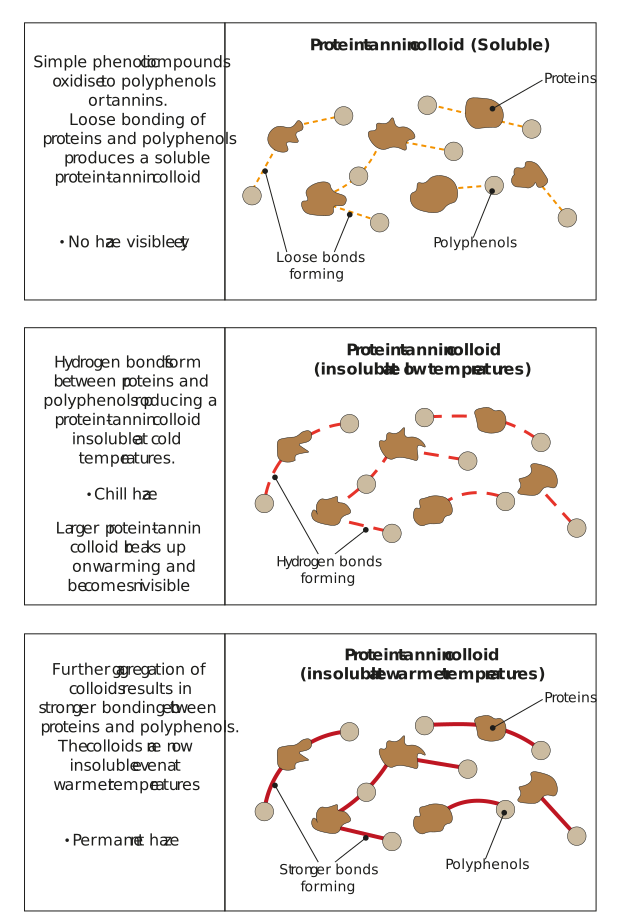
Figure: Mechanism of haze formation
Permanent haze cannot be reversed by heating.
It is no surprise that polyphenols also derive from malt, although hops contribute about 30% of polyphenols in wort and beer. For beer that has been heavily dry hopped, the contribution of the hops can be greater. Polyphenols have two or more phenol rings. They bind with protein polypeptides to form haze complexes and also protect beer against oxidation, by chelating metals such as iron and copper. However some are pro-oxidants.
The polyphenols active in haze formation are the flavanols and their derivatives, which contribute about 10% of all beer polyphenols. In beer, these are catechin, epicatechin, gallocatechin, and epigallocatechin. More important, however, are the dimers and trimers of these compounds: the simple flavonoids or proanthocyanidins (also known as anthocyanogens).
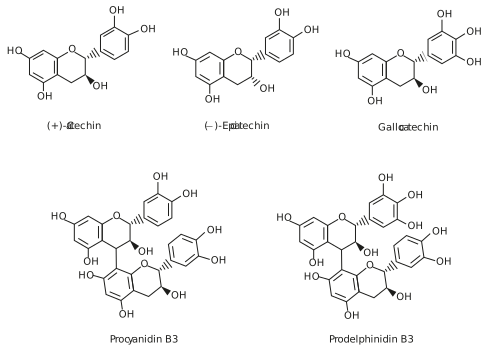
Figure: Beer flavanols and their dimeric active proanthocyanidins
The two flavonoid dimers shown are particularly important for haze formation and contribute around 33% of the flavonoids but only 3% of the polyphenols.
The oxidation of monomers produces the dimers. These dimers are able to bridge between the separate protein molecules. Monomers cannot bridge as they will only react with one proline-rich site on an individual polypeptide. Oxygen and metal ions catalyse the polymerisation of polyphenols.
In the model proposed by Siebert, shown below, the binding sites of the polyphenols and proteins should be in equal proportions (stoichiometric) for the optimal formation of haze. If there is an excess of either, cross-linking will be hampered, and optimal particle formation will not occur. The brewer’s strategy to promote colloidal stability is, therefore, to remove either one or both of these components. Later on, we will discuss how this is done in practice.
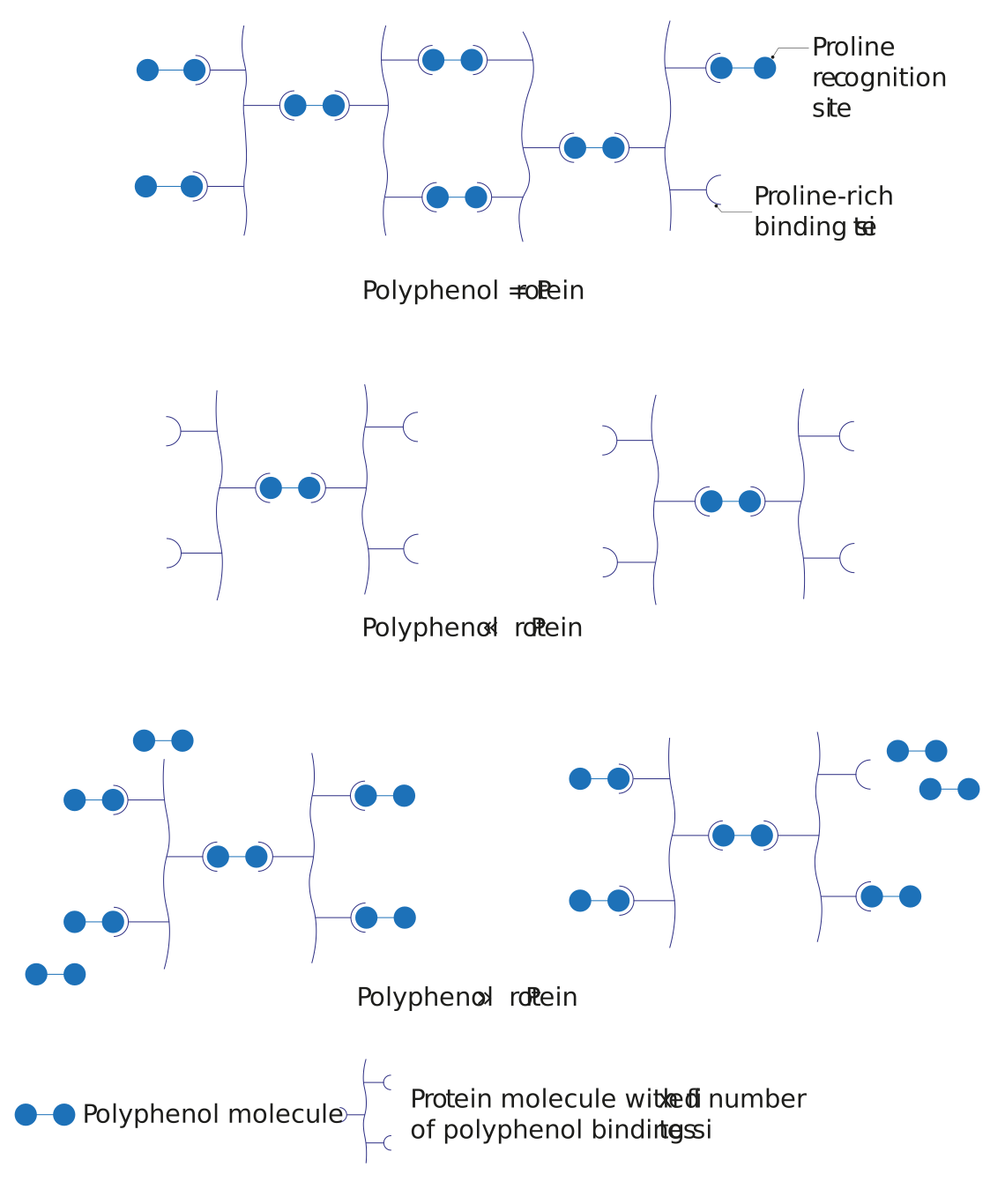
Figure: Effect of protein and polyphenol concentrations on haze formation