
Lesson 4 - Beer Haze
In this lesson we will discuss beer haze. This will include defining the biological and non-biological (protein-polyphenol) haze types and their formation. We will also identify other hazes that can occur in beer. We will consider the influence of raw materials and discuss processing. To end the lesson, we look at how haze is measured and how we can use accelerated shelf-life testing to predict colloidal stability.
Predictive Tests
As brewers, we need to get an idea of what will happen to our beer throughout its declared shelf-life. One of the key cues to consumers is the visual appearance of the product so to help understand a beer’s colloidal stability, a number of predictive tests have been developed.
There are two types of prediction tests:
-
Forcing tests – where beer is subjected to cycles of temperature extremes to simulate ambient conditions for the duration of shelf-life.
-
Precipitation tests – these are useful for assessing colloidal stability before and after the addition of substances that induce haze formation.
Forcing tests need to be calibrated with normal shelf-life haze. The EBC recommended cycle is to chill to 0 ºC overnight, read the initial haze then heat to 60 ºC for 48 hours, then chill again to 0 ºC overnight and read the forced haze. The cycle can then be repeated. If the haze can be matched to the beer's normal haze increase over its shelf-life duration, a correlation can be established between accelerated cycles and normal haze increase.
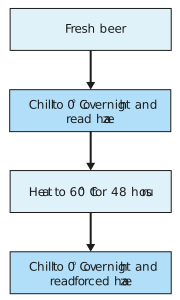
Figure: EBC accelerated test cycle
The ASBC formalise this exercise based on a 12 week shelf-life.
-
Normal shelf-life (NSL) tested beers are stored at 22 ºC for eight weeks whereupon a subset of the sample is cooled at 0 ºC overnight, and the haze recorded. This is repeated from week eight until week 12.
-
Accelerated shelf-life (ASL) tested beers are stored at a specified temperature (40, 50 or 60 °C) for seven days, chilled to 0 °C for 24 hours and the haze read. The ASL temperature most closely corresponding to the NSL 12 week haze is chosen as the ASL standard.
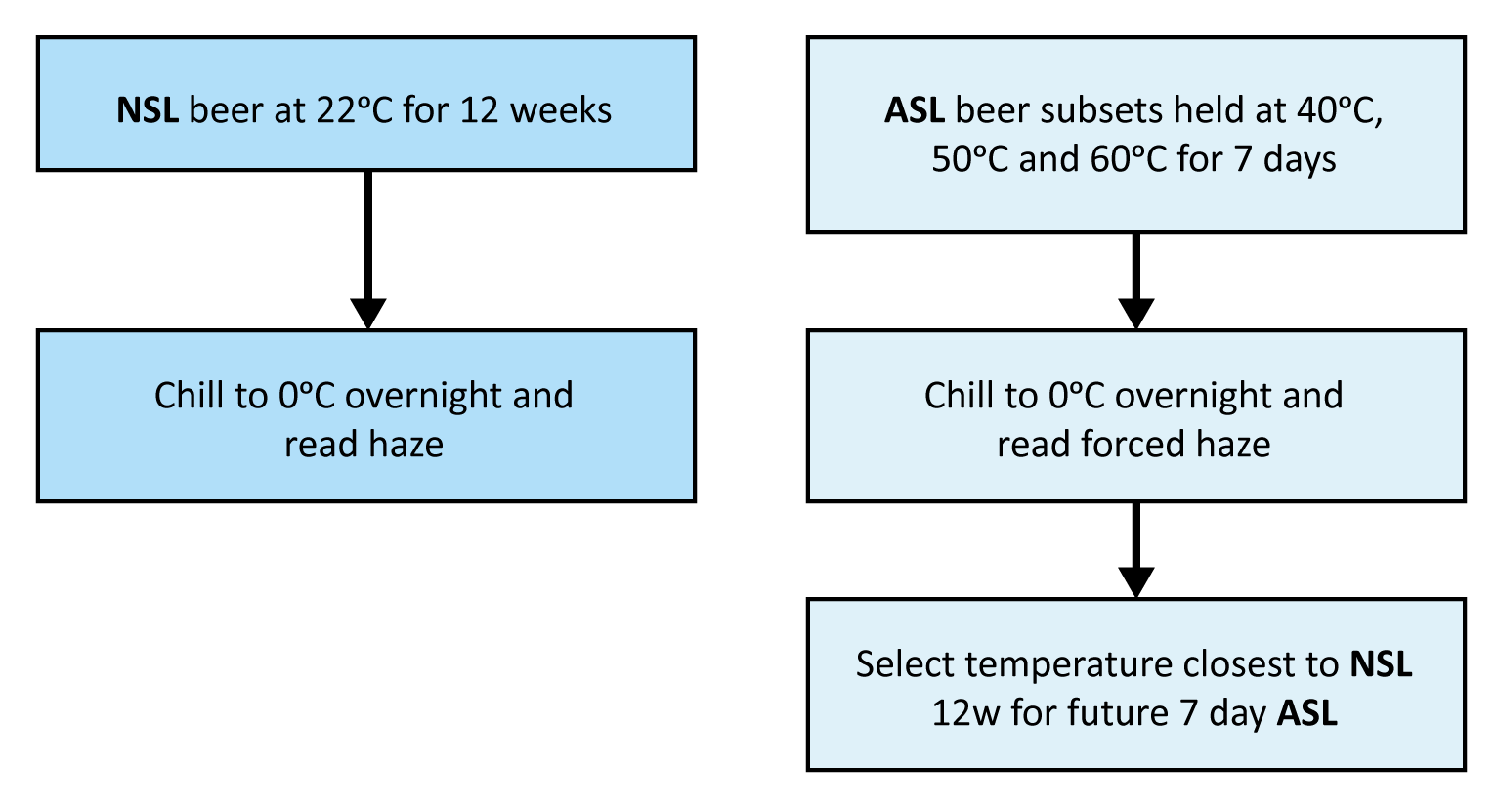
Figure: ASBC forcing test cycle determination
These tests have been criticised for being inaccurate and not reflecting reasonable conditions of beer handling, e.g. 60 ºC. For this reason, brewing companies tend to develop their own systems, often using Arrhenius’ equation that implies a 10 ºC rise in temperature doubles the reaction rate. Thus, storing a beer at 30 ºC for two weeks should equate to storing a beer at 20 ºC for four weeks.
Precipitation tests give a measure of the instability caused by either protein or polyphenol. Due to the variable composition of beer, these tests do not give an accurate prediction of shelf-life; however, they are useful in comparing beers within brewing companies. Many of these tests build on the work of Chapon and his group at the University of Nancy, in France.
Chapon reviewed a 30 year period of his work in an historical paper that is worth a read.
https://onlinelibrary.wiley.com/doi/epdf/10.1002/j.2050-0416.1993.tb01146.x
Next, we will briefly look at the common precipitation tests in use.