
Lesson 4 - Beer Haze
In this lesson we will discuss beer haze. This will include defining the biological and non-biological (protein-polyphenol) haze types and their formation. We will also identify other hazes that can occur in beer. We will consider the influence of raw materials and discuss processing. To end the lesson, we look at how haze is measured and how we can use accelerated shelf-life testing to predict colloidal stability.
Haze Measurement
We have read a great deal about haze formation in beer, but how do we quantify this? Visually, beer is deemed unacceptable long before sufficient haze particles can be collected and analysed.
Brewers use the principle of light scattering to measure haze, called nephelometry. When illuminated by a light source, haze particles in a beer scatter light. By measuring the intensity of scattered light at a specific angle to the incident light against a direct beam light, we can quantify the haze.
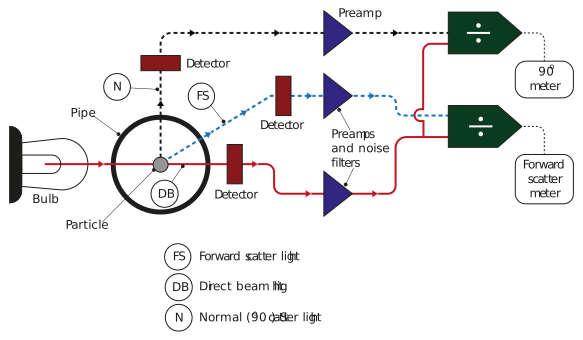
Figure: Principle of 90° and forward scatter nephelometry
The different analytical bodies use different scales as shown in the figure below.
Table: Haze descriptions and corresponding haze measurement
|
Description |
EBC |
ASBC |
|
Bright |
0-0.5 |
0.0-34.5 |
|
Almost bright |
0.5-1.0 |
34.5-69 |
|
Very slightly hazy |
1.0-2.0 |
69-138 |
|
Slightly hazy |
2.0-4.0 |
138-276 |
|
Hazy |
4.0-8.0 |
276-552 |
|
Very hazy |
> 8.0 |
> 552 |
A stable formazin standard defines both sets of units. However, the standard solutions are prepared differently, and the formazin standard used for calibration has particle sizes on average of 2.1 µm, leading to overestimation of suspended particles < 0.5 µm. We will discuss under the invisible haze section.
Comparison between methodologies is further complicated by method specification:
-
EBC and MEBAK specify 650+/-30 nm
-
ASBC specify 580 nm
As a consequence, the available instruments are not always comparable. Most measure 90º scattered light, but some measure 11, 13 or 25 degrees forward scatter.
The 90º is good at measuring small haze particles and the 11, 13 and 25 degree good for larger particles, for example, yeast cells, diatomaceous earth and calcium oxalate crystals.
In most cases, the 90° reading will correlate well with the observed lack of clarity in the sample. An exception occurs with the invisible hazes, which appear visually bright but give high 90° readings due to very small particles of < 0.1 µm.
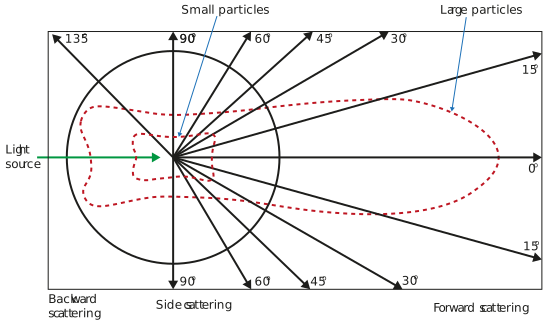
Figure: Light scattering and particle size
Modern haze meters can optionally modify light wavelength through a change of filters. They automatically rotate samples to take multiple readings, which are then displayed on the digital readout of the meter. Best of all is that tests can be done in bottle, and different bottle colours and sizes can be calibrated. Reading a beer haze is a quick and easy process, making quality control of haze a simple task.