
Lesson 8 - Clarification – Filtration
This lesson discusses the process of beer clarification via filtration. The filtration process primarily removes suspended particles from the matured beer to produce a clear stabilised beer that is ready for packaging. This lesson also discusses the importance of this process, the different filtration technologies available to the brewer, and the impact of filtration on final beer quality.
Bright Beer Handling
As a brewer, you have taken great care to filter your beer and achieve the best quality product ready for packaging. So, what could go wrong from here? Well, actually… quite a lot!
As this stage, the beer is very susceptible to oxidation and microbiological contamination. We must put measures in place to protect the beer’s integrity before packaging.
A bright beer tank (BBT) or a final product tank (FPT) is a dish-bottomed or cylindro-conical vessel, pressure-rated, temperature-controlled tank used to hold beer in preparation for packaging. The term “bright” refers to “bright beer,” or beer that has been rendered bright (clear) by filtration, centrifugation, fining, and/or maturation. In most breweries, beer will have been filtered after leaving a unitank or maturation vessel. It will then have been directed into a bright tank. In the case of a beer that is not being filtered, the tank may be regarded as a FPT, as the beer is not bright.
Let us list the essential features of a bright beer tank (or final product tank):
-
Capacity. The BBT/FPT must be sized to hold and process enough product to meet the demands of the brewery, especially during peak production periods. A bright beer vessel is normally designed with a 5% headspace.
-
Cleaning and sanitation. Vessels and process equipment must be designed to allow effective cleaning to remove organic soiling and sterilisation to remove any microbial activity.
-
Process control. Vessels and process equipment must have appropriate ancillary equipment to allow temperature and pressure control, and appropriate gas supply. There should be in-line analytical equipment such as oxygen, carbon dioxide, and gravity measurement, to monitor quality analysis whilst filling the vessels.
-
Flavour control. To control adverse flavour development, there must be controls in place to reduce the risk of oxygen and eliminate microbial contamination during filling, emptying, and ingredient addition (if applicable).
-
Temperature control. It is essential to maintain temperatures no greater than 2ºC to ensure smooth filling with no CO2 breakout and overfobbing leading to overfilled containers and beer loss. Cold temperatures also discourage microorganism growth.
-
Quality analysis. A sampling point is necessary to take frequent samples for analytical and microbial analysis to ensure that the ageing and finishing processes are in control.
-
Oxygen control. Oxygen pick-up is a major concern in the final stages of transferring the finished beer to packaging. It is important to minimise oxygen pick-up during transfer from tank-to-tank, through pipework, or through hose. It is difficult to correct a package release tank that has a high concentration of dissolved oxygen. Elevated oxygen leads to staling flavours. It will negatively impact the ‘fresh’ character a brewer works hard to achieve. To minimise oxygen pick-up, vessels should be purged and blanketed with CO2 to displace any oxygen. Similarly, pipework and hoses should be purged with deaerated water, or even CO2, to displace air.
-
Pressurised vessel. The BBT or FPT should be a pressure vessel and filled under a back pressure of approximately 1 bar to ensure the CO2 or N2 stays in solution. Using a slow fill rate such as 1.5 m/s at start of fill helps to minimise fountaining and in addition, a back pressure is applied to retain CO2 in solution, which would otherwise create fob and loss of dissolved gas. Collapsed foam (fob that has re-dissolved in the finished beer) can create haze; this should be avoided at all costs.
When brewing beer in batches, a BBT/FPT receives and stores the final beer for a settling period prior to being transferred to packaging. These tanks are filled one at a time or in a series simultaneously. In-line instrumentation can be used to measure key quality parameters. When full, the tanks are quality and sensory assessed before being released for packaging.
Dynamic or continuous BBT/FPTs have a slightly different function. They may be filled from the filter whilst being emptied to packaging at the same time. The buffer capacity allows a continuous operation of the filler in the event of a filtration stoppage. It is paramount to have in-line instrumentation when using dynamic vessels as these monitor the process closely. Any issues must be detected immediately before the beer is filled into final package. Quality assurance teams will sometimes carry out correlation tests to verify instrumentation accuracy. Sensory samples are also taken frequently to ensure that the product is true to type, and also to detect any issues early.
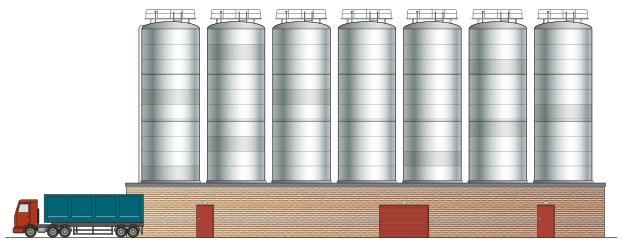
Figure: Bright beer tanks may be positioned outside
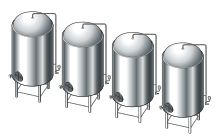
Figure: Bright beer tanks may be positioned inside and used to serve directly from in a brewpub
So, we are now in the final stages of the brewing process. Our beer meets all pre-determined packaging specifications and we want to maintain this during this final stage. Let us take a look at the critical process controls that will achieve the optimum quality beer, ready to be enjoyed by our consumer.
Table: Process parameters and control measures
|
Parameter |
Importance of Control |
| Minimise fountaining and fobbing during filling of tanks | Avoid producing fob during the filling of vessels. This will minimise the loss of foam positive proteins or collapsed foam, which may lead to hazy beer (due to dissolution of proteins from the foam into the beer). It also may lead to loss of CO2. Slow fill speeds at the start of transfer and maintaining consistent CO2 top pressures on vessels will aid this. |
| Minimise/eliminate oxygen ingress into the transfer line | Air must be evacuated from all transfer lines, hoses, filters, ancillary equipment, and vessels before product is introduced. This will avoid oxidation and the development of staling flavours in the beer. This is best achieved by filling lines with deaerated water and then displacing the water to drain with the beer. Another factor is to ensure BBT/FPTs are not drawn 100% empty as this risks cavitation of the pump and lack of pulling power from the next queued tank. An appropriately positioned low level probe can control this and when uncovered, it causes the beer transfer from that vessel to cease. |
| No deterioration in microbiological quality | The presence of any bacteria or wild yeast in the vessel is totally undesirable. The presence of micro-organisms will encourage off-flavours in the beer. Effective CIP protocols should be put in place and the required frequency of cleans should be strictly adhered to. |
| Minimise temperature pick-up | Warm beer can cause gushing or fobbing at the filler. BBT/FPTs should be well-insulated. The temperature should be kept below 2°C at all times. |
| Minimise residence/ holding time in BBT | We should hold beer in BBT/FPT for as little time as possible. Extended times can lead to microbiological instability and potentially lead to colloidal instability if any foam created during filling dissolves back into the beer. |
| Maximise right-first-time controls | Correction of any out of specification parameter results in splitting tanks or topping up. Both of these practices should be avoided as they are time consuming and may have negative quality implications, for example, increasing the chances of microbiological contamination. |
The key quality parameters that are deemed critical to the successful management of bright beer handling are:
-
Taste – the beer must be true to type
-
Dissolved oxygen – high oxygen levels can cause oxidation
-
Chill haze – high hazes are unacceptable unless the product has not been filtered
-
Alcohol level – alcohol levels must comply with consumer legislation requirements
-
Original extract and real extract – extract levels must comply with consumer legislation requirements
-
pH – low or high values may indicate CIP acid or caustic contamination
-
Colour – must reflect the brand and not be too light or dark
-
CO2 or N2 – must represent the brand; under- or over-carbonation is unacceptable and will cause issues in packaging