
Lesson 8 - Clarification – Filtration
This lesson discusses the process of beer clarification via filtration. The filtration process primarily removes suspended particles from the matured beer to produce a clear stabilised beer that is ready for packaging. This lesson also discusses the importance of this process, the different filtration technologies available to the brewer, and the impact of filtration on final beer quality.
Overview of Depth Filtration
Depth filtration is achieved by building a filter bed using different grades of powder. This creates a filter bed that traps solid particles.
The filter screen or septum can either be a mesh stainless steel screen, a cellulose sheet hung over the plates or a wedge wire candle, and is normally pre-coated with a filter aid in advance of the beer filtration run. This precoat forms the base layer for the bed.
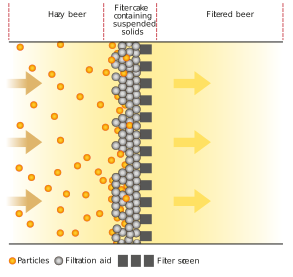
Figure: A filter bed
The rough beer (also known as green beer) to be filtered is dosed with more filter aid, called body feed, at a concentration determined by the solids content to be removed. As beer is run through the filter, the bed’s thickness increases due to the build-up of the body feed being constantly fed onto the filter.
Various grades of powders are used, depending on the filtration performance desired and the beer to be filtered. To clarify this further, if filtering a beer with heavy solid particle loading, a brewer may use a coarser filter powder and high dose rate to capture the large volumes of solids. Conversely, for a beer with a low solid content, a brewer may choose to use a finer filter powder at a lower dose rate. This will remove finer or a smaller volume of solids.
Pre-coat: this forms the base of a filter bed against the filter screen. It is also referred to as a support medium with a coarse filter aid grading.
Body-feed: beer is dosed with the body feed filter aid during the filtration run. This traps yeast and solids particles, which are then all held back by the precoat. The filter does not ‘blind’ because the body feed continually creates a new filter bed.
We have mentioned filter powders a great deal so far. However, what are filter powders and how do we use them?