
Lesson 8 - Clarification – Filtration
This lesson discusses the process of beer clarification via filtration. The filtration process primarily removes suspended particles from the matured beer to produce a clear stabilised beer that is ready for packaging. This lesson also discusses the importance of this process, the different filtration technologies available to the brewer, and the impact of filtration on final beer quality.
Differential Pressure (∆P)
Differential pressure refers to the difference in pressure between two points in a system.
The following clip explains the principle of ∆P and pressure measurement:
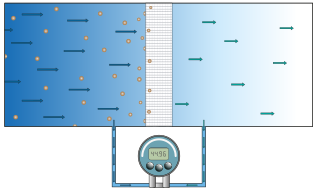
Figure: ∆P and Pressure Measurement
Note, this is for illustrative purposes only and is not a recommendation or endorsement of a particular supplier’s product.
Filters are operated until the differential pressure rises beyond a designated point. This usually occurs at the point where the filter bed depth reaches a thickness that bridges the spaces between the septum in the filter, resulting in a reduced flowrate.
Filter systems are designed to function within a specific range of pressures. An excessive differential pressure can cause:
-
Solids to break through the filter bed. These solids can contaminate the clear filtrate and result in a final product that contains haze levels that are out of specification.
-
Damage to the septa or filter screen. The excess pressure could damage the filter plates, which might then need to be replaced. This is an expensive mistake that should be avoided at all costs!
-
The transfer pumps to fail. If the differential pressure is high, the pumps may not be sized appropriately to operate and process the increased energy needed to maintain the flow rate.
The relationship between filter operational parameters is shown below:

∆P is the differential pressure
V is the beer flow rate
µ is the beer viscosity
L is the bed depth
β is the bed permeability
How do these variables affect a filter run? Firstly, all the variables above the line increase ∆P and the one below it (bed permeability) reduces it. Most filters are run at a constant flow rate (V) because time is money and we need to keep up with demand from packaging lines and ultimately our consumers. The amount of solids in the beer does not substantially affect its viscosity (µ) so again this is fixed. The permeability (β) of filters declines as solids block or foul the filter so permeability decreases and ∆P increases throughout a filter run.
With diatomaceous earth (DE) filters, by dosing in body feed DE we can delay the decline in permeability. However, in doing so we gradually increase the bed depth (L) which slightly but not substantially reduces the benefit. Dosing extra DE does not create new pores in the filter so eventually all routes that the beer can take are blocked. The rate increase in ∆P during a DE filter run is slow to begin with, (due to the body feed delaying the drop in permeability), with the rate of increase accelerating towards the end. This results in a pressure curve as shown in the figure below:
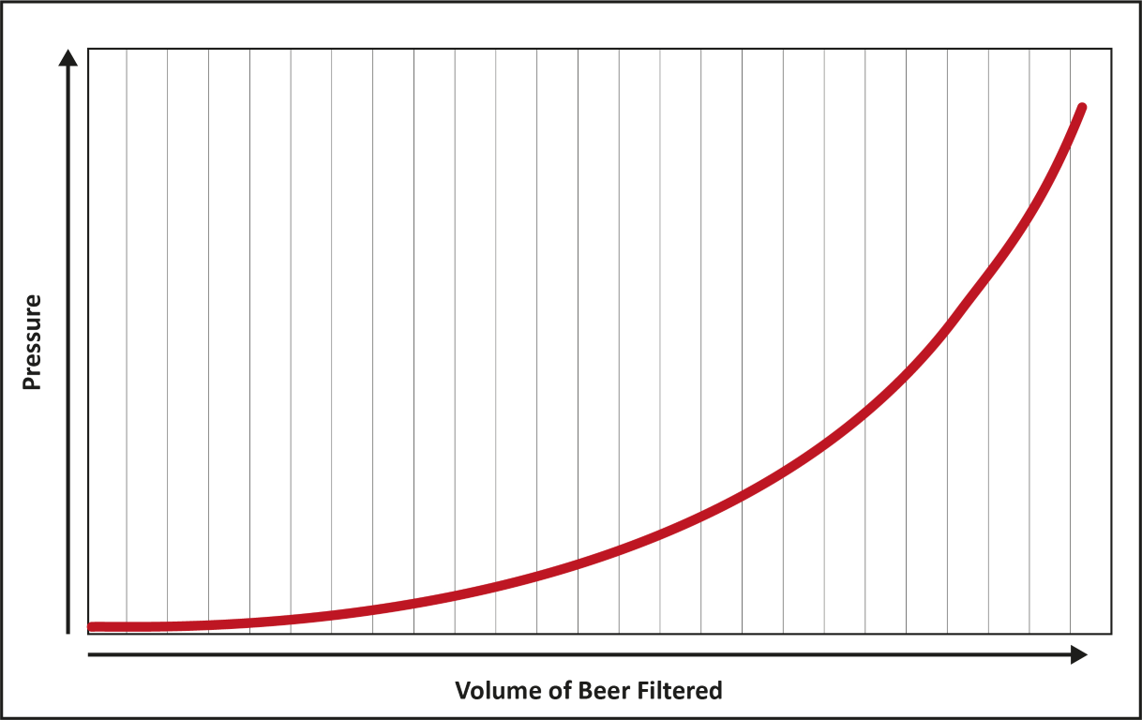
Figure: Differential pressure across a DE filter run
Filter runs are stopped when the differential pressure reaches the limit set to protect the equipment and avoid breakthrough of solids.
With cross-flow filtration, flow rate (V) is constant, the bed depth (L) is fixed, and the viscosity changes very little. ∆P therefore increases in proportion with the reduction in permeability (β). The washing action of the tangential flow of the beer along the septum slows the rate at which it is blocked or fouled by solids and its permeability is reduced. Although the rate of fouling is slowed, permeability does decline throughout the run and as a result ∆P increases to a point where the filter needs to be backflushed or cleaned in place to remove the solids fouling the filter septum. The effect of the tangential flow makes the increase in ∆P more linear than is the case of DE filtration and allows a much higher volume of beer to be filtered before blocking than with sieve filtration. Cross-flow filters tend to be fouled by material with a high affinity for their septa rather than by sheer weight of solids.