
Lesson 8 - Clarification – Filtration
This lesson discusses the process of beer clarification via filtration. The filtration process primarily removes suspended particles from the matured beer to produce a clear stabilised beer that is ready for packaging. This lesson also discusses the importance of this process, the different filtration technologies available to the brewer, and the impact of filtration on final beer quality.
Depth Filtration Technology
Depth filtration includes most of the more traditional filters used in brewing. The technology within them, however, has improved significantly.
Plate and frame filters
This filter consists of vertical plates covered with a filter cloth or pad. Adjacent to the plates are hollow frames that contain the filter aid. These alternate the entire length of the filter and terminate at end plates.
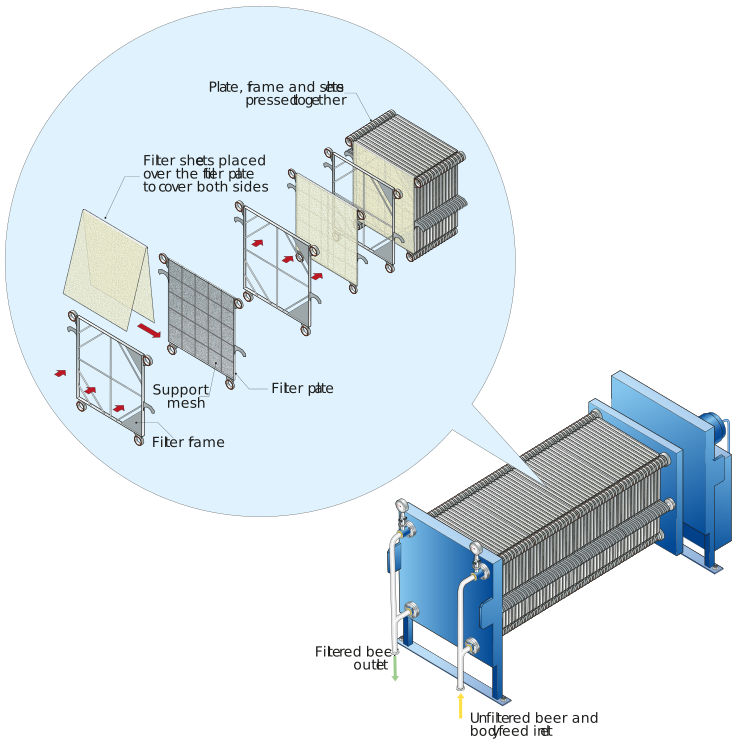
Figure: Plate and frame filter
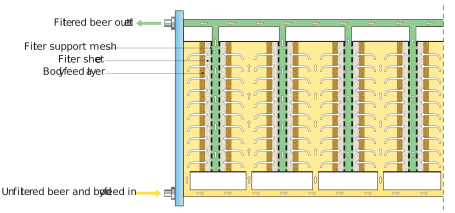
Figure: Plate and frame operation
Beer and filter aid are fed into the frames, where DE then traps solids on the filter cloth. Clear beer flows into the adjacent hollow plates and out of the filter through collection tubes. Once the bed permeability of the filter becomes unsatisfactory, the filter run stops, the filter is opened, and the spent DE is washed off with low pressure water and discharged for removal. If in a satisfactory condition, the filter pads may be re-used. The filter is then closed up, flushed with cold process water, sterilised and then flushed with deaerated water prior to the next filtration run.
Sheet filter
With an appearance similar to the plate and frame filter, the sheet filter uses compressed cellulose pads filled with DE. There are no open frames, but rather two sets of channelled plates. Turbid beer flows in on one side of the pad, and clear filtered beer exits on the other. Sheet filters have less surface area than other powder filters. They are mainly used as secondary or polishing filters to remove any finer particles and even micro-organisms after primary filtration. Sheet filters are easy to use, but filtering hazy beer can be slow, and it requires frequent backflushing. This is why sheet filters tend to be more popular today with small-batch breweries rather than with larger ones.
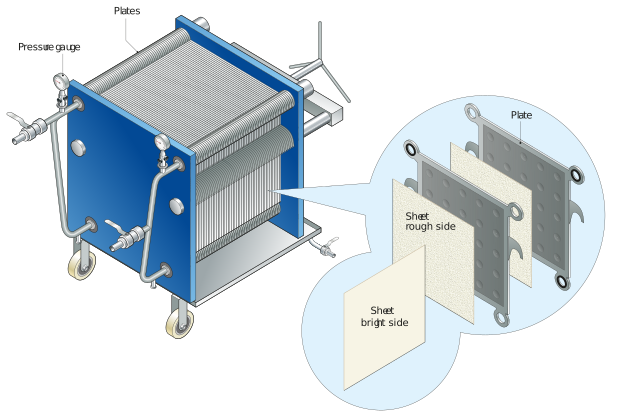
Figure: Sheet filter
Leaf filter
Leaf filters use hollow mesh screens (leaves) mounted horizontally or vertically along a central shaft, housed inside a cylindrical vessel.
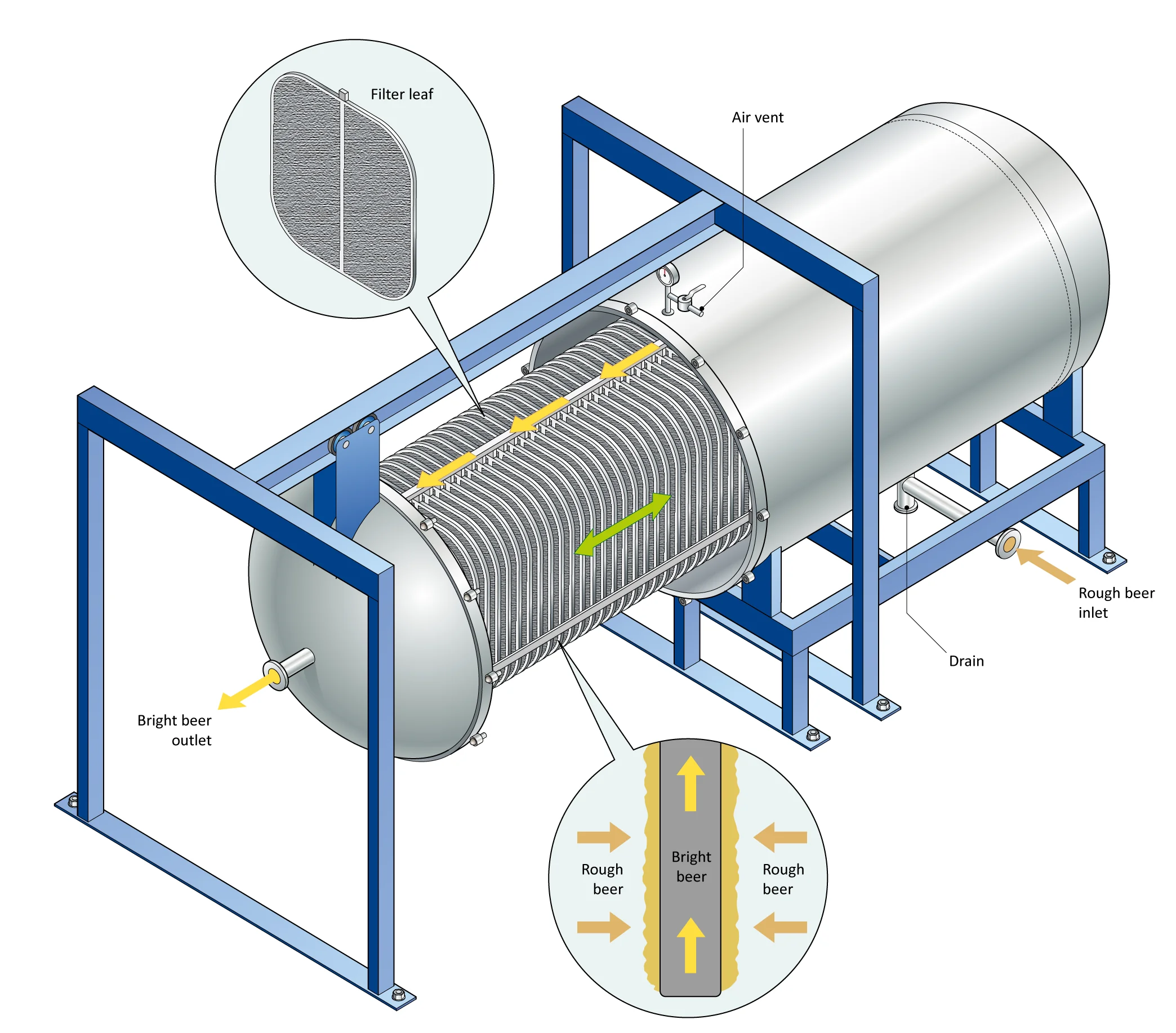
Figure: Vertical leaf filter
The leaves in the horizontal filters have a stainless-steel woven septum that supports the bed whilst the vertical filters have a septum on both sides.
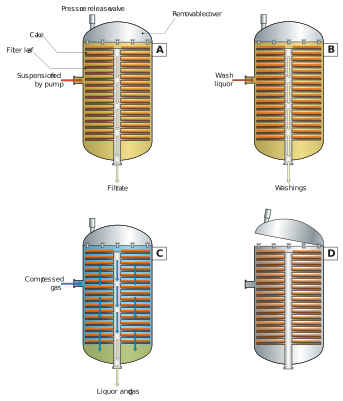
Figure: Horizontal leaf filter arrangement showing a) production mode b) flush-out mode c) filter CIP mode d) opening filter
During pre-coating, a mixture of beer (or water) and DE is pumped into the vessel and recirculated until all the DE is trapped on the screens and the liquid is clear. The water is blown out using CO2 pressure and then the beer is introduced. The nominal filtration range for screen filters is 3-5 μm, which can trap most large particles including yeast (shown in figure a above).
Filtration continues until the ∆P reaches 4 bar, at which point the bed will be ‘spun off’ (shown in figure b above and in the figure below). This involves emptying the filter housing, releasing the pressure, and then spinning the central shaft to which the plates are attached at high speed.
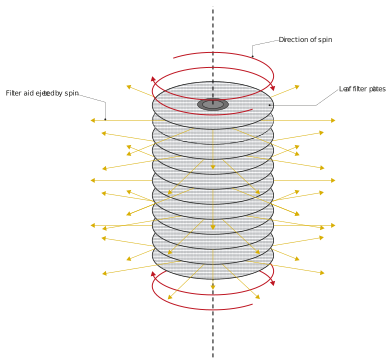
Figure: Horizontal leaf filter spinning off the DE bed
This centrifugal force spins the spent DE off the plates. The spent DE is then discharged at the base of the filter. The filter is purged with air before water jets displace the filter bed from the rotating plates, through a series of wash-offs and spins. It is then sanitised for the next filter run (as shown in figure c). The filter can be periodically opened for inspection or maintenance, as illustrated above in figure d).
A horizontal filter can also be used for PVPP dosing. You can read more about this in the Process Aids and Additions lesson, which describes the function and dosing of PVPP post primary filtration, in order to increase product and shelf-life stability. It operates in a similar way to the DE leaf filter but is positioned after the main beer filter.
Candle Filter
Candle filters have a completely different design yet their filtration principle is the same. The name comes from the shape of the filter element, which is a long, thin cylinder resembling a candle. Candle filters are available in numerous sizes. The larger types may have an area of 200 m2 and contain 250 or more filtering elements installed in a 2.5 to 3.0 m diameter vessel. The candles are mounted inside a cylindrical pressure vessel that receives unfiltered beer. The candle itself is the septum that holds the DE during the solid–liquid separation. The candles themselves do not perform any filtration. The filter aid that coats the candle performs the actual filtration. The filtration tubes can be porous ceramic, but they are usually perforated or fluted, stainless-steel tubes covered or surrounded by a stainless-steel support of various types.
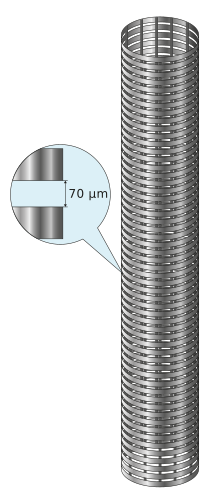
Figure: A spiral wound candle
Its cylindrical design means that the bed thickness increases less during operation than with other filters. The pressure drop increase also occurs at a slower rate.
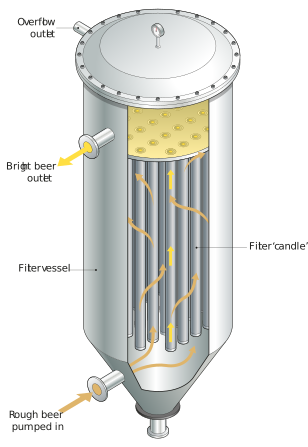
Figure: Beer flow in a candle filter
Unfiltered beer passes from the outside of the candle, through the filter cake, and into the centre of the candle. The beer (which is now filtered) passes up through a mounting plate or manifold holding the candles, and out of the filter housing. Most candles are mounted to the top of the filter housing, but some models have a bottom-mounted candle. When the DP reaches 6 bar, the filter cake must be removed and discharged. At this point, the pressure in the filter housing is released, the cake outlet is opened, and the candle stack is backwashed with water to discharge the cake.
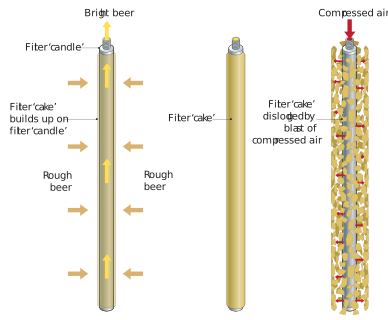
Figure: Filter cake formation and removal on a filter ‘candle’