
Lesson 8 - Clarification – Filtration
This lesson discusses the process of beer clarification via filtration. The filtration process primarily removes suspended particles from the matured beer to produce a clear stabilised beer that is ready for packaging. This lesson also discusses the importance of this process, the different filtration technologies available to the brewer, and the impact of filtration on final beer quality.
Filtration Mechanism
In brewing terms, filtration is simply the separation of solids (e.g. haze forming particles) from liquid (e.g. beer). We can use different mechanisms to achieve this, including the following:
-
Depth filtration – uses a porous filtration medium to retain particles throughout the medium, rather than just on its surface or filter. The beer has to flow through a convoluted labyrinth of channels in the filter media, which trap particles, typically using DE, perlite, or other porous media. Depth filtration is often considered rough or primary filtration. However, in many small breweries, this is the only filtration performed. Examples of filters using this filtration mechanism includes plate and frame, screen, and candle. We will look at each of these later in this lesson.
-
Surface filtration – uses a thin film material with pores that are smaller than the particles to be removed. Particles remain on the surface of the filter while clarified beer flows through the filter. If the pores are of a defined size (for instance, up to 5 μm), filtration is said to be “absolute” to the pore size. Examples include membrane filters and cross-flow filtration. Again, we will look at each of these individually, later in the lesson.
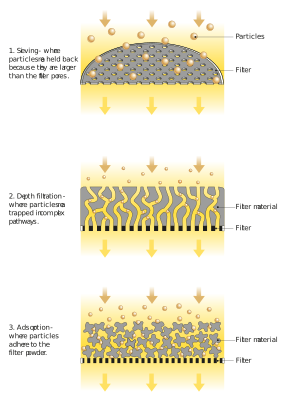
Figure: The filtration mechanism
- Adsorption – is where a thin layer of molecules adheres to the surfaces of liquids or solids that it comes into contact with. As an example, activated charcoal filters clean water through adsorption.
Let us take a deeper look at depth filtration and consider how we use filter powders to create the filter bed.