
Lesson 8 - Clarification – Filtration
This lesson discusses the process of beer clarification via filtration. The filtration process primarily removes suspended particles from the matured beer to produce a clear stabilised beer that is ready for packaging. This lesson also discusses the importance of this process, the different filtration technologies available to the brewer, and the impact of filtration on final beer quality.
Surface Filtration Technology
Cross-flow filtration
Cross-flow filtration rapidly pumps liquid across the filter surface, which is usually constructed of polyether sulfone (PES) or ceramic (typically aluminium oxide).
Tubes are bundled together inside a cylinder, also known as a cassette. Each cross-flow filtration system consists of multiple cassettes connected in series. This is also known as beer membrane filtration (BMF) technology.
It is still a relatively new technology; there are currently a limited number of cross-flow filter suppliers, all of whom have their own individual designs. The designs are expected to continue to evolve and become more operationally efficient and cost effective through improved filter run lengths and utility usage, e.g. water and energy usage.
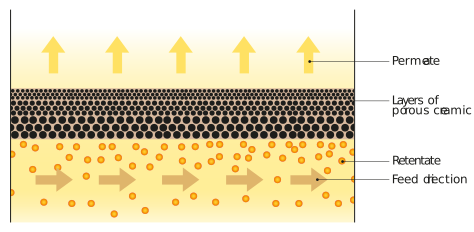
Figure: Ceramic micro-filtration
Cross-flow filtration uses, rather unsurprisingly, flow across surface of the filter rather than straight through it. Therefore, solid particles do not build up on the filter as they are constantly removed by the flowing retentate (beer containing the solid haze material), as shown in the figure below. The permeate, e.g. the filtrate, is then allowed to freely pass through the filter.
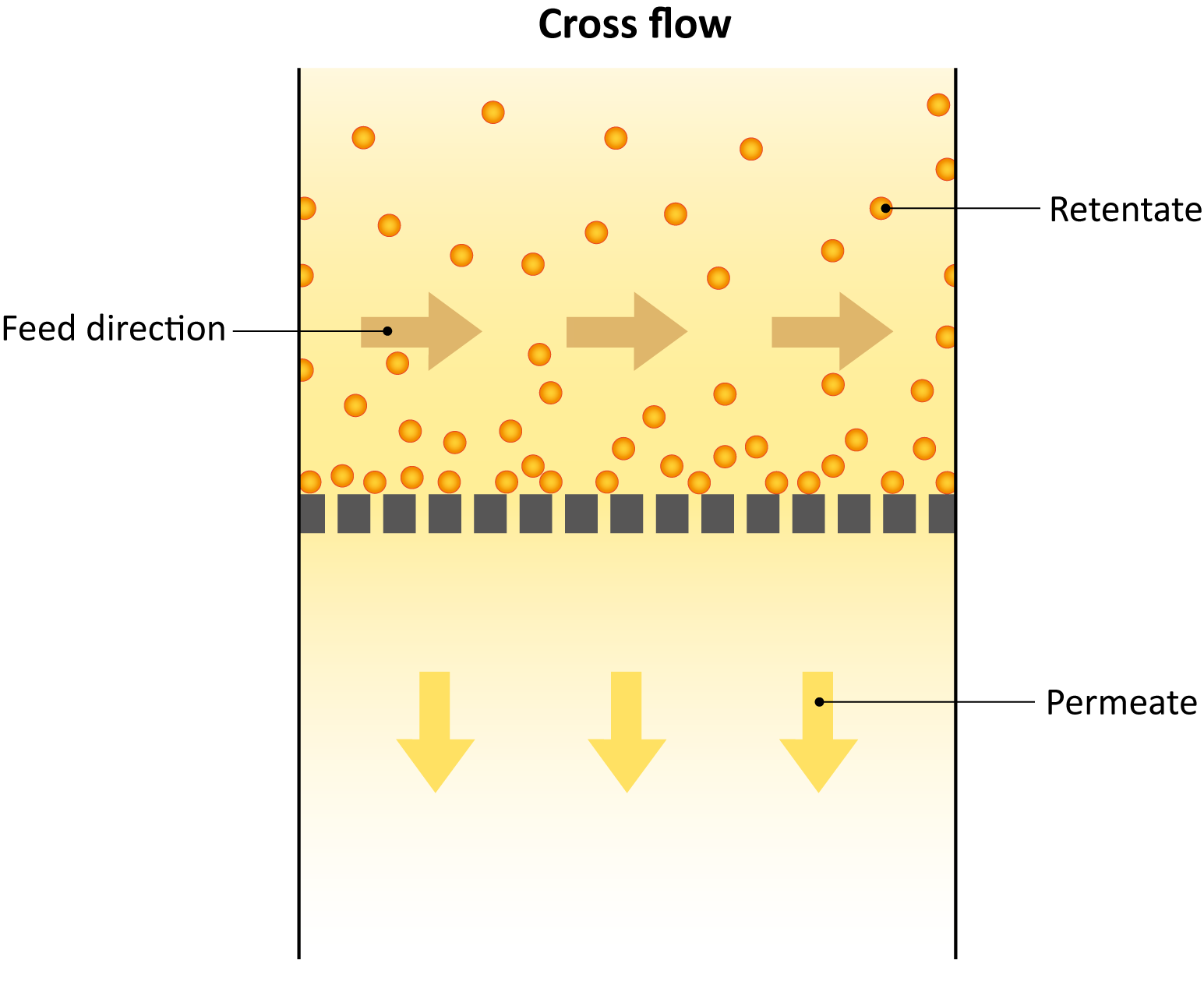
Figure: Principle of cross-flow filtration
Let us compare this to the DE filtration shown in the figure below and look at the main differences in their principles of operation. By using the cross-flow methodology, the overall impact on flow rate and filtration duration is substantially different. It can be more cost effective due to longer filter run lengths, fewer stoppages, slower differential pressure increase, and no requirement to wash off the filter bed.
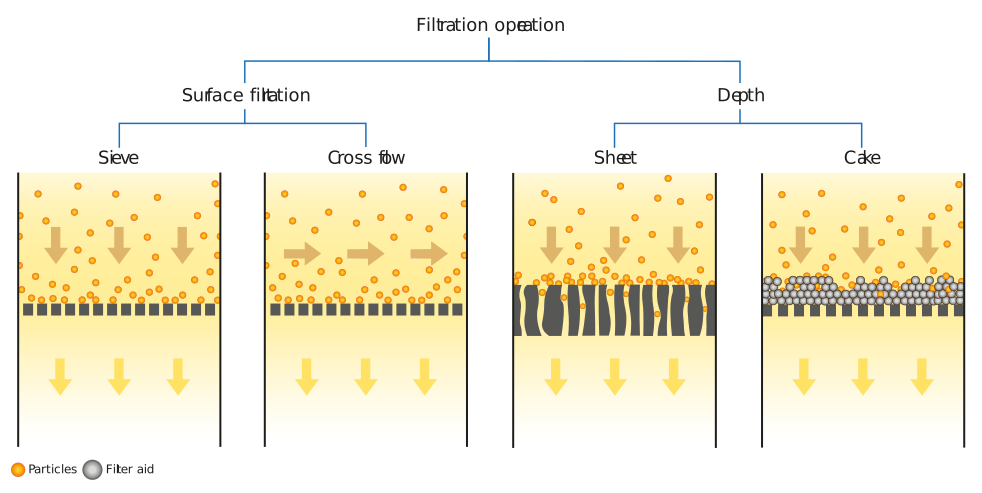
Diagram: Comparison of cross-flow vs dead end filtration
Some larger brewers are purposefully moving away from DE filtration as the basis for beer filtration. This is for sustainability, quality, safety, and corporate image reasons. This particularly applies to isolated areas of the world where spent DE costs are high.
There are some major benefits to cross-flow filtration. These include:
-
Lower operating expenditure, as there is no need for DE.
-
Lower beer losses, as there is no residual beer in the spent DE at the end of filtration. As a result, there are no spent DE disposal costs.
-
No requirement for DE storage, handling, or logistics.
-
Very little operator intervention is required – this is ‘black box’ technology. In other words, this is controlled effectively by automation.
-
A sustainable method of filtration – it uses less water, has a smaller carbon footprint, and no process aids are required.
-
No disposal problems of what is often considered hazardous waste (kieselguhr).
-
No safety issues associated with handling dry kieselguhr and other fine particulate filter aids.
You can read more about cross-flow filtration here:
Pentair - Cross-flow filtration technology
GEA - Ceramic beer membrane filtration
Note, this is for illustrative purposes only and is not a recommendation or endorsement of a particular supplier’s product.
Sterile filtration
Sterile filtration can be defined as an operation that produces beer that does not need subsequent pasteurisation. It does not mean the beer is sterile!
The process removes sufficient product spoilage organisms from the beer to ensure that for at least the stated shelf-life of the product, insufficient microbiological growth can take place for microbiological spoilage to occur.
Some argue that several filter types are suitable for sterile filtration. These include the sheet, membrane, lenticular, and ceramic candle filters. Some of these are nominal rated filters, which means that some particles larger than the pore size rating pass through during a filter run. As they can let spoilage organisms through, it is not accurate to classify them as sterile.
Absolute filters provide much more microbiological protection than nominal rated filters. Absolute rated filters remove 100% of solid particles greater than the stated micron size. As standard beer spoilage organisms are larger than 0.45 µm, an absolute rated 0.45 µm filter removes all beer spoilage organisms. Absolute rated filters are expensive, but when used and operated correctly, they guarantee beer microbiological stability. PES pleated membrane filters are absolute rated and are the most common type of sterile filter.
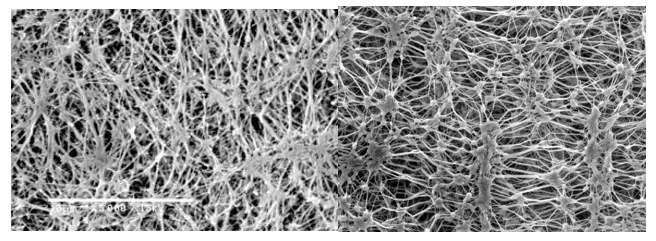
Figure: A filter matrix and its pores that trap solid particles or bacteria
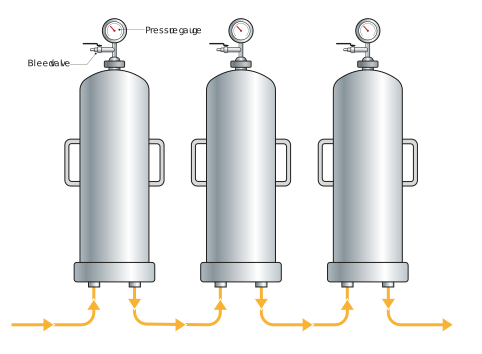
Figure: Sterile filter set up (the last filter in the series is the sterile filter)
Sterile filters must be preceded by at least one other filter that can remove all the colloidal load (including process aids, yeast, and haze forming units). Typically, the bulk of suspended particles is removed with a DE filter, followed by a trap filter that removes residual material sufficiently to reach the target haze specification before the sterile filter.
Everything after the sterile filter must be hygienic to prevent contamination of the sterile filtered beer. Microbiological sampling must also be undertaken to confirm the absence of spoilage organisms. We must also perform integrity tests on the filters.
Integrity testing
These tests involve the use of an integrity tester which is dedicated to a particular filter housing or group of filter housings. A gas supply is connected to the tester. The tester is then connected to the inlet side of the housing, typically at the top, and the outlet side of the housing is opened to the atmosphere. Gas is introduced on the inlet side with careful monitoring by the integrity tester. Test resolution is typically at or less than 2 mbar to provide better accuracy.
Common integrity tests include bubble point and forward-flow pressure decay analysis.
Bubble point tests involve measuring the pressure that is required to overcome the resistance of the liquid (typically water) in the pores of the filter element. This pressure is a function of the size of the largest pore and it is known for a specific filter type. This test is qualitative rather than quantitative, but it indicates the size of the largest pores in the element. If the test indicates that the largest pore in the filter is bigger than the standard absolute pore size, then the filter element has failed and we should replace it. The figure below demonstrates the gas bubble that is produced as a result of the enlarged pore.
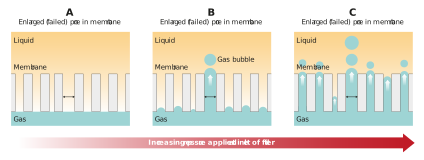
Figure: Progression of a bubble point test
In picture A it is obvious that one of the pores in the element is larger, which allows particles larger than absolute pore size to pass through the filter. In picture B, a gas bubble passes through the enlarged pore at a lower gas pressure than is typical. Gas on the liquid side of the element at this pressure indicates a failure. Picture C shows continued increased pressure which demonstrates how the gas would typically pass through all pores if they are at absolute filter size.
Pressure decay with forward-flow test involves pressurising the inlet side of a housing to a set pressure and adjusting the gas flow to maintain that pressure. With constant flow and pressure, the system is allowed to stabilise. This is followed by stopping the inlet gas flow and measuring the rate of pressure decay. The acceptable rate of decay is known for each particular housing and filter type. A faster rate of decay indicates that the total area of the pores is larger than it should be and, as with the bubble point test, the filter is proven to be damaged and should be replaced.
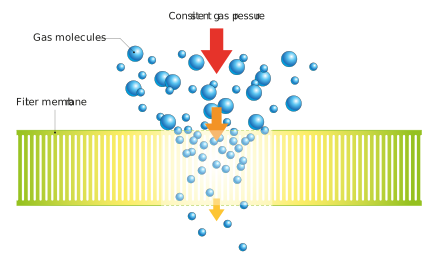
Figure: Pressure decay testing
You want to invest in a new filter plant to improve brewery capability, increase throughput, and improve product quality. Losses from the current plate and frame filter are high. What options should you consider? Summarise the benefits and considerations of DE vs surface filtration, taking into consideration operational needs and maintenance.
Give yourself 5-10 minutes to think about this, and then click ‘Next’ to continue with this lesson.