
Lesson 8 - Clarification – Filtration
This lesson discusses the process of beer clarification via filtration. The filtration process primarily removes suspended particles from the matured beer to produce a clear stabilised beer that is ready for packaging. This lesson also discusses the importance of this process, the different filtration technologies available to the brewer, and the impact of filtration on final beer quality.
Filter Powder
As we discovered in the previous lessons of this unit, green beer contains many suspended solids. Filter powder (or filter aids) helps to trap these solids on the filter and as a result, it enhances filtrate clarity. Many breweries employ this system to deliver beers with a packaging specification of < 0.5 EBC haze units. The most commonly used filter powder is diatomaceous earth (DE) which is also known as kieselguhr. Another common filter powder is perlite, which is derived from volcanic rock.
Kieselguhr
Kieselguhr is the fused skeletal remains of diatoms. So, are we really saying a brewer uses fossils to filter beer? Absolutely, yes, we are!
Diatomite is a sedimentary rock from the Miocene period. It contains skeletons of unicellular freshwater plant organisms that contain silica.
Chemically, the material is almost pure amorphous silica, unlike most fossil material, which is very high in calcium carbonate. The skeletons of these diatoms are only a few microns in diameter and are highly porous – they come in an amazing variety of shapes, as shown in the figure below:
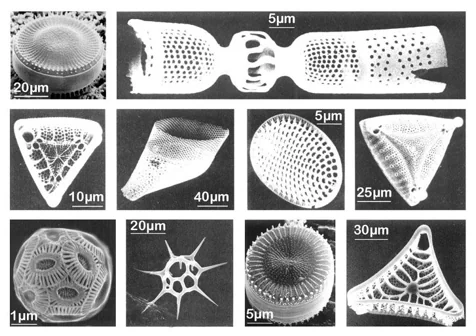
Figure: Diatoms
The raw earth is a soft, powdery, mineral-resembling chalk. It is ground, sterilised, and calcined at 300-1,000°C to destroy any traces of organic matter. This gives almost pure silica (> 85%) with traces of other minerals such as carbonates or clay. Despite this, the filter powder may contain low levels of iron that may get into the finished beer and negatively impact flavour stability.
The range of temperatures mentioned above covers three main groups of kieselguhr:
-
Natural – dried guhrs or fine guhrs (dried at 300°C)
-
Calcined – ignited and calcined guhrs or medium guhrs (dried between 600 and 800°C).
-
Flux-calcined – guhrs ignited with a flux additive (calcium carbonate) – also called coarse guhrs (heated to 1,000°C)
A packed bed of granulated kieselguhr has very high porosity. As little as 15% of the total volume of packed kieselguhr is solid, the rest is empty space. Such high porosity allows free flowing liquid around the particles, which improves the filtration rate.
There are numerous grades of kieselguhr, and they vary from fine to medium, to coarse. The finer the kieselguhr, the better the clarification. However, the filtration run is slower due to lower porosity. Conversely, coarser kieselguhr provides a more rapid filtration flow rate but poorer clarity due to a smaller surface area of diatoms with which to trap solid particles. Kieselguhr usage rates vary between 70-220 g/hL. These rates are determined by the solid loading onto the filter and the beer clarity of the final product.
We must make a balanced decision when deciding kieselguhr dosing rates. We want to achieve a desirable product haze value, yet also sustain an efficient filtration run length.
A high filter aid dose rate will shorten filter run lengths because the filter bed will increase in thickness at a faster rate and therefore become less permeable. This reduces the flow rate of the beer through the filter to an unacceptably low level, indicating the end of the filtration run.
A brewer should therefore minimise the solid particle loading from the maturation vessel onto the filter as much as possible. We can deliver lower loading onto the filter by ensuring effective removal of cold break, yeast, and tank bottoms from fermentation and maturation vessels.
Kieselguhr’s numerous pores trap and adsorb solid particles when beer is passed through the filter bed.
Perlite
Perlite is commonly used in conjunction with kieselguhr. It is a volcanic material that is composed of aluminium silicate. After mining, it is heated to 750°C, which causes the particles to burst and form glassy structures. These structures are then milled to form a fine powder that is approximately 30% lighter per unit than kieselguhr.
One limitation of using perlite in a low pH environment (< pH 5.0) is that it can release iron. Iron can give beer a metallic flavour and negatively impact its flavour stability. This may produce a noticeable taint in beers with delicate flavours, such as lagers or pilsners.
Using filter aids gives some major benefits to beer processing and quality. However, there are also some drawbacks:
-
Filter aids add to the cost of filtration. We must therefore experimentally establish the minimum quantity needed to achieve the desired result.
-
Kieselguhr absorbs liquid, therefore we must minimise this process loss and take it into consideration when sizing the filter aid addition plant.
-
It is costly to dispose of spent kieselguhr containing waste cell material as the biomass it contains cannot be used as animal feed. It must therefore be landfilled, which has a negative environmental impact.
-
Filter powders may be delivered to the brewery in sacks, requiring the operator to lift and move the bags to the point of use. Ideally, the powder should be delivered in bulk bags and handled with lifting gear.
-
Kieselguhr is unfortunately a health hazard to the person handling it. Precautions should be taken to avoid inhalation, such as installing a dust extraction system and by wearing an appropriate face mask. When the filter powder is handled, it can create a lot of dust. The abrasive nature of this powder means that inhaling this dust can damage the lungs. Intense, long-term exposure could lead to silicosis; certain grades of flux calcined material have been implicated as a cause of lung cancer.