
Lesson 2 - Wort Clarification Technology and Process Control
This lesson compares the design and operation of different wort clarification systems. It provides you with the information to help you justify why you would choose one method over another.
Kettle Whirlpool
We have already met the kettle whirlpool in the wort boiling lesson. They are as their name suggests, a kettle that also acts as a whirlpool.
Although you might find kettle whirlpools with internal coils and calandrias, kettle whirlpools that actually work have external calandrias or heating jackets. Anything fitted in the vessel (calandria, spreader etc.) breaks up the whirlpool vortex rendering it ineffective.
When an external calandria is used, the return of the wort to the kettle is via a tangential inlet usually above the surface of the wort. Kettle whirlpools have the following advantages:
- Reduces the number of brewhouse vessels required saving on capital cost, energy cost and enabling brewhouse to be housed in smaller building.
- Removes the time taken to transfer the wort from the kettle to the whirlpool.
- Prevents any damage to trub particles resulting from transfer from kettle to whirlpool.
- Can start boiling as soon as jackets or external wort boiler are covered.
Disadvantages include:
- Vessel is tied up from the start of wort separation to the end of casting out so brewhouse cycle time is longer than with dedicated kettle and whirlpool.
- Design is a compromise so both boiling and wort clarification may not be optimal.
Unless space is a problem, kettle whirlpools can almost be said to be solving a problem that doesn’t exist. Whirlpools are simple and relatively inexpensive vessels so their purchase cost can quickly be paid back by the extra brews that can be performed each day compared to the number possible with a kettle whirlpool.
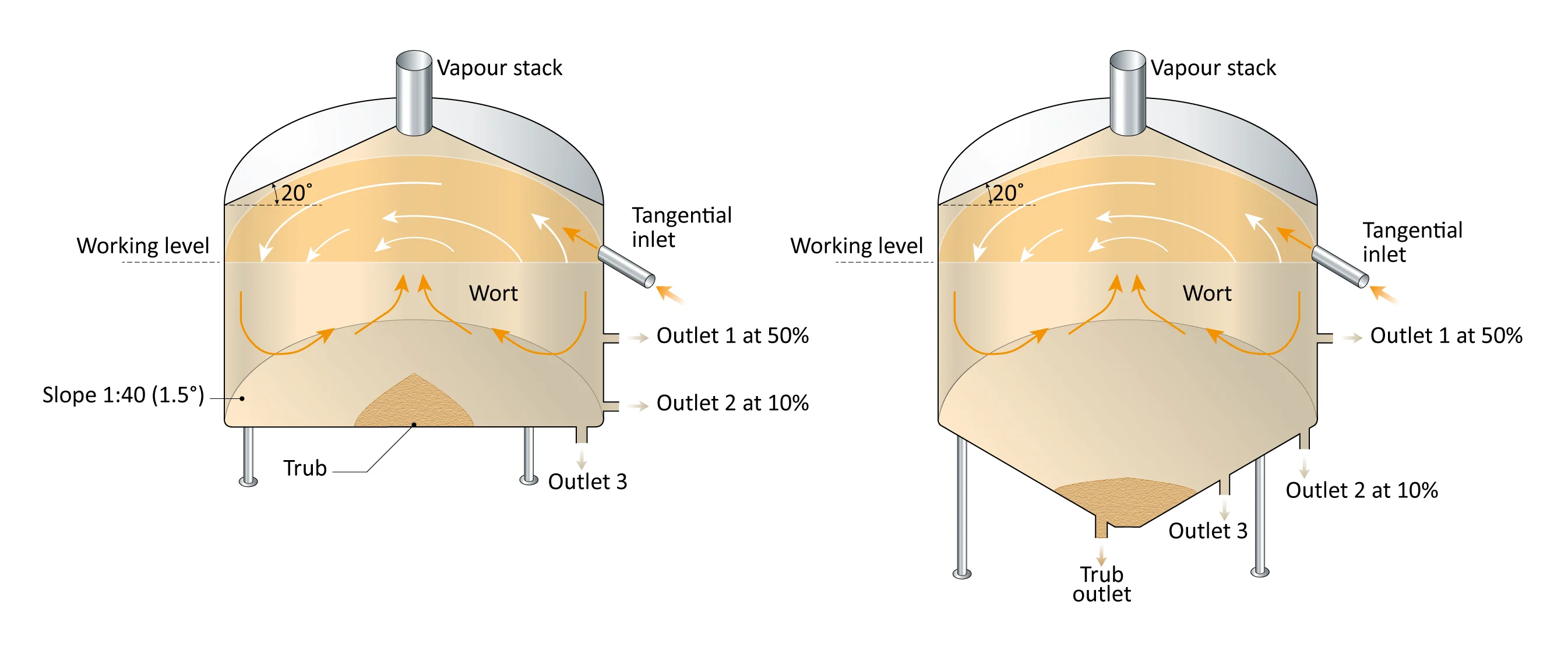
Figure: Kettle whirlpools
Historically filtration has been used to remove trub. Filters similar to those used in the depth filtration of beer, like leaf filters have been used. It is unlikely that any are in use today. They are very high maintenance and the wort produced is often too clear to give effective fermentations.
This leads us nicely on to trub processing and disposal next.