
Lesson 2 - Wort Clarification Technology and Process Control
This lesson compares the design and operation of different wort clarification systems. It provides you with the information to help you justify why you would choose one method over another.
Sedimentation Tank
Sedimentation tanks work on the principle that trub is denser than wort so sediments by gravity if given long enough. Settling is much slower than with a centrifuge or whirlpool.
Boiled wort is pumped directly to this vessel and allowed to settle. Wort depth in older designs was typically 1.0-1.5 m and it took around one hour for trub to fully settle. After approximately 40 mins, clarified wort was drawn off from a collection tube near the surface of the wort. The inlet of the tube was maintained just under the surface of the wort with a float. Once the level of trub had dropped low enough a lower outlet could be used.
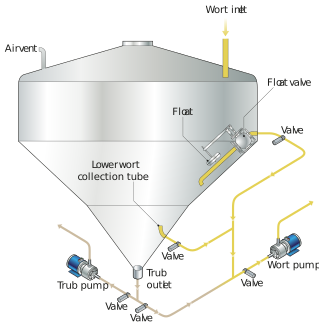
Figure: A sedimentation tank
The older sedimentation tanks were often used in conjunction with further processing equipment to collect the wort in the last of the trub. A decanter centrifuge would often be used. The residence time in sedimentation tanks is long so there is a greater risk of producing DMS and the thermal load on the wort is increased.
A modern version of the sedimentation tank is the Meura Clarisaver. It is designed to be used in combination with the Ecostripper so a longer residence time than encountered with a whirlpool or centrifuge is less of a concern with regard to DMS formation. The video below shows one in action.
Note, this is for illustrative purposes only and is not a recommendation or endorsement of the supplier’s product:
Stokes’ law
Stokes’ law relates to the sedimentation of solid material in liquids and can be represented by an equation. This equation is shown below:

V = velocity of the trub particles
d = diameter of the sphere
ρ = particle density
L = medium density
n = viscosity of medium
g = gravitational force
In the brewery we can influence:
1. The diameter of the sphere (floc size).
2. The medium density (gravity).
3. The medium viscosity (β-glucans and temperature).
We can also reduce the time taken for sedimentation by reducing the settling distance by changing the design of the vessel. However, there is a limit to how shallow the wort can be without affecting the vessel’s ability to remove wort without entraining trub.
As with all equations, the factors in the numerator (top line) increase the value of the subject of the equation and factors in the denominator (bottom line) reduce its value. As the subject of the equation is the velocity (V) of the trub particles, we can see that a larger diameter, a greater particle density compared to wort density and greater gravitational force increase the velocity of the trub particles. Increases in wort viscosity reduce the velocity of the trub particles. The most significant factor in the equation is particle diameter as d is squared. To ensure we maximise particle size we need to ensure we have an effective boil. We can also use process aids like kettle finings, gallotannins, silica sols and PVPP. Finally, we need to minimise shear forces during the boil and transfer to the wort separation vessel to avoid breaking up the flocs.
The relative density of the particle to that of the medium is important. The higher the wort gravity, the slower the settling rate of trub. The viscosity is also important. Think of dropping a spoon in a cup of water and a cup of syrup. The spoon hits the bottom much faster in the water! Viscosity is related to gravity, temperature and to a lesser degree material dissolved in the wort like β-glucans. We do not want to cool the wort too quickly, as this will increase wort viscosity and slow settling rates. We can increase the density of trub particles by adding solid material like kieselguhr but this is uncommon. Kettle finings and PVPP can increase trub density, however overdosing has the opposite effect.