
Lesson 2 - Wort Clarification Technology and Process Control
This lesson compares the design and operation of different wort clarification systems. It provides you with the information to help you justify why you would choose one method over another.
Hop Strainer
The hop strainer is another relatively old technology. There are very few in use today.
Wort and hops flow into a hopper with an inclined screw conveyor at the base. The hops settle out to the bottom and the screw carries them up a progressively narrow pipe. They are squeezed as they reach the end of the pipe, helping remove wort. Sparge can also be introduced in the tube to reduce extract losses. The hop strainer does not remove any trub so the wort needs to be clarified in a whirlpool or centrifuge after. The squeezing not only risks extracting polyphenols bit also reduces the size of trub particles making their subsequent removal harder.
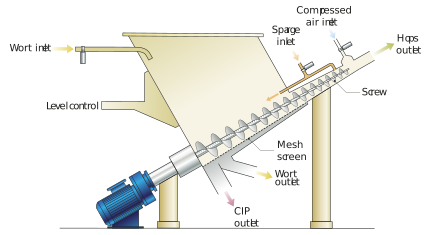
Figure: A hop strainer
The hop strainer is used in combination with a separate trub removal system, such as a whirlpool. The hop back has the benefit of removing spent hop material as well as trub particles. The hop strainer only removes spent hops; it is ineffective at removing the trub particles. Therefore, the hop strainer is generally used in combination with an additional clarification step. The hop strainer uses more energy and requires more maintenance than the hop back. However, throughput is much faster.