
Lesson 2 - Wort Clarification Technology and Process Control
This lesson compares the design and operation of different wort clarification systems. It provides you with the information to help you justify why you would choose one method over another.
Coolship
Coolships cover a large area and are shallow. They can be made of wood or iron but most are made from copper, or more commonly today stainless steel. Traditionally they were situated in rooms with curved ceilings, so that any condensation forming above the vessel would not drip back into the wort.
These large, open vessels are difficult to keep clean, and take up a lot of floor space. Also wort losses can be high. Some coolships have refrigerated pipes running through the wort to accelerate the cooling process, making them even more difficult to clean.
The boiled wort is run directly into the coolship, in some cases via an integral hop straining basket. Hot break settles out while the wort is hot and some cold break forms as the wort cools. The wort depth is typically only 15 cm and the very large surface area provides cooling by evaporation and removal of volatiles like DMS. As the wort is shallow, the trub settles very quickly. Some trub is unavoidably entrained as the vessel is emptied so removal is not as effective as in a whirlpool or centrifuge.
Coolships are open to the atmosphere which means any microbes present inoculate the wort. These microbes contribute to the flora that undertake spontaneous fermentation. Traditional lambic beers and modern spontaneously fermented beers are made using coolships for this reason.
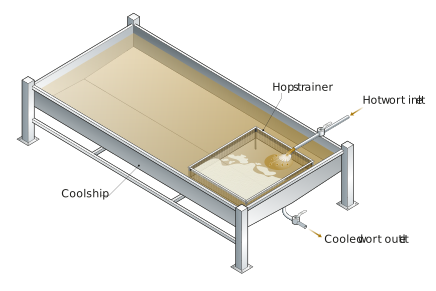
Figure: Coolship
In some breweries coolships were used with trickledown or Baudelot coolers which completed cooling to fermentation temperature. These Baudelot coolers are stacks of looped copper pipes over which the wort from the coolship cascaded before it was collected in an open trough. Cold water flowed inside the pipes providing cooling. These were just as unhygienic as the coolship!