
Lesson 2 - Wort Clarification Technology and Process Control
This lesson compares the design and operation of different wort clarification systems. It provides you with the information to help you justify why you would choose one method over another.
Centrifuge
The moving parts of centrifuges spin and this spinning increases the forces inside the machine that separate more dense material from less dense material. The common type of centrifuge used in wort clarification is a disc stack centrifuge.
The disc stack (also called disc bowl) centrifuge consists of a bowl with a stack of discs inside. Although they are called discs, they are not disc shaped but conical.
Unclarified wort flows down the inside of the central column of the centrifuge and is thrown out to the side by the machine’s rotation. The forces on the solid trub particles are greater than that on the liquid wort, so they remain stuck in the solids space at the edge of the bowl while the wort flows up and out of the bowl. Separation of wort and trub is aided by the discs (with gaps of 0.4-0.6 mm and angled at 50-60°) which help direct trub to the solids space. The clarified wort passes out of the centrifuge via the outside of the central column. Most units have a paring pump fitted in the outlet, that pumps the wort out as it is processed. A feed pump controlled by a variable speed drive and back pressure valve, work with this pump to balance wort flows across the machine.
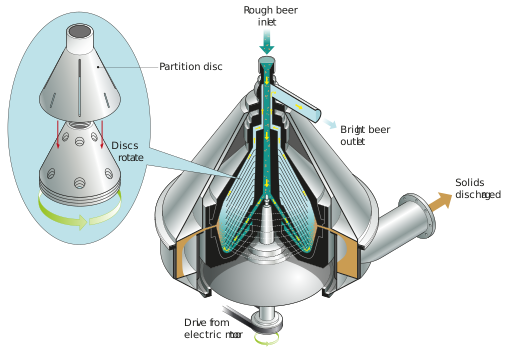
Figure: Disc stack centrifuge
The centrifuge bowl comprises of two sections held together by water pressure applied underneath the lower section. When the solids space is full, the pressure holding the two sections together is dropped and they separate for a fraction of a second. As they do, the trub in the solids space is ejected due to the pressure in the bowl. Ejections can be timed, triggered by a change in pressure in the solids space or triggered by increasing turbidity in the wort outlet.
The video below explains how it works. Note, this is for illustrative purposes only and is not a recommendation or endorsement of the supplier’s product:
Stokes’ law can be applied to centrifuge operation but as gravity is not used the term for gravity is replaced. The equation relating to centrifuges is shown below.

V = sedimentation rate or velocity of the sphere
d = diameter of the sphere
ρ = particle density
L = medium density
n = viscosity of medium
ω2r = centrifugal force
The term for gravity (g) is replaced by ω2r, where r is the radius of the circular path and ω is the angular velocity. The rate of centrifugation is dictated by the angular velocity. The angular velocity is the rate of change of angle and is measured in radians per second. π (3.142) radians is 180° so 2 x π radians is 360° or a complete revolution. So, to convert rpm into angular velocity we use this equation (the divided by 60 is there to convert the rate per second into rate per minute).

So, if we have a centrifuge that rotates at 4000 rpm the angular velocity is:

And if this centrifuge has a bowl with a radius of 50 cm (0.5 m) we can calculate ω2r.
ω2r = 418.932 x 0.5
ω2r = 175,502.34 x 0.5 = 87,751.17 m/s2
Another term used to describe the force generated in a centrifuge is relative centrifugal force (RCF). This is the force on the particle generated by the rotation of the centrifuge, relative to gravity and is sometimes called g-force. It depends on the speed of rotation in rpm, and the distance of the particles from the centre of rotation (bowl radius). The speed of rotation is given in rpm, and the distance (r) is expressed in cm:

So for our centriuge above with a bowl radius of 50 cm that spins at 4000 rpm the RCF is:

RCF = 11.18 x 50 x 16 = 8,944
So, by using this centrifuge we apply a force to the particles in the wort of nearly 9000 times the force due to gravity. As gravitational acceleration is 9.81 m/s2, if we multiply RCF by 9.81 we should get a figure similar to ω2r. Fortunately for us, in this example it is!
8,944 x 9.81 = 87,740.64 m/s2
Another aspect of centrifuge design that increases solid removal effectiveness is the distance the particles need to move to settle. This is reduced by the discs in the bowl. This distance is 0.4-0.6 mm in most designs and particles that hit the underside of the discs are in effect sedimented.
Advantages of using a centrifuge for wort clarification:
- Very good trub removal.
- Low wort losses (0.2-0.3 %).
- Cleaning in place (CIP) achievable.
- Steaming in place (SIP) achievable.
- Fully automated and continuous operation.
- Short processing times.
- Small footprints.
- Corrosion resistant.
- Sealed against oxygen and contamination pick up.
Disadvantages of using a centrifuge for hot wort clarification:
- High capital costs.
- High energy costs.
- High maintenance costs.
- More bits to go wrong than on a whirlpool or sedimentation tank.
- Can produce high noise levels.