
Lesson 2 - Wort Clarification Technology and Process Control
This lesson compares the design and operation of different wort clarification systems. It provides you with the information to help you justify why you would choose one method over another.
Whirlpool
The whirlpool is probably the most widely used technology for removing trub. The whirlpool has a simple design but that does not mean all commercially available whirlpools are effective! There are no moving parts (some whirlpools may have rotary jets, to help remove the trub). Once set up correctly, the whirlpool presents very few problems.
As shown in the diagram below, a tangential entry creates the whirlpool action.
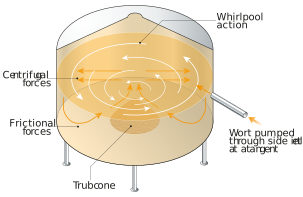
Figure: Whirlpool action
The whirlpool effect can be described by the tea leaf paradox, which was solved by Albert Einstein in 1926. It was previously not understood why stirred tea leaves grouped in the centre of a cup bottom, and not on the outer edges.
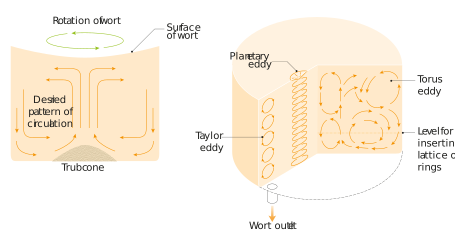
Figure: Whirlpool currents
The process of whirlpooling is as follows:
- Wort is pumped tangentially into the vessel from the kettle and/or on a recirculation loop.
- This causes mass flow around the circumference of the vessel and rotation (spinning) of the wort.
- Centrifugal force causes the liquid to be pulled towards the tank wall, reducing the pressure in the centre.
- The friction on the liquid in the base of the vessel is greater than at the top so the surface rotates faster than the base.
- This causes a secondary rotation of liquid from the bottom centre to the top and from the top edge to the bottom.
- Particles in this flow pattern collide with the vessel wall and are carried down to the base.
- This causes the trub particles to be swept into the centre to form a cone.
- If the force of the secondary rotation is less than the inertia of the trub particles, they stay in the cone in the centre of the base.
- Collisions between trub particles cause them to stick together (agglomerate) which increases their size and inertia, causing them to settle out more readily.
- When the wort is no longer being pumped into the whirlpool, the rotation of the wort slows, with the wort in contact with walls and base slowed more rapidly due to friction.
- The force lifting the trub particles reduces and more particles are added to the cone.
The diagram above shows some types of current or eddy that we do not want to see in our whirlpools. Torus currents can be the most troublesome type of eddy. They disrupt whirlpooling action making it less effective. We can prevent these currents from forming by adding lattice rings or ring structures. Modern whirlpools are designed so the eddies do not form and these rings are not required.
The wort inlet is sometimes tapered and always tangential to the vessel (usually at 30° to the tangent to the vessel wall). The velocity of the wort entering the vessel drives the whirlpool motion and is typically 3.5 m/s. Pumps recirculating the wort should be low shear to prevent damage to the trub flocs.
The wort is usually recirculated until the whirlpooling motion is established. Once the whirlpooling motion is established, the pump if stopped and the whirlpool is allowed to stand. The stand typically lasts 15-25 minutes. During the stand, the whirlpool action and gravity complete the formation of the trub cone. The wort at the top of the vessel clarifies first. This is the reason why the whirlpool has multiple draw-off points, as shown in the diagram below. If the vessel has a flat bottom, these draw off points are ideally placed at 50, 10-15, and 0% of the level of the surface of the wort. Casting out of the wort can begin as soon as the wort at the first draw off is clear, so long stands are avoided. This minimises vessel residence time, thermal load and DMS pick up. The figure below shows a trub cone.
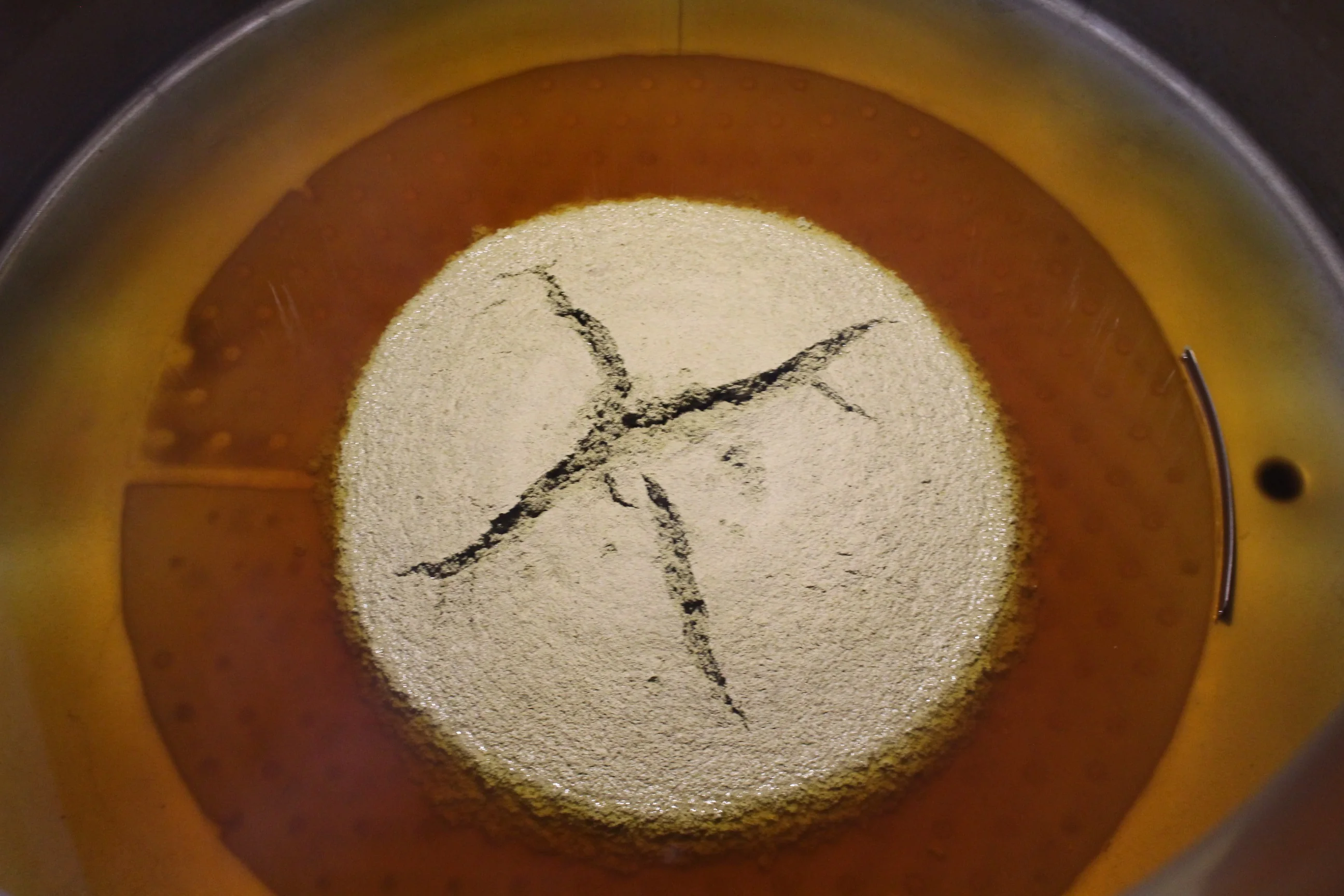
Figure: Trub cone
A number of different base designs are available including shallow dishes, shallow cones that point down and shallow cones that point up, all with and without sumps to hold trub. Flat-bottomed bases at a slight (usually 1%) incline are now the most popular in larger commercial breweries. The incline assists trub removal once the clarified wort has been drawn off. Water is applied to break up the cone and the trub slides down to the outlet. The typical diameter:height ratio of whirlpools is around 3:1 although ratios of 1:1 to 5:1 can be found. 3:1 provides a short settling distance without excessive vessel footprint and wort losses.
We can’t apply Stokes’ law directly to whirlpool operation because the whirlpool effect makes the solid removal process more complex than simple sedimentation. The forces in the whirlpool are analogous to gravity so more force pulling the trub to the centre of the vessel, the faster the rate of clarification and tighter the trub cone. The other factors in the equation do apply.
The relative density of the particle to that of the medium is important. The higher gravity the wort, the less compact the trub cone as the trub is more likely to be buoyant. Large and dense trub particles form a tighter trub cone more easily than small light trub particles. The same measures that we described earlier for improving particle size and density (effective boil, low shear, process aids etc.) improve trub removal in a whirlpool.
Conditions that can lead to poor trub removal in the whirlpool include:
- Excessive velocity and shear during transfer to whirlpool.
- Failing to reach 3.5 m/s when filling and recirculating the whirlpool.
- Excessive use of process aids (kettle finings, silica sols, gallotannins or PVPP).
- Poor wort separation leading to high solids loading.
- Poor quality malt or poor protein and non-starch polysaccharide breakdown during mashing.
- Problems with whirlpool design (wrong tangent on inlet, structures in whirlpool that break whirlpool vortex).
- Inadequate coagulation of nitrogenous material in boil.
- Lack of hop pellet material (if extracts are used) to stabilise cone.
- Adding ingredients like fruit peels or whole hops that act differently to hop pellet particles.
When casting out of a whirlpool it is usual to slow flowrate as the trub cone is exposed. This prevents the trub cone from slumping and spreading across the base, potentially contaminating the wort.
Below are some links to the details of some commercially available whirlpools. Others are available.
Note, this is for illustrative purposes only and is not a recommendation or endorsement of the supplier’s product:
https://www.ziemann-holvrieka.com/industries/beer/brewhouse/wort-treatment
https://www.gea.com/en/products/brewery-systems/brewhouse/wort-treatment/whirlpool.jsp
https://www.portlandkettleworks.com/brewery-whirlpools-and-brewing-equipment/
https://www.paulmueller.com/commercial-brewing-equipment/whirpool