
Lesson 6 - Mashing Technology
Mashing Vessel Design
We now know a great deal about the technologies that sit in, on, under or around our mashing vessels. So, in our last section, we will discuss the design details of the various mash vessels themselves.
Mash tun
While it is perhaps the oldest mashing vessel still in use, the mash tun is the most complex. The reason for this is that it is also used for wort separation. This means mash tuns need wedge wire false floors and facilities for sparging the mash bed. Older versions were constructed of cast iron and steel with gunmetal false floors. Those currently manufactured are made exclusively of stainless steel. The base and side of mash tuns are insulated to prevent heat loss during the temperature stand. Older vessels had cork insulation; modern versions use low chloride mineral wool.
The figure below is an illustration of the features of a mash tun.
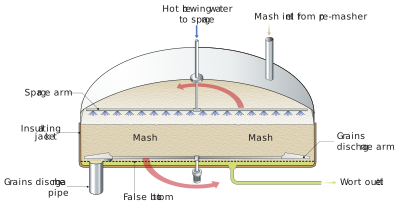
Figure: Mash tun
The mash tun should be wider and shallower than other mashing vessels. This is because it needs a larger surface area for filtration. Some smaller craft mash tuns are quite narrow but these provide poorer extract efficiency and slower wort separation. Unlike the other vessels, mash from the pre-masher is usually directed to the centre of the mash tun to help establish an even filter bed. The depth of the mash is around 1 m in larger mash tuns. The operation of the mash tun in wort separation will be covered in the Wort Separation unit.
MCV – decoction mash kettles
Some traditional brewhouses undertaking decoction mashing have dedicated vessels for mixing and for boiling mash. The mash kettle was smaller and was equipped to boil the mash. In modern brewhouses, decoction and temperature-programmed mashing are undertaken in vessels of the same design. These vessels are constructed from stainless steel, are insulated with low chloride mineral wool, and clad in polished stainless steel. Historically they were made of copper. They feature a flue to allow vapour to escape. Heating systems (jackets or heating media injection) are sized to provide the required heating rates and to boil where necessary.
MCVs typically have a low aspect ratio (ratio of height to diameter) of 0.6:1 to 1.6:1, which helps ensure there is sufficient surface area for heat transfer from the heating system. We shouldn’t need reminding that they also have agitators!
To bring all the elements of the components of an MCV together, the figure below shows how they are coordinated during a temperature-programmed mash and the reasons for the activities performed at each step.
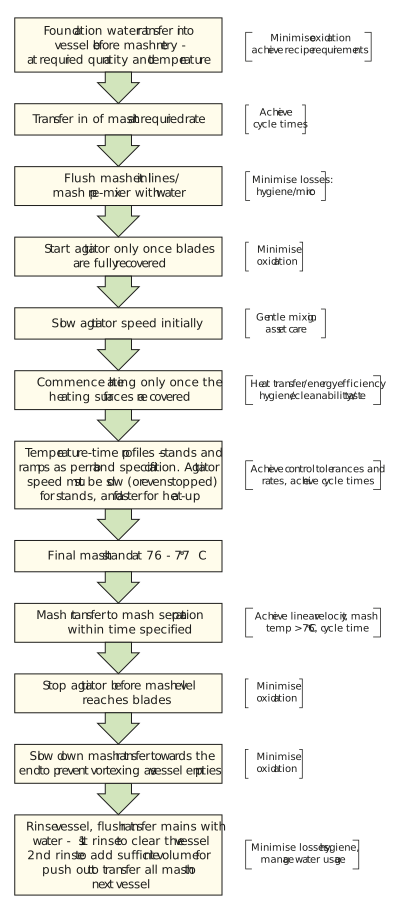
Figure: Single-vessel temperature-programmed mash process
Cereal cooker
Cereal cookers undertake a very similar task to that of the MCV, and in some brewhouses, the vessels are used interchangeably. Dedicated cereal cookers are usually smaller vessels and have comparatively high heating surface areas allowing them to heat to the boil quickly and maintain the boil. Older vessels were able to pressure cook grains, whereas modern versions tend to operate at atmospheric conditions.
With our understanding of mashing biochemistry, process control and technology complete, it’s time to mash out of this unit and into wort separation.