
Lesson 6 - Mashing Technology
Pre-mashing Technology
Pre-mashing technology is used as part of the mashing in process. For all vessel and process types, this starts with the addition of hot brewing water to the vessel to form the foundation water. This water heats the vessel, helps cushion the mash’s entry and improves the evenness of hydration.
The pre-masher connects the mashing vessel with the system used to deliver the grist and is our first opportunity to ensure mashing is successful (or unsuccessful!).
So, what do we need our pre-mashing technology to achieve?
-
Even grist hydration
-
Minimal damage to husk material
-
Minimal oxygen pick-up
-
Mash homogeneity
-
Hygienic operation
Let’s discuss each of the pre-mashing technologies to see how well they achieve each of these objectives.
Mixing in tank
At the most rudimentary level, pre-mashing is undertaken by filling a tank with the correct volume of mashing water at the correct temperature and then adding the grist as a fine stream while agitating. In very small craft operations, operators tip sacks of pre-milled grist into a mashing vessel filled with mashing water while stirring vigorously (and arduously) with paddles. The next step up from this in terms of scale and complexity is to add the grist by gravity through a valve into a mashing vessel with an agitator.
Both processes take a long time, produce a lot of dust, admit significant amounts of oxygen and struggle to produce a homogenous mash. The figure below shows a mashing vessel where pre-mashing is also carried out. These vessels are very rare and becoming rarer.
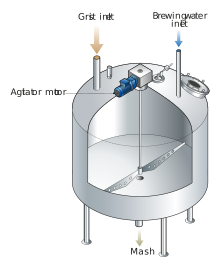
Figure: Mashing in with no pre-masher
When pre-mashing goes wrong
Failing to evenly hydrate (wet) grist at mashing leads to a phenomenon called agglutination.
Agglutination is a term that describes the clumping together of particles to form non-dissolvable aggregates or, to put more simply, lumps or balls of dry grist (sometimes called dough balls). The outside of the lumps is wet, but inside, the grist is still powder. Once formed, these aggregates are hard to break open and tend to float to the top of the mash, where they look like little islands. They are a lot more common in in-tank mixing and are only good news for the cows destined to eat the spent grains.
In-line pre-mashers
Our next pre-mashing technology is designed to help hydrate the grist as it falls into the mashing vessel. In-line pre-mashers are designed to work with the thinner mashes used in decoction and temperature-programmed mashes (3.1:1-5.4:1 water:grist). They are not designed to completely hydrate grain on their own. However, they do the bulk of the work, with the hydration process completed by the mash agitator.
For in-line pre-mashers to work effectively, there needs to be as large an interface between the grist and the mashing water as possible. This means the surface area of the streams of water and the grist need to be as large as possible. The flow of water also needs to be as turbulent as possible. This maximises the contact between the water and the grist as they are combined in the pre-masher.
For the grist, this is achieved by metering its flow into the pre-masher and ensuring there is a sufficient vertical drop to the point where the water is injected. The vertical drop allows the grist particles to separate. In some pre-mashers, the falling grist flows as a thin stream over a cone in the centre of the unit. Metering of grist flow can be achieved by a speed controller on a conveyor and/or a slide gate valve. The slide gate valve can be controlled manually or automatically to achieve a specific percentage opening. A slide gate valve is shown in the figure below.
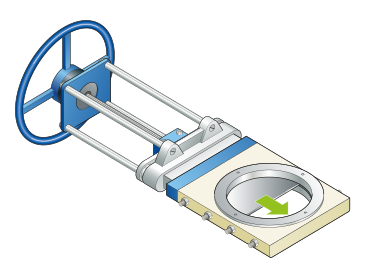
Figure: Slide gate valve
For the water, a high surface area and turbulence are achieved by introducing the flow of water through small apertures, so it sprays into the grist or by producing a thin film or vortex through which the grist falls. The supply of mashing water needs to be maintained at a specific flow rate and pressure to provide the correct water flow characteristics within the device, or pre-mashing will be inadequate.
Once the initial contact is made between the grist and water, they then need to flow together to encourage further mixing. Most mixers include a tube with a bend that directs the mash to the sidewall of the vessel. As well as helping to mix the mash, this prevents the mash from falling directly to the bottom of the vessel, reducing the forces that the grist particles are subject to, and the amount of oxygen picked up. Even with this pipe, the mash is still subject to more damage and oxygen pick-up than when a pre-hydrated mash is fed into the base of the mashing vessel.
Maintaining an even flow of grist from a grist case can be difficult. When the grist case is full, flow is high. As it empties, the flow slows. This means that the water to grist ratio and level of hydration achieved will vary throughout mashing in. You can see why the agitator is so important!
In older manual breweries, water flow, grist flow and water temperature were controlled manually. The water temperature was regulated by adjusting valves on the hot and cold water flows to a blending station. The flow was regulated with another valve and the grist by a slide on the bottom of the grist case. The thickness of the mash was judged by leaning over the mash tun and checking visually. Because managing this control was such a tough job, mashing in was said to be a job for a three-armed man (this was allowed back then, today it would be a three-armed person).
There is usually a knife gate valve at the inlet to the pre-masher that opens and closes the feed to the mashing vessel completely. This prevents water vapour from rising into the grist feed after mashing in is completed.
Most in-line pre-mashers incorporate a spray device (usually a spray ball) that can be used for rinsing the pre-masher at the end of mashing in. It is also used to supply detergent and rinse solution during cleaning in place. The knife gate valve keeps both liquids out of the grist supply system. The figure below shows a knife gate valve.
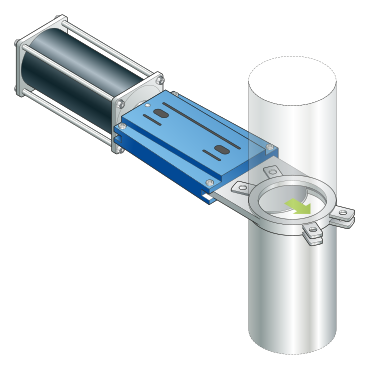
Figure: Knife gate valve
In smaller breweries, pre-mashers are removed and scrubbed/hosed out manually.
Today there is a wide range of in-line pre-mashers in use and on the market. Each work according to the principles we have just described and achieve our pre-mashing objectives to varying extents. Let’s discuss some common types.
Maitland mashers
Maitland mashers are an old form of pre-masher, and while some may still be in use, they are no longer manufactured. Grist falls through the pre-masher and passes a spray device that creates a fountain of hot water. There is a counterweighted flap on the end of the masher that holds back some of the mash in the tube to increase mixing. When mashing is complete, the counterweight closes the flap, preventing the water vapour rising into the grist feed. Maitland mashers were designed to work best with the very thin mashes used in decoction.
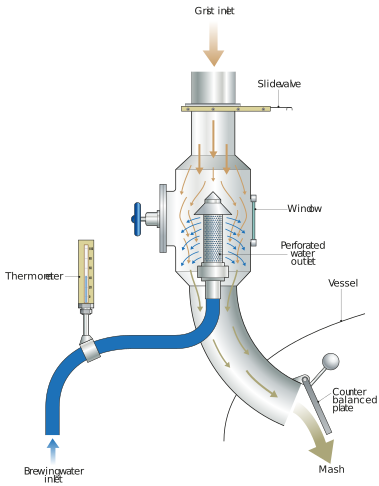
Figure: Maitland masher
Some small brewers use a semi-homemade version of the Maitland masher comprising a CIP spray ball housed in a 100 mm diameter plastic drainpipe through which the grist falls!
Cone pre-masher
In the cone pre-masher, the grist flows over a cone. Water is forced through a small aperture, increasing its velocity, and a stream is directed at the cone where the flows of water and grist combine. The design is very common in smaller breweries, and there are more sophisticated versions available for larger breweries. The figure below shows an example of a cone pre-masher.
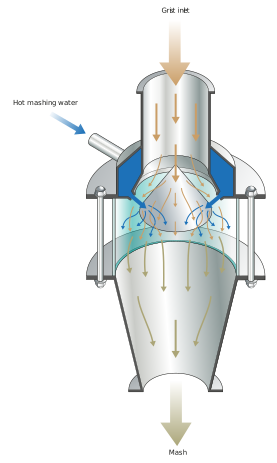
Figure: Cone pre-masher
Vortex pre-masher
In the vortex, pre-masher water enters a jacket around the central tube of the device at a tangent. This causes the water flow to follow the circumference of the tube. The water sprays through a slot in the tube into the flow of descending grist as a vortexing film. The action of the vortex is designed to ensure all the grist comes into contact with water, reduce dust and form a barrier to oxygen. Its effectiveness in reducing oxygen pick-up is quite limited. The figure below shows a vortex pre-masher.
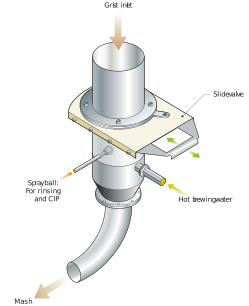
Figure: Vortex pre-masher
Here's a video of a pre-masher that combines the vortex and cone (or what the manufacturers call an olive in place of the cone) in action. Please note this is not an endorsement of this product:
Steinecker pre-masher
The Steinecker pre-masher works on a very similar principle to the vortex pre-masher in that water enters a jacket surrounding the hydrator tube. However, instead of producing a vortex through tangential flow, it uses vanes mounted on a plate to produce a vortex of water through which the grist descends. Water in the jacket is forced through a small slot, increasing its velocity before it hits the vanes, inducing a vortex in the mashing water. The diameter of the pre-masher is reduced after the point where the water is injected, increasing the velocity of the water and the grist. This also brings them into closer contact encouraging mixing of the grist and water. A cross-section of the Steinecker pre-masher is shown in the figure below.
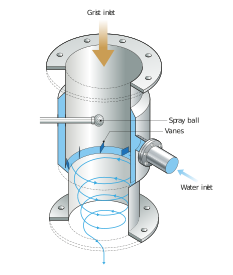
Steinecker pre-masher
The pre-mashing technologies we have discussed so far are designed to work with MCVs and decoction mashes. They have no mechanical parts, so maintenance costs are low. The low capital cost of the simpler mashers means they are also used by smaller breweries undertaking isothermal mashes.