
Lesson 6 - Mashing Technology
Mash Transfer – Mash-out
When the programme in the MCV is complete, or it is time to make another decoction, we need to move mash to another vessel. Mash is not an ideal fluid for transfer because it consists of particles of various sizes suspended in a liquid that is more viscous than water. It also needs to be handled with care!
The vast majority of mashes are pumped from the MCV/mash kettle/mash mixer. While the mash pump is the most important element in the mash transfer system, the design of the pipework can have a significant effect on the success of the operation. What does successful mash transfer look like?
We need to transfer the mash with the:
-
Minimum of mash shearing
-
Minimum of air entrainment
And this needs to be accomplished in the minimum amount of time.
Pipework
The diameter of the outlet of the mashing vessel and pipe that feeds into the pump should be large enough to keep the pump fed at the correct rate and pressure during its operation. The pump inlet should not be located a significant horizontal distance from the mashing vessel outlet, and the pump inlet should be low enough to provide the minimum head (pressure due to vertical column of fluid) to enable the pump to operate effectively. Bends or obstructions (valves, unions, probes) slow flow to the pump, so they must be avoided. If flow to a pump is inadequate, the pressure in the pump will drop, and air can be entrained through seals. Any bends in mash pipework should be smooth sweeping bends. This ensures mash flows smoothly and minimises the shear on the mash. The pipes should also be hygienically designed so soiling cannot build rapidly. Heavy soiling and rough pipe surfaces create resistance to flow and turbulence, which affects pumping performance and can damage the mash.
Pumps
For pumping mash, it is best to have a large pump running slower than a small pump running fast. A speed of < 1,000 rpm is recommended, but the slower, the better. As well as a low speed, the pump should also remain on the correct point of its design curve throughout mash transfer. Ensuring this minimises air entrainment and damage to the mash particles. Pump design curves are covered in detail in Module 3 of this course.
For a centrifugal pump, the design of the impeller is also important. Every surface in the pump is another potential source of shearing, so an open impeller is a better option than a closed one. An example of each is shown in the figure below.
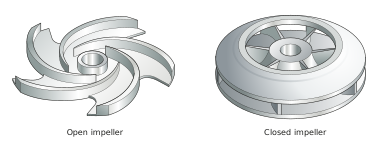
Picture: Open versus closed impeller
The rate of pumping is best controlled using a VSD to achieve velocities of < 1.5 m/s which reduces shear. The speed of the pump should be reduced as the mash level becomes low to prevent forming a vortex in the mash and the pressure in the pump dropping.
Operation
Mash transfer pipework should be filled with deoxygenated water before transfer. Pump speed should be reduced towards the end of the transfer as the head on the inlet of the pump will be lower. Deoxygenated hot water can be used to flush the vessel and chase out the mash. This helps minimise oxygen ingress and shear forces on the mash.