
Lesson 6 - Mashing Technology
Heating Jackets
There are three types of heating jacket used on MCVs and mash kettles. We will discuss each, ranging from the oldest type to the most modern but let’s first discuss the media we use to carry the heat and how heat is best transferred.
Hot water
Hot water is used in some brewhouses to heat mashes via jackets. It cannot deliver as much heat energy as steam, so it needs to be supplied at a higher pressure and through large jackets. It is, however, a very energy-efficient way to use heat recovered from other brewhouse operations. We will cover this in more detail later in this module.
The driving force of heat transfer into the mash is the temperature difference between the heating medium and the mash.
Thermal fluid
Thermal fluid (typically oil) is used in some brewhouses. The fluid selected has a higher specific heat capacity than water so can transfer more heat. The fluid is typically heated using electrical or combustion heaters. The fluid is more viscous than water so heating jackets are typically larger than those carrying water to allow it to flow.
Steam
Steam is the most commonly used medium for mash heating. Steam is able to provide heat more effectively when it condenses to form a liquid (water). We supply steam to the jackets and remove the water (condensate) from them.
Heat transfer into the mash
The amount of heat transferred into the mash depends on these factors:
-
Area of jackets (larger jackets heat more rapidly)
-
Difference between the temperature of the mash and the temperature of heating medium (the greater the temperature difference, the faster heat is transferred)
-
Overall heat transfer coefficient which is a combination of:
• mash and heating media velocities/turbulence (faster and more turbulent the better)
• degree of fouling/scale on the heating surface (cleaner the better)
• jacket wall thickness (thinner the better)
• jacket material of construction (more thermally conductive, the better)
All modern mashing vessels are made of stainless steel, and we need to avoid high temperatures in the heating medium to prevent enzyme damage and fouling. The velocity of the mash is limited by how fast the agitator can run without damaging the mash. Therefore we need to ensure the jackets have sufficient surface area for the required heating duty. Jackets are usually installed on the base cone or dish of the vessel, with one or two jackets installed on the sidewalls.
We can consider how these heat transfer factors are affected by the design of the jackets used for mash heating as we discuss each type.
Conventional jackets
A conventional jacket is a second shell installed on part of the vessel. This creates a space within which the heating medium flows. To improve heat transfer, turbulence enhancing devices can be installed inside the jacket. These could be baffles that direct flow in a spiral pattern around the jacket or agitating nozzles that cause high turbulence at the point where the heating medium is introduced into the jacket. A conventional jacket is shown in the figure below.
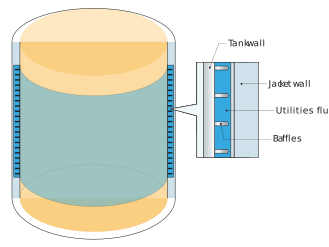
Figure: Conventional jackets
Half-pipe jackets
Half-pipe jackets are fabricated by taking a pipe and cutting it in half along its length. The half-pipe is then wound around the outside of a vessel in a helix and welded into place. The velocity of the heating medium is highest in half-pipe jackets, so they provide excellent heat transfer. They are also the lowest cost jacket available and are the only jacket type suited to the use of high-pressure hot water. They are shown in the figure below.
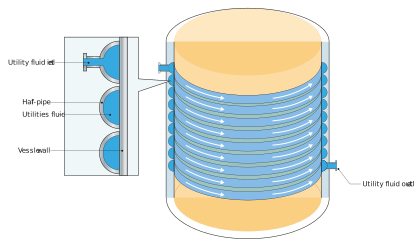
Figure: Half-pipe jackets
Dimple jackets
Dimple jackets are made by pressing and punching out small ‘dimples’ at regular intervals from a thin sheet of stainless steel. These dimples are positioned at about every 50 mm. The sheet is then wrapped around the vessel and welded to the vessel wall at each punched-out dimple. Most MCVs manufactured today are fitted with dimple jackets. The figure below shows a vessel with a dimple jacket.
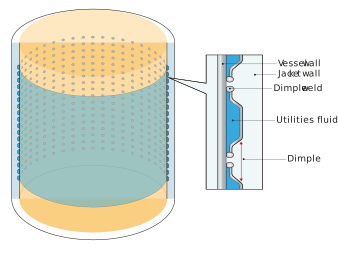
Figure: Dimple jacketed vessel
The dimples impart turbulence to the heating medium as it flows through the jacket. This improves the effectiveness of heat transfer.
In some modern MCVs, the dimple jacket is installed on the inside of the vessel shell, so it is in contact with the mash. This improves heat transfer because the jacket material is thinner than the vessel wall. Because the internal walls are thinner, lower pressure (and hence temperature) steam can be used, reducing the risk of denaturing enzymes and fouling the heating surface. The shape of the dimpled wall also improves heat transfer by creating micro-turbulences around the dimples as the mash flows over them. Although this means the internal walls of the vessel are bumpy, it is still possible to clean them effectively. Also, with less fouling due to lower temperatures of heating media, internal dimple jackets need to be cleaned less frequently than other jacket types. Dimple jackets can also be used with hot water, but the heating area must be increased to account for the lower temperature.
Control of heating jackets
Heating jackets can be controlled manually or automatically. Automatic control varies in terms of sophistication. The most modern systems will control each heating jacket and zone individually according to the mashing programme. Valves supplying the heating medium are opened and closed to varying extents according to how far the mash temperature is away from its set point. When very close to the set point, the valve may be pulsed open to allow small amounts of the heating medium into the jacket. This avoids exceeding the target temperature for the mash stand.
Heating jackets must be controlled to only heat when covered with mash. If a jacket is part covered with mash, it drastically increases fouling, and with high-temperature heating media, it can lead to burning mash onto the vessel wall. Not only does this make the vessel difficult to clean, but it can also affect the flavour of the finished beer.
Many mashing vessels are filled at a temperature slightly lower than the target temperature for the first stand. The heating jackets are then used after mashing in to achieve the set point. Accurate level measurement is essential to ensure the jackets are heated as soon as they are covered during mashing in and off in time for their heat to dissipate before they are uncovered during mashing out.