
Lesson 6 - Mashing Technology
Pre-mashing – Steel’s Masher
Our next pre-mashing technology can be used for mashes of all types but was originally designed for isothermal mashing and mashes with a 2.2:1-2.7:1 water to grist ratio.
Unlike our pre-mashers, up to now, the Steel’s masher undertakes grist hydration in a horizontal tube. The flow of grist and water are regulated as they would be in the other pre-mashers, although (especially older) Steel’s mashers are much more likely to be manually controlled. Inside the horizontal tube, there is a screw (auger) and a set of rods fixed to a shaft which is rotated by a motor. Grist falls from the grist case or conveyor into the screw, where it is combined with water sprayed from above. The action of the screw pushes the grist and water along the tube into the section with the rods. The rods (or beaters) mix the mash further and help to break up any balls of un-hydrated grist that may have formed. The tube containing the rods and the screw is typically about half full during operation. This means that unless continuously flushed with CO2, they introduce significant amounts of oxygen to the mash.
The Steel’s masher was patented by James Steel of Glasgow in the nineteenth century, hence the name. The original Steel’s masher did not have a screw, only stirring rods.
The figure below shows a Steel’s masher.
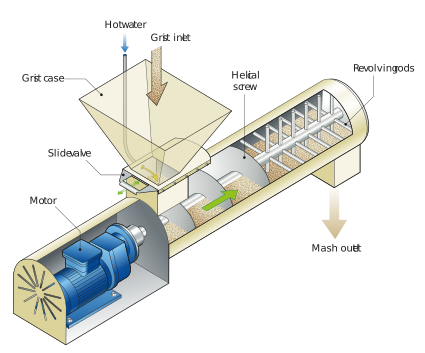
Figure: The Steel’s masher
Although this sounds intensive, Steel’s mashers are not designed to achieve the same level of hydration as the combination of the MCV agitation and pre-mashers. For a mash tun to operate effectively, the grist should not be completely saturated with water. During conversion and wort collection, most of the spent grain in a mash tun should be suspended in the wort, so it needs to be buoyant. This is impossible with full hydration. Steel’s mashers are costly to buy and maintain compared to the other in-line pre-mashers, and although still manufactured, they are becoming increasingly rare. More mash tuns around the world are fitted with the more basic hydrators than use Steel’s mashers. While on the subject of mash tuns, we should note that all the technology described from now on only applies to MCVs. Mash tuns are always fed from above and are never heated or agitated.
Mash tun, mash mixer or MCV?
If you read brewing literature, you will see that the term mash tun is used to describe the vessel in which we mash isothermally and undertake wort separation. You will also see mash tun used for a vessel in which you heat and mix mash with an agitator. In these lessons, we use mash tun for the isothermal vessel where wort separation is carried out and MCV for the vessel used just for mashing. Some websites and home brewers call a pre-masher a mash mixer, and some US brewers and suppliers call an MCV a mash mixer. We use a mash mixer to describe the vessel that doesn’t do the boiling in decoction mashing.
European brewers tend to call anything that isn’t decoction an infusion. While in the UK, infusion generally refers to isothermal mashing. We use the terms decoction, isothermal mashing, and single-vessel temperature-programmed mashing to save infusion confusion!
Oxygen control in in-line pre-mashing
All the pre-mashing technologies so far present a higher risk of oxygen pick-up than pumping hydrated grist gently into the base of the MCV under a cushion of deoxygenated foundation water. Purging the mashing vessels and grist cases with CO2 and N2 can help reduce the risk but only to a limited extent. Doing this properly uses a significant amount of process gas, so it is not a sustainable activity. The next pre-mashing technologies can achieve significantly lower levels of dissolved oxygen and mash damage.
Oxygen isn’t actually very soluble in wort at above 50℃, and as mashing temperatures increase, it becomes less and less soluble. The maximum possible concentration of oxygen in water at 60℃ is 4.74 mg/L and 2.84 mg/L at 80℃. It is even lower in wort. So after pre-mashing, dissolving oxygen in mash is difficult. That said, oxidation reactions are extremely rapid and stale beer flavour compounds are perceptible at extremely low (ng/L) concentrations. So a little oxygen quickly does a lot of damage!
Pre-mashing vessel
This evolution of the Steel’s masher, designed to supply hydrated grist to the base of the mashing vessel, was developed in Germany in the late 20th century. In this system, a motor rotates a shaft with inclined discs fitted to it. The discs sit in the bottom of a horizontal tank into which the grist and deoxygenated water are fed. The tank is purged of oxygen before filling starts. As the discs are rotated, they mix the grist and water to form a fully hydrated mash with minimum shear and oxygen pick-up. The commercial-scale version of this technology is no longer manufactured, but a similar device based on a screw conveyor is. The figure below shows a pre-mashing vessel.
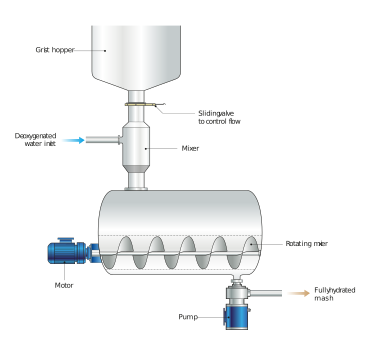
Figure: Pre-mashing vessel
Meura Mechamasher
The latest evolution of the Steel’s masher is the Meura Mechamasher. The Mechamasher consists of a small cylindrical tank housing a screw and beaters (much like in the Steel’s masher). Like the Steel’s masher, grist and water are fed at controlled rates into the screw. However, in the Mechamasher, the whole mixing tank is filled with grist and water, thus excluding oxygen. The grist is hydrated along the length of the tank before being pumped to the base of the mashing vessel using a progressive cavity pump. The Mechamasher picks up virtually no oxygen through its operation and delivers grist with little damage. It is designed primarily to work with mash filters and can pre-mash very thick mashes (down to 1.8:1 water to grist ratio). This makes it ideal for high gravity brewing. The Mechamasher is the highest cost pre-masher and has the most moving parts and control equipment. It is, therefore, most suited to very large breweries.
The video below shows an animation of the operation of a Mechamasher.
Please note this is for illustrative purposes only and is not a recommendation or endorsement of the supplier’s product.
Whatever pre-masher is selected, it should ensure that dry balls of grist are not formed. Mash agitators are not designed to hydrate dry balls of grist.
Wet milling
We have already met one form of pre-mashing in the Milling unit. With wet mills, pre-mashing is incorporated into the milling operation. If we cast our mind back to those, we should remember that they achieve all of the above criteria aside perhaps from the last one (hygiene). And in fact, the latest designs of steep conditioned mills also have good standards of hygiene when operated correctly.
Wet milling systems supply a fully hydrated mash with an optimal husk profile to the base of the mashing vessel. If operated with deoxygenated water, they can reduce oxygen pick-up to the bare minimum.
The links below will allow you to compare and contrast some of the pre-mashers available. Please note this is for illustrative purposes only and is not a recommendation or endorsement of the supplier’s product.
https://eshop.czechminibreweries.com/product/bhpm-1000/
https://braukon.de/en/produkt/braukon-alloysius-en/
https://www.steinecker.com/media/downloads/vormaischer_en.pdf
https://zipbier.com/pdf/ziptech_pre-masher_catalogue_EN.pdf
https://www.gwkent.com/grist-hydrator.html
https://store.ssvlimited.co.uk/products/grist-hydrator
http://www.kunzel.de/index.php/en/our-performance/components/premashing-screws