
Lesson 6 - Hop Products
Hop Aroma Products
Hop aroma products are used to add hop aroma to beer; the timing of addition is important.
Addition points are typically:
- End of boil/whirlpool = late hop aroma.
- Fermentation/maturation = dry hop aroma.
It is possible to dose at the start of the boil but as most of the aroma would be lost in the process it is not usually done. The most common point for dosing is after fermentation.
Hop oils products can add different aromas to beer, depending on the type of product used and when it is added.
Hop oil products are usually produced commercially from ethanol or CO2 extracts by steam and vacuum distillation, thin film evaporation (also undertaken under vacuum conditions), CO2 fractionation or chromatography. They are also made by steam distillation of uncompressed dried hop cones.
The distillation process (including thin film evaporation) separates out the components of the hop or hop extract on the basis of their volatilities. The hops or extract are heated and when the boiling point of the specific component is reached it is evaporated. The oil vapour can then be condensed and collected. Using a pressure lower than atmospheric pressure in a vacuum still reduces the temperature of the boiling point for each component. This means that less heat needs to be applied to evaporate them.
In CO2 fractionation, manufacturers adjust the conditions during CO2 extraction to affect a change in its polarity and hence the nature of the molecules dissolved in it. More polar molecules like the oxygenated fraction dissolve more easily in a more polar solvent. Non-polar molecules like the hydrocarbons dissolve better in non-polar solvents. This means that by changing the polarity of the CO2, the non-polar hydrocarbons can be separated from the polar sulphur compounds and the even more polar oxygenated compounds. By separating out the essential oil components and blending them in specific proportions, products with specific flavour properties (citrus, floral etc.) can be made.
Using hop oil products
Many hop oil products come as an aqueous emulsion with propylene glycol which holds the oils in solution and makes them easier to dose. It is also possible to purchase them as the pure oil and one manufacturer supplies them encapsulated in maltodextrin as granules. Some pure oils must be dissolved in a solvent such as liquid CO2 before dosing. However, some modern pure oil products come as liquid blends that are easier to dose. For most products, dosing is best carried out over at least 80% of the time taken to transfer beer from vessel to vessel and into the suction side of a pump to aid dispersal. The granulated product can be added at the same time as dry hops.
Barth Haas SPECTRUM is made from CO2 extract and is formulated so that it can be added directly to a vessel after dispersal in deoxygenated water or in some cases dosed directly. SPECTRUM uses a secret component of the hop extract as the emulsifier in place of propylene glycol.
Hop oil products provide a different aroma and taste to hop pellets and whole hops. To achieve the dry hop character associated with dry hopped beers, using a combination of pellets and or whole hops along with the oil products is necessary. The search is still on for an extract that can replace dry hops.
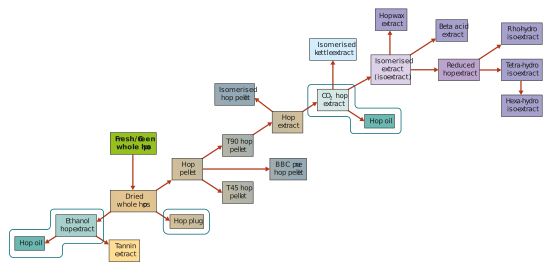
Figure: Overview of hop products and how they are typically derived