
Lesson 6 - Hop Products
Whole Cone Hops
There are two sub-categories of whole cone hops: dried whole hops and fresh/green whole hops.
Dried whole hops
Preparation
The hop bales can be broken down into smaller quantities and then packaged. If the brewery uses a lot of hops, bales can be used directly.
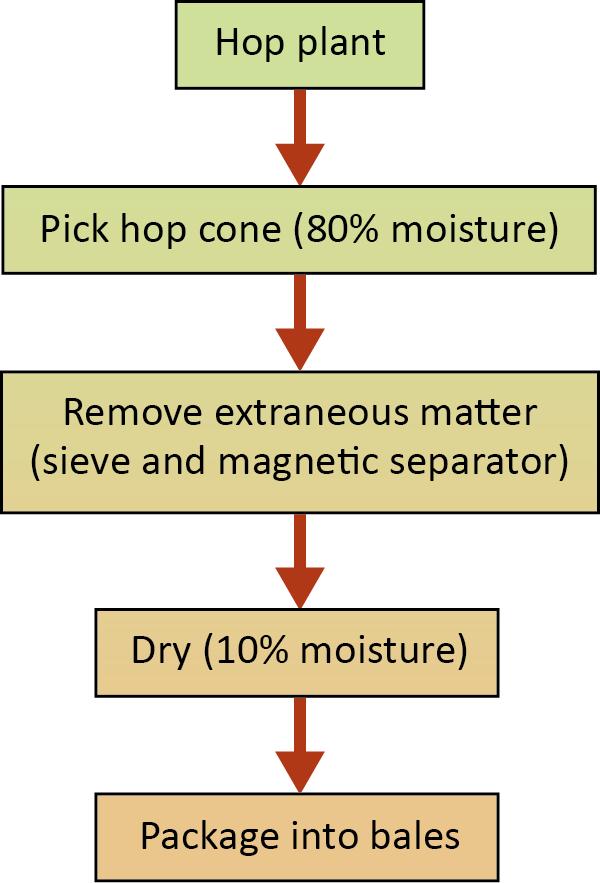
Figure: Dried whole hop preparation
Application
Dried whole hops can be used for either bittering or aroma.
Point of use
Dried whole hops can be added to the wort kettle during wort boiling or during fermentation or maturation as a dry hop.
Composition
The composition of the whole hops is the same as we have seen in the previous hop lessons.
Table: Average chemical composition of whole dried hops
|
Constituent |
Amount (% w/w) |
| Lipids | 2-5 |
|
Total resins |
15-30 |
|
α-acids |
2-18 |
|
β-acids |
2-14 |
|
Essential oil |
0.5-3 |
|
Proteins |
15 |
|
Monosaccharides |
2 |
|
Polyphenols |
4 |
|
Pectins |
2 |
|
Amino acids |
0.1 |
|
Waxes and sterols |
Trace |
|
Ash |
8 |
|
Moisture |
10 |
|
Cellulose, etc. |
43 |
Advantages
- Most natural and unprocessed – free from extraction solvents.
- Some brewers like to use the fact that they use whole hops in their marketing.
- Can help trub (coagulated protein and polyphenol bound together) formation and settling.
- Form a filter bed to strain the boiled wort during wort separation, removing trub and helping to clarify the wort.
- Less processing means essential oils are preserved as long as the hops are fresh.
Disadvantages
- Bulky and expensive to store due to their low bulk density.
- Take longer to wet than other products leading to poor utilisation.
- Lupulin glands remain intact, again reducing utilisation and aroma extraction.
- More prone to oxidation – resulting in loss of brewing value.
- May contain debris, fertilisers and pesticides.
- Wort/beer/extract loss can be high due to the whole hops absorbing a lot of liquid. Sparging or squeezing spent hops can yield astringent flavour compounds.
- Less homogeneous than other hop products.
- Percentage α-acids and essential oil varies from year to year and from farm to farm.
- Low utilisation (25-30% generally).
- Disposal of spent hops is harder, due to their bulk.
We can see from this list that when using dried whole hops, the disadvantages probably outweigh the advantages. Those who do use them feel the flavour produced is worth the inconvenience.
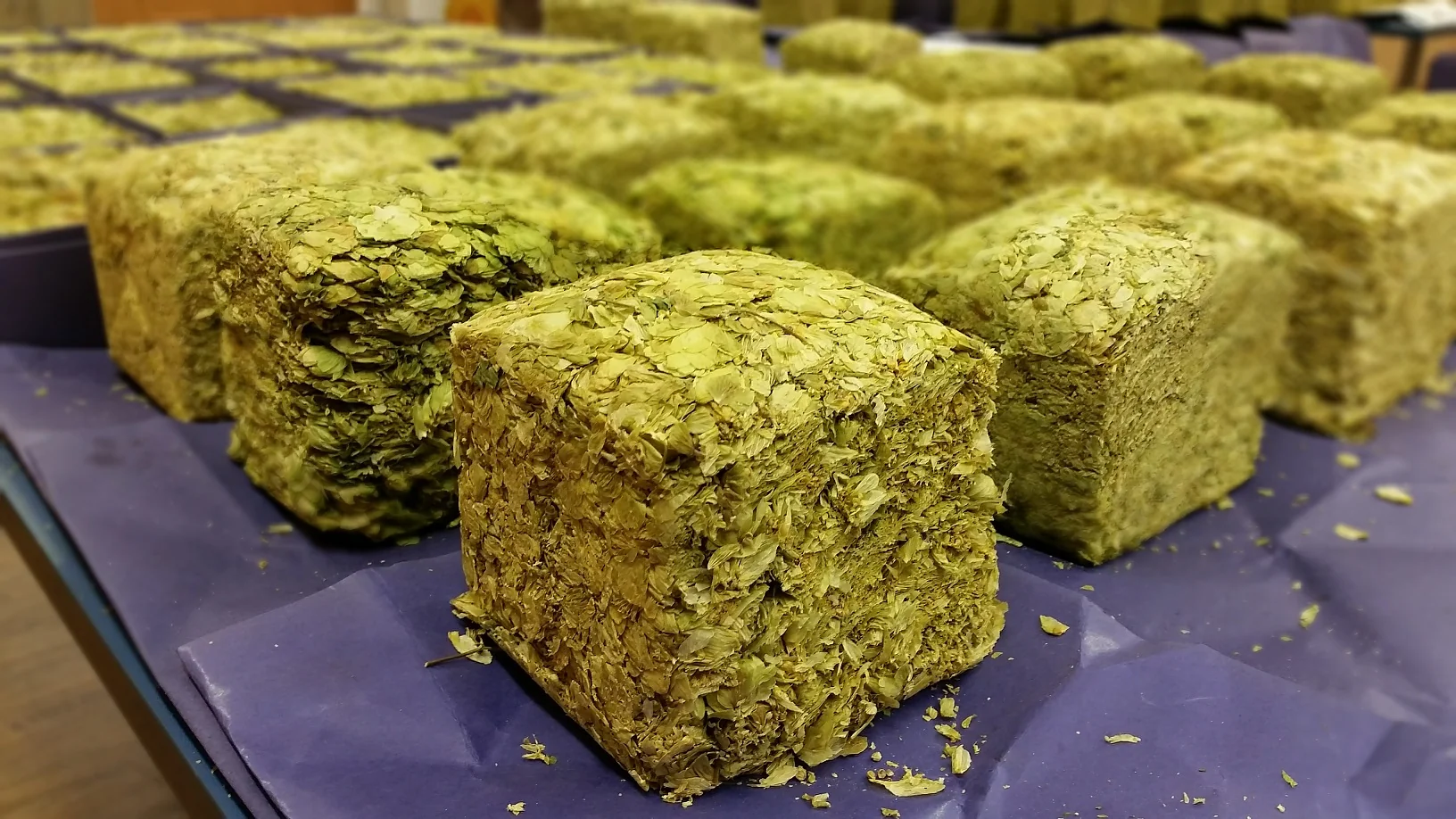
Image courtesy of Charles Faram
T100 pellets
Although called pellets, T100 are actually 25 mm compressed plugs of whole cone hops. They are used by some breweries producing cask ale to add hops to the beer more easily and consistently than using lose hop cones. Their use today is relatively uncommon.
Fresh/Green Whole Hops
Another type of whole hop that can be used in the brewing process, is known as fresh whole hops or green whole hops. These are not widely used and only smaller breweries use them.
Fresh hops are:
- Harvested fresh as whole, wet cones at the farm and then shipped to customers for immediate use within 36 hours of harvest.
- Can only be used once per year (at harvest).
- Full of vibrant flavours, as the hops are completely unadulterated.
- Very unpredictable in character – in most cases the α-acid content is not known before brewing so they are best used for aroma.
- Due to the hops being around 80% moisture, a significantly greater mass is required than that normally required when adding as dried whole hop.
- Used for one-off seasonal beers, marketed as coming direct from the farm.
Fresh hops are an interesting concept, but the majority of brewers want products that are more predictable and can be used all year round.